

India’s semiconductor ambitions received a significant push with the foundation of a ₹3,700-crore chip assembly and test facility in Uttar Pradesh, jointly developed by HCL Group and Taiwan’s Foxconn. The project, located in the Yamuna Expressway Industrial Development Authority (YEIDA) region near the upcoming Noida International Airport, represents a strategic milestone in the country’s efforts to build domestic chip manufacturing capabilities and reduce import dependence.
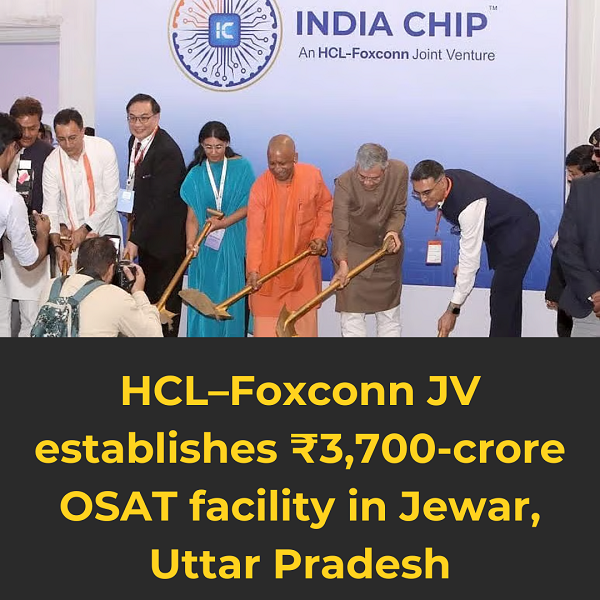

Prime Minister Narendra Modi laid the foundation stone of the project—named India Chip Pvt. Ltd.—in February 2026, describing it as a decisive step toward technological self-reliance and a stronger position in the global semiconductor value chain. The plant is part of India’s broader semiconductor mission aimed at creating a resilient electronics supply chain and attracting advanced manufacturing investments.

India’s First North India Semiconductor Hub
The upcoming facility will function as an Outsourced Semiconductor Assembly and Test (OSAT) unit, packaging and testing silicon wafers into finished chips for applications ranging from smartphones and laptops to automotive and consumer electronics. With a planned capacity to process about 20,000 wafers per month, the plant is expected to produce tens of millions of display driver chips used in electronic display panels.
Once operational—targeted around 2028—the unit is projected to generate over 3,500 direct and indirect jobs while catalysing local supply chains and ancillary industries. The project also includes ecosystem initiatives such as skill development, technology transfer, and collaboration with regional institutions to support semiconductor talent creation.
The venture is structured as a 60:40 partnership between HCL and Foxconn, combining domestic engineering capabilities with global manufacturing expertise. Industry observers view the collaboration as a model for future semiconductor partnerships in India, where local technology firms and international manufacturing leaders jointly build capacity.
Strategic Importance for India’s Tech Self-Reliance
Government leaders highlighted semiconductors as foundational to emerging technologies such as AI, 5G/6G, electric vehicles, and defence systems. The new plant aims to reduce India’s reliance on imported chips—especially display driver integrated circuits (DDICs), a critical component in modern electronics.
The project also reflects lessons from global supply-chain disruptions during the pandemic, which exposed vulnerabilities in chip availability worldwide. By expanding domestic assembly and packaging capacity, India aims to strengthen supply resilience while positioning itself as a trusted semiconductor manufacturing destination.
Uttar Pradesh Emerging as Semiconductor Hub
The location of the facility near Jewar and the Yamuna Expressway industrial corridor underscores Uttar Pradesh’s growing role in India’s electronics manufacturing landscape. The region already hosts major mobile and electronics production clusters, and the semiconductor plant is expected to anchor a broader high-tech ecosystem around the upcoming international airport.
State and central incentives under the Semiconductor Mission and related policies have helped attract the investment, reinforcing the government’s push to establish multiple semiconductor units nationwide. The HCL–Foxconn facility is among the approved projects aimed at building India’s chip assembly and packaging base.
Strengthening India’s Position in Global Chip Value Chain
While India currently lacks large-scale wafer fabrication, OSAT facilities like the HCL–Foxconn unit play a crucial role in the semiconductor value chain by converting processed wafers into finished, tested chips ready for electronics manufacturing. Experts note that such packaging and testing capacity is essential for developing a complete domestic ecosystem and supporting future fab investments.
The project is expected to meet rising domestic demand for semiconductors across consumer electronics, automotive, and industrial sectors, while encouraging global companies to integrate India into their supply chains.
A Step Toward Semiconductor Self-Sufficiency
The launch of the HCL–Foxconn plant signals India’s continued momentum in semiconductor development after years of limited domestic manufacturing. Combined with other ongoing projects and policy incentives, it reflects a long-term strategy to position the country as both a design powerhouse and a manufacturing hub.
As construction progresses toward its 2028 operational target, the Uttar Pradesh facility is poised to become a cornerstone of India’s emerging semiconductor ecosystem—bringing the vision of “Made-in-India chips” closer to reality and strengthening the nation’s role in the global electronics supply chain.