



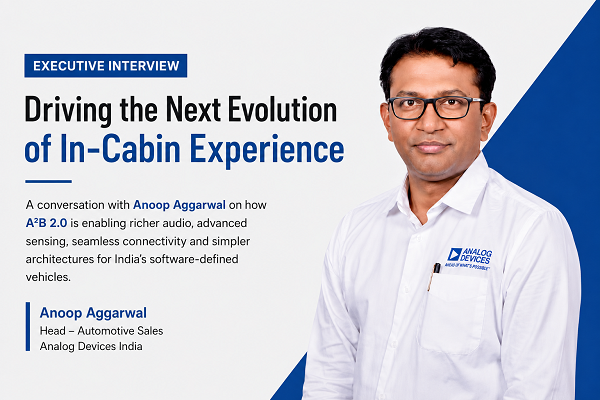



Q1. For Indian OEMs and Tier 1s, what are the three most tangible benefits A²B 2.0 brings compared with legacy in-vehicle audio/connectivity solutions?

Anoop Aggarwal:
Indian OEMs are looking to deliver more sophisticated in-cabin experiences while keeping architectures efficient and scalable. That’s where A²B™ 2.0 offers a meaningful advantage.
First, it significantly expands system capability with four times the bandwidth of the previous generation, enabling richer audio experiences alongside support for microphones, vibration sensors and other audio-related sensing nodes over the same network. Second, it delivers deterministic, low latency, which is critical for applications such as road noise cancellation, voice processing and active sound management where timing is essential. Finally, by transporting audio, control data and power over lightweight unshielded twisted pair (UTP) cabling, A²B 2.0 helps simplify vehicle wiring and system integration, allowing manufacturers to add functionality without proportionally increasing complexity.
Q2. How production ready is A²B 2.0 for large scale deployment in India, and what certification, supply chain or validation milestones should manufacturers expect before series production?
Anoop Aggarwal:
A²B 2.0 has been developed to support production vehicle programmes and builds upon a mature technology platform already deployed across the automotive industry. For OEMs in India, deployment will naturally align with their vehicle development cycles and standard automotive validation processes.
Like any automotive technology, it will undergo rigorous qualification, system integration and vehicle-level validation before entering series production. The advantage is that manufacturers can leverage the experience gained from the established A²B ecosystem while adopting the enhanced bandwidth and capabilities of A²B 2.0. Our focus is to ensure customers have the technology, engineering support and manufacturing readiness needed for long-term deployment.
Q3. As OEMs move toward zonal and domain ECUs, how does A²B 2.0 fit into evolving software-defined vehicle architectures and coexist with automotive Ethernet backbones?
Anoop Aggarwal:
We see A²B 2.0 as complementary to automotive Ethernet rather than an alternative. As vehicles become increasingly software-defined, different networking technologies will continue to serve different functions.
Ethernet is an excellent backbone for transporting high-bandwidth data across the vehicle, while A²B 2.0 is optimised for deterministic, synchronised audio and sensor connectivity. Applications such as microphone arrays, speakers and active noise cancellation require predictable latency, which is where A²B 2.0 delivers significant value. We expect future vehicle architectures to combine both technologies, with Ethernet providing central connectivity and A²B 2.0 efficiently connecting edge audio and sensing devices.
Q4. Given India’s cost sensitivity and long product lifecycles, how can automakers deliver advanced in-cabin experiences (spatial audio, multi-mic arrays, voice assistants) without pushing up BOM or lifecycle costs?
Anoop Aggarwal:
The key is designing platforms that are scalable from the outset. Rather than developing different electrical architectures for different vehicle segments, manufacturers can build a common platform capable of supporting multiple feature levels through software and modular hardware.
A²B 2.0 supports that approach by enabling multiple microphones, speakers and sensors over a simplified wiring architecture using low-cost UTP cabling. This helps manufacturers introduce premium features such as immersive audio, voice assistants and active noise cancellation while managing wiring complexity and long-term lifecycle costs. It creates flexibility to differentiate vehicles without fundamentally redesigning the underlying architecture.
Q5. With edge intelligence expanding inside vehicles, what compute and sensor strategies should automakers adopt to enable low latency, privacy-preserving in-cabin AI features?
Anoop Aggarwal:
As vehicles become more intelligent, automakers should design in-cabin AI around distributed sensing, edge processing and deterministic connectivity. Use cases such as voice assistants, occupant awareness, active noise cancellation and personalised sound zones require microphones and sensors to communicate with low and predictable latency.
At the same time, privacy should be built into the architecture. Sensitive audio or cabin data should be processed locally wherever possible, with only relevant insights passed to higher-level compute platforms. A²B 2.0 supports this approach by enabling low-latency, synchronised connectivity for edge audio and sensing devices, while allowing the broader vehicle network to focus on higher-level intelligence and software-defined features.
Q6.
Which middleware, partner silicon, and standards are critical for A²B 2.0 to achieve broad ecosystem adoption in India, and where do you still see gaps?
Anoop Aggarwal:
The automotive industry is increasingly focused on open, interoperable ecosystems. OEMs expect technologies to integrate seamlessly with existing software frameworks, domain controllers and development environments, regardless of supplier.
Broad adoption therefore depends not only on silicon innovation but also on close alignment between semiconductor companies, Tier 1 suppliers, middleware providers and OEM engineering teams. While the industry continues to make strong progress, one of the biggest opportunities lies in simplifying integration across multiple networking technologies as software-defined vehicle architectures become more complex. That is where continued ecosystem engagement will be particularly important.
Q7. Over the next 3–5 years, how will improved in-cabin audio and connectivity drive vehicle differentiation and new revenue opportunities (subscriptions, branded experiences) for Indian OEMs?
Anoop Aggarwal:
As vehicles become increasingly software-defined, the in-cabin experience will play a much greater role in purchasing decisions. Consumers are placing greater value on seamless digital experiences, personalised interaction and premium entertainment alongside traditional vehicle performance.
For OEMs, this creates opportunities to differentiate through software-enabled features that can evolve throughout the vehicle’s lifecycle. High-quality audio, personalised sound zones, intelligent voice interaction and connected cabin experiences all have the potential to support premium offerings and, where appropriate, new service-based business models. Building that flexibility requires a connectivity architecture that can accommodate future innovation without requiring major hardware changes, and that is precisely the direction the industry is moving.