

Introduction
A Brushless DC Motor (BLDC motor) is a high-performance electric motor widely used in modern applications such as electric vehicles, robotics, HVAC systems, and industrial automation. Due to its high efficiency, long lifespan, and precise speed control, the BLDC motor has become a preferred choice over traditional brushed DC motors.
What is a Brushless DC Motor?
A Brushless DC electric motor, also known as an Electronically Commutated Motor (EC motor) or synchronous DC motor, is a type of synchronous motor that operates using a direct current (DC) power supply. It is called a synchronous motor because the magnetic field produced by the stator and the magnetic field of the rotor rotate at the same frequency, maintaining constant synchronization.
Types of DC Motors
There are two commonly used types of DC motors:
- Brushed DC Motors
- Brushless DC Motors (BLDC Motors)
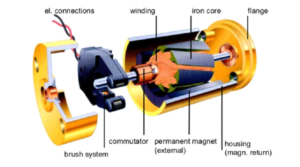

Fig. Dissection of a BLDC motor
Brushed DC motors use mechanical brushes and a commutator to achieve motor rotation. In contrast, BLDC motors eliminate brushes and rely on electronic commutation, improving reliability and efficiency.
Construction of a BLDC Motor
A BLDC motor consists of the following main components:
- Stator: Contains windings that generate a rotating magnetic field
- Rotor: Made of permanent magnets
- Electronic Controller: Replaces mechanical commutation
Unlike conventional motors, BLDC motors use permanent magnets instead of electromagnets, resulting in reduced energy losses and lower heat generation.
Working Principle of BLDC Motor
When current flows through a stator winding, it produces a magnetic field. In the presence of the rotor’s magnetic field (created by permanent magnets), a force is generated that causes the rotor to rotate.
Maximum torque is produced when the conductors are positioned at 90 degrees to the magnetic field. Electronic controllers precisely switch current between stator windings using an inverter, ensuring continuous rotation. The inverter converts DC power into a controlled AC waveform to energize the stator windings in the correct sequence.
Advantages of Brushless DC Motors
The major advantages of BLDC motors include:
- Better speed versus torque characteristics
- High dynamic response
- High efficiency (85–90%)
- Long operating life due to absence of brushes
- Noiseless operation
- Low maintenance
- Wide speed range
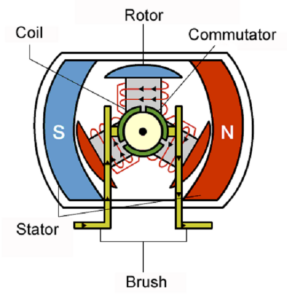

Fig. Position of Stator , Rotor and Commutator in a BLDC motor
Since there are no brushes, ionizing sparks are eliminated and electromagnetic interference is significantly reduced.
Efficiency and Performance
BLDC motors offer efficiency levels of 85% to 90%, compared to 75% to 80% for brushed DC motors. This higher efficiency makes them ideal for battery-powered applications like electric vehicles. They provide high torque per unit volume, compact size, better speed control, and fast acceleration.
Types of BLDC Motors
BLDC motors are available in the following configurations:
- Single-phase BLDC motor
- Two-phase BLDC motor
- Three-phase BLDC motor
Among these, the three-phase BLDC motor is the most widely used due to its smooth operation and superior performance.
Applications of BLDC Motors
Brushless DC motors are widely used across various industries, including:
- Electric vehicles (EVs)
- HVAC systems
- Industrial automation and robotics
- CNC machine feed drives
- Medical equipment
- Computer peripherals
- Semiconductor manufacturing
Disadvantages of BLDC Motors
Despite their advantages, BLDC motors have some limitations:
- Higher initial cost compared to brushed DC motors
- Complex electronic control circuitry
- Possible vibration during low-speed operation
- Resonance issues at certain speeds
Speed and Operating Characteristics
BLDC motors are known for quiet operation, high acceleration, and long service life. They can achieve speeds of up to 14,000 RPM, making them suitable for high-speed and precision applications.
Conclusion
The Brushless DC Motor is a powerful and efficient solution for modern electric drive systems. Its high efficiency, reliability, and maintenance-free operation make it an ideal choice for electric vehicles and advanced industrial applications. Although the initial cost is higher, the long-term benefits of energy savings, durability, and performance make BLDC motors a superior alternative to traditional brushed motors.