

Introduction
A frequency counter is an electronic test instrument used to measure the frequency of electrical signals with high accuracy. These instruments are widely used in radio frequency (RF) engineering and electronic testing applications.
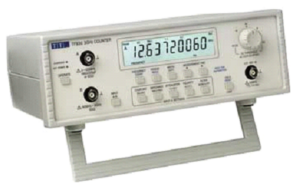

Frequency counters and counter timers are commonly used to measure the frequency of repetitive signals as well as the time interval between edges of digital signals. Although their applications differ, both instruments share similar internal circuitry, allowing some frequency counters to operate as timers.
RF frequency counters are widely available at low cost. However, low-cost equipment may compromise performance, accuracy, or reliability, so selection should be based on application requirements rather than price alone.
Introduction of Digital Frequency Counter
Before the introduction of digital frequency counters, measuring frequency was complex and less accurate. Early RF test equipment lacked sophistication and precision. One of the earliest methods was the absorption wavemeter. This device consisted of a tuned circuit connected to a diode detector and a meter. When the meter deflected, it indicated the presence of a high-power RF signal and gave an approximate frequency.
For more accurate measurements, heterodyne frequency meters or wavemeters were used. These devices employed crystal oscillators, typically operating at 1 MHz and 100 kHz, to provide calibration signals at known intervals. The transmitted signal was mixed with the internal oscillator, producing a heterodyne tone that could be heard through headphones. Because the internal oscillator was accurately calibrated, the frequency of the unknown signal could be determined precisely.
Early frequency counters used nixie tubes for display and provided faster frequency measurement than heterodyne wavemeters. With advancements in technology, digital frequency counters evolved to offer higher frequency ranges, improved triggering, and modern digital displays.
What is an RF Frequency Counter?
A frequency counter is an electronic instrument that measures frequency by counting the number of times a signal crosses a specific voltage level, known as the trigger point, within a fixed time interval.
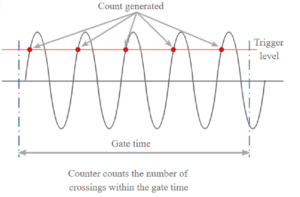

Most frequency counters automatically set the trigger level, usually near the zero-crossing point of the waveform. Some advanced models allow manual trigger adjustment. For example, if the counter gate time is one second and the signal crosses the trigger point 100 times, the signal frequency is 100 Hz. If the gate time is reduced to 0.1 seconds and 10 crossings are counted, the frequency is still calculated as 100 Hz.
Gate Time and Accuracy
There is a trade-off between measurement accuracy and gate time. A longer gate time results in more counted cycles and higher accuracy but slower display updates. To maintain precise timing, the gate signal is derived from a crystal-controlled oscillator.
High-accuracy counters often use TCXO (Temperature Compensated Crystal Oscillator) or OCXO (Oven Controlled Crystal Oscillator). Signal noise can cause false triggering and incorrect counts. Proper input circuitry design and filtering help minimize these errors.
RF Frequency Counter Applications
Frequency counters are used in a wide range of RF and audio frequency applications, including:
- Measuring transmitter carrier frequency
- Measuring oscillator frequency in electronic circuits
- Determining line signal frequency
- Measuring steady and repetitive signals
To measure an RF signal accurately using a frequency counter, the signal must be stable, unmodulated, and of sufficient amplitude. Overloading the input should also be avoided.
Types of Frequency Counters
Bench Frequency Counter
Bench frequency counters are the most commonly used instruments in laboratories and testing environments.
PXI Frequency Counter
PXI frequency counters are modular instruments used in automated test systems. They are installed in PXI racks and integrated with other test modules.
Handheld Frequency Counter
Portable handheld frequency counters are compact and useful for field measurements and quick diagnostics.
Frequency Counter in Digital Multimeter
Some digital multimeters include a frequency counter function. These are generally less accurate due to limited time base precision and probe-based measurements but are sufficient for basic troubleshooting.
Panel Meter Frequency Counter
Panel-mounted frequency counters are designed to be integrated into larger systems for continuous frequency or time interval monitoring.
Advantages of Frequency Counter
- Provides accurate and fast frequency measurements
- Widely used in RF frequency measurement
- Simple operation and easy readability
- Cost-effective for most applications
- Ensures frequencies remain within specified limits
Applications of Frequency Counter
- Measurement of pulse frequency from square wave generators
- Accurate frequency measurement in transmitters and receivers
- Clock pulse measurement in data transmission systems
- Oscillator frequency testing
- RF signal analysis
- Detection of high-power transmission frequencies
Due to their accuracy, affordability, and simplicity, frequency counters remain essential instruments in electronic laboratories, RF testing, and communication systems.