

Introduction
Haptics is a technology that adds the sense of touch to virtual environments. It allows users to feel as if they are touching or manipulating real physical objects while interacting with a digital system. This technology creates the illusion of touch by using forces, vibrations, or motion feedback. Haptic systems are widely used in fields such as virtual reality, robotics, medical simulation, and gaming.
Several haptic devices have been developed to enhance user interaction. Some of the most commonly used systems include the Phantom device, CyberGlove, Novint Falcon, and other similar haptic devices. These systems use sensors and actuators to track the position and movement of the user’s hand or body. The sensors detect movement, while the actuators generate force or vibration feedback to simulate the feeling of touch.
Another important part of haptic systems is force rendering algorithms. These algorithms calculate the forces that should be applied to the user so that virtual objects feel realistic when touched or manipulated.

What is Haptics?
Haptic technology is a technology that uses forces, vibrations, and motions to simulate the sense of touch while interacting with a virtual world. This mechanical stimulation helps create virtual objects that exist only in computer simulations. It also allows users to control these virtual objects and improves the remote operation of machines and equipment, commonly known as teleoperation.
This rapidly developing technology has already found applications in many industries. For example, haptic technology has made it possible to study the human sense of touch in greater detail by allowing researchers to create precisely controlled virtual objects.
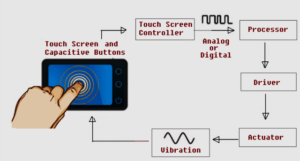

These objects are used to systematically investigate human haptic skills, which would otherwise be difficult or impossible to study. These research tools help scientists better understand how the sense of touch works and how the brain processes tactile information.
Although haptic devices can measure the forces applied by the user, they should not be confused with tactile sensors. Tactile sensors measure the pressure or force applied to an interface by the user, whereas haptic devices mainly provide force feedback to simulate touch. The term “haptic” originates from the Greek word “haptikos”, which means “relating to the sense of touch.” It is derived from the Greek verb “haptesthai”, which means “to contact” or “to touch.”
Applications of Haptic Technology
- Virtual Reality (VR) systems
- Medical training and surgical simulations
- Robotics and teleoperation systems
- Gaming and entertainment devices
- Remote control of machinery and equipment
- Scientific research on human touch perception
Conclusion
Touch and physical interaction are essential ways in which humans learn about and interact with the world. This has been true throughout both human development and evolution. According to Frank Wilson, early primates needed to develop a deeper understanding of their physical environment in order to survive. This required a new way for the brain to interpret and express the behavior of objects moving and changing under the guidance of the hand.
At the fundamental level of human communication and language, there exists a representational system that describes cause and effect, stories, and experiments, each with a beginning, middle, and end. The development of haptic technology represents our effort to communicate information by describing how objects feel. Our enthusiasm for this technology may reflect a deeper human desire to express and understand experiences through a physically based language that has yet to be fully explored.