


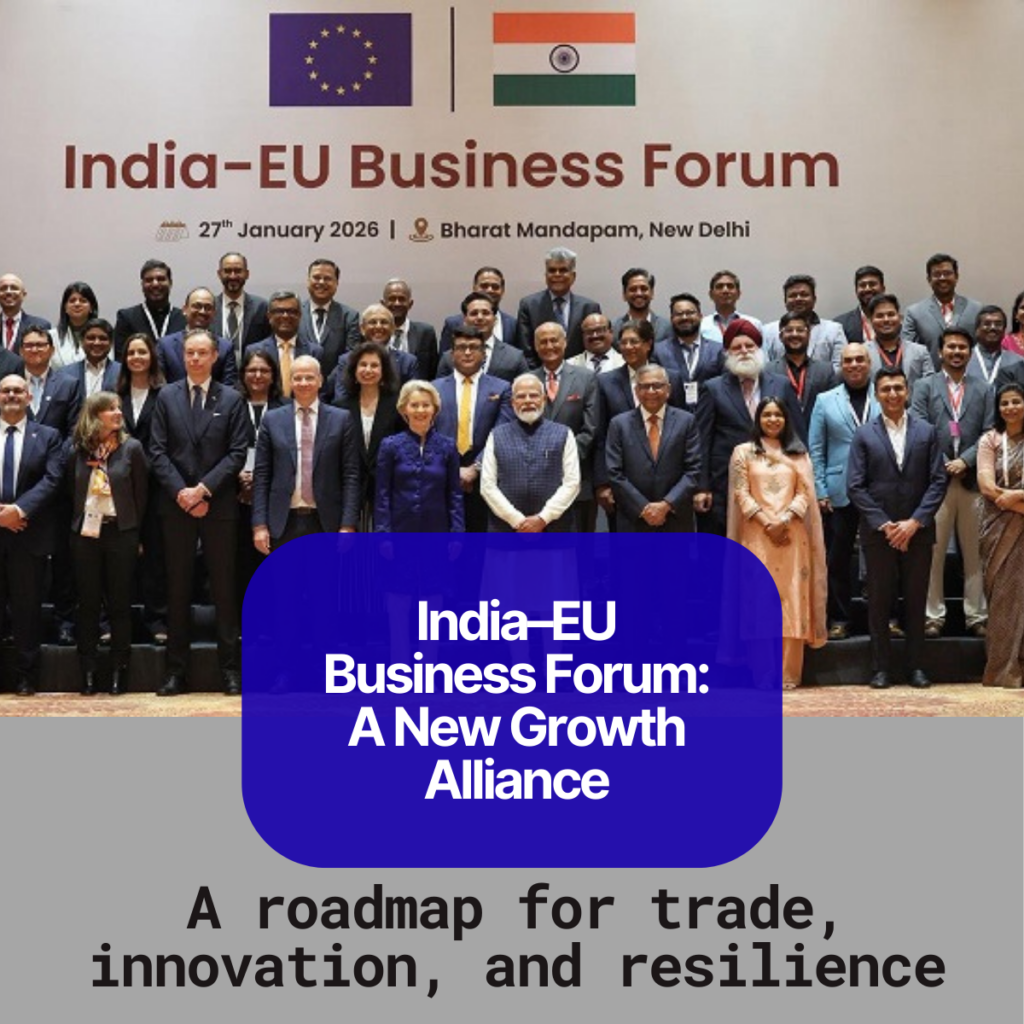
Historic trade agreement and strategic collaboration set the tone for resilient growth and shared prosperity
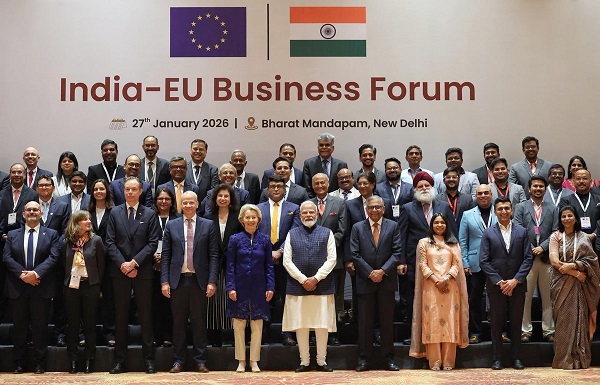

The India–EU Business Forum, held on January 27 at Bharat Mandapam, New Delhi, marked a decisive moment in the evolving relationship between India and the European Union. Against a backdrop of global economic uncertainty, geopolitical realignments, and supply-chain disruptions, the forum brought together political leaders, policymakers, and business stakeholders to reaffirm a shared commitment to cooperation, stability, and long-term growth. The gathering was widely seen as a turning point, underscored by the announcement of a historic Free Trade Agreement (FTA) between India and the EU, one of the most comprehensive trade deals concluded by either side.
A Historic Trade Milestone
The conclusion of the India–EU FTA stood out as the forum’s most significant outcome. Negotiated over several years, the agreement represents a bold step toward deeper economic integration between two major global economies. Leaders described the pact as a forward-looking framework designed to unlock new opportunities for trade, investment, and innovation across a combined market of nearly two billion people.

The agreement is expected to reduce or eliminate tariffs on a wide range of goods and services, simplify regulatory processes, and create a more predictable business environment. For India, it opens greater access to European markets for sectors such as textiles, engineering goods, leather, pharmaceuticals, gems and jewellery, and agri-based products. For the European Union, the deal enhances market access in areas including machinery, automobiles, advanced technologies, and high-value manufactured goods.
Beyond numbers and tariffs, the FTA was positioned as a stabilising force in an increasingly fragmented global economy, reinforcing the importance of open, rules-based trade and diversified partnerships.
“By aligning trade with technology, sustainability, and innovation, India and the EU are shaping a future-ready economic partnership.”
Trade, Investment, and Supply-Chain Resilience
Discussions at the forum highlighted the role of the FTA in strengthening supply-chain resilience and reducing overdependence on limited geographies. With recent global disruptions exposing vulnerabilities in international trade, both India and the EU emphasised the need for trusted partners and diversified sourcing strategies.
The agreement is expected to encourage fresh investments, particularly in manufacturing, logistics, electronics, clean energy, and industrial infrastructure. Indian states and regional clusters are likely to benefit through increased export opportunities, job creation, and stronger integration into global value chains. Small and medium enterprises, in particular, were identified as key beneficiaries, gaining improved access to international markets and technology partnerships.
Beyond Trade: Technology and Innovation
While trade was central to the forum, the broader agenda extended well beyond commerce. Leaders underscored the importance of collaboration in technology, innovation, and digital transformation. Areas such as artificial intelligence, semiconductors, advanced manufacturing, cybersecurity, and digital public infrastructure featured prominently in discussions.
Both sides recognised that future competitiveness would be driven by innovation ecosystems rather than isolated industries. Joint research initiatives, startup collaboration, and cross-border innovation platforms were highlighted as ways to translate policy intent into real economic value. The forum reinforced the idea that India and the EU can complement each other—India with its scale, talent pool, and digital capabilities, and Europe with its technological depth, research strengths, and regulatory experience.
Sustainability and Green Growth
Sustainability emerged as a unifying theme throughout the forum. India and the EU reiterated their shared commitment to climate action and green growth, aligning economic development with environmental responsibility. Cooperation in renewable energy, green hydrogen, electric mobility, energy-efficient technologies, and climate-resilient infrastructure was identified as a priority.
The FTA is expected to support the transition toward low-carbon economies by encouraging the flow of green technologies and investments. Leaders emphasised that sustainable development is no longer optional but central to long-term economic resilience and global competitiveness.
People, Skills, and Mobility
Another important dimension of the India–EU partnership highlighted at the forum was people-to-people connectivity. Mobility of skilled professionals, collaboration in education, and joint skilling initiatives were discussed as essential enablers of economic integration. Enhanced cooperation in vocational training and higher education can help bridge skill gaps, support emerging industries, and foster innovation-driven growth.
By strengthening institutional and human linkages, both sides aim to ensure that economic agreements translate into inclusive and broad-based benefits.
A Strategic Partnership for a Changing World
Leaders at the forum framed the India–EU partnership as more than a bilateral relationship—it was positioned as a strategic alliance capable of contributing to global stability and growth. In a world marked by economic turbulence and shifting alliances, the partnership was described as a “new engine of global growth,” combining India’s development momentum with Europe’s economic and technological strengths.
The forum also reinforced cooperation in areas such as security, maritime stability, and cybersecurity, reflecting a shared understanding that economic prosperity and strategic stability are deeply interconnected.
Looking Ahead
The India–EU Business Forum at Bharat Mandapam was not merely a celebratory event but a forward-looking platform that set the tone for the next phase of engagement. With the FTA providing a strong foundation, attention now shifts to implementation, execution, and sustained collaboration across sectors.
As businesses, policymakers, and institutions begin to operationalise the agreements and commitments announced at the forum, the India–EU partnership stands poised to redefine economic cooperation in the years ahead. Rooted in shared values and mutual interests, this evolving alliance promises to play a meaningful role in shaping a more resilient, inclusive, and balanced global economy.