

Introduction
With the continuous expansion of the energy market and increasing complexity of power generation systems, controlling power flow has become critically important. A Phase Shifting Transformer (PST) is widely used to control active power flow in transmission networks.
Phase shifting transformers enhance grid reliability, reduce transmission losses, and protect transmission lines from overload. They can be classified based on their construction as symmetrical or asymmetrical, and as direct or indirect phase shifting transformers.
What is a Phase Shifting Transformer?
A Phase Shifting Transformer (PST) is used to control the active power flow in three-phase transmission systems. This is achieved by varying the phase angle difference between the sending-end and receiving-end voltages.

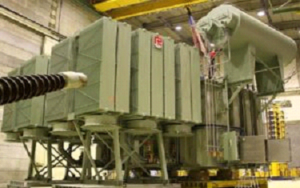

The operation of a PST is based on injecting a phase-shifted voltage into the transmission line through a series-connected transformer. This voltage is supplied by a shunt transformer. The phase shift is mainly determined by the configuration and connection of these transformers.
Phase shifting transformers improve the efficiency and stability of AC power networks. As power transmission increases, networks approach their operating limits, increasing the risk of instability. PSTs help avoid such conditions by controlling power flow.
These transformers protect high-voltage equipment and transmission lines from thermal overloads, prevent system instability, and increase transmission capacity. Compared to conventional transformers, PSTs are highly complex devices with additional windings, tap changers, and interconnections among the three phases.
Construction of Phase Shifting Transformer
According to transmission theory, the power flow in a transmission line is proportional to the sine of the phase angle difference between the sending-end and receiving-end voltages. A phase shifting transformer modifies this phase angle difference, thereby controlling the power flow in parallel transmission lines and redistributing load as required.
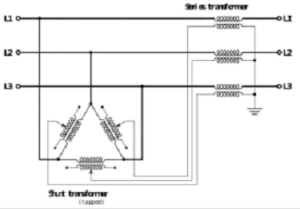

The construction of a PST consists mainly of two transformer units:
- Shunt Unit: Connected in parallel with the transmission line.
- Series Unit: Connected in series with the transmission line.
The shunt unit generates a voltage that is phase-shifted by 90 degrees, which is then applied to the series unit. The series unit injects this phase-shifted voltage into the transmission line. The phase angle can be adjusted by changing tap positions or winding connections.
Phase shifting transformers are also known as Phase Angle Regulators (PAR), Phase Angle Regulating Transformers (PART), Quadrature Boosters, or Phase Shifters.
Functions of Phase Shifting Transformer
The main functions of phase shifting transformers include:
- Controlling the flow of power between two interconnected power systems.
- Regulating the amount of active power transmitted by modifying phase displacement between input and output voltages.
- Preventing undesirable loop flows caused by impedance differences in parallel transmission paths.
- Protecting transmission lines from thermal overload and improving system stability.
Phase shifting transformers are commonly used in high-voltage systems such as 420 kV networks, with power ratings reaching up to 1630 MVA.
Types of Phase Shifting Transformer
Direct Phase Shifting Transformers
Direct PSTs are based on a three-phase core structure. The phase shift is achieved by appropriately connecting the transformer windings.
Indirect Phase Shifting Transformers
Indirect PSTs consist of two separate transformers: a variable tap exciter transformer and
a series transformer. The exciter transformer controls the magnitude of the quadrature voltage,
while the series transformer injects this voltage into the transmission line.
Asymmetrical Phase Shifting Transformers
Asymmetrical PSTs generate an output voltage with both a changed amplitude and phase angle
relative to the input voltage.
Symmetrical Phase Shifting Transformers
Symmetrical PSTs change only the phase angle of the output voltage while maintaining the same
amplitude as the input voltage.
Why Testing of Phase Shifting Transformers is Important
Due to the inductive nature of power systems, active power flow between sources and loads depends on phase displacement. Phase shifting transformers provide an effective method to control this. Although PSTs involve high investment costs, the benefits of improved flexibility, faster operation, and reduced transmission losses justify the expense. These transformers are usually installed at critical network nodes, making regular testing and maintenance essential. Transmission System Operators (TSOs) and Distribution System Operators (DSOs) rely on periodic testing to ensure long-term reliability and safe operation.
Testing Methods for Phase Shifting Transformers
Since the terminals of the exciting unit are often inaccessible in the field, most tests are performed at the factory. Common tests include:
- Turns Ratio Test
- Phase Shift Measurement
- DC Winding Resistance Test
- Dynamic Winding Resistance Test
- Exciting Current Test
These tests help verify the electrical and operational characteristics of the transformer. Advanced test equipment allows accurate measurements even for complex PST configurations.
Advantages of Phase Shifting Transformer
Some key advantages of phase shifting transformers are:
- Effective management of loop flows and congestion relief.
- Optimized power flow between parallel transmission lines.
- Improved utilization of existing transmission infrastructure.
- Deferred investment in new transmission lines.
- Reliable and cost-effective power system operation.
Applications of Phase Shifting Transformer
The major applications of phase shifting transformers include:
- Regulating active power flow in high-voltage transmission networks.
- Improving stability of interconnected power systems.
- Utilizing available network capacity efficiently.
- Enhancing security of interconnections between power grids.
By adjusting the phase angle difference between equivalent voltages, PSTs enable precise control of power flow, making them indispensable in modern power systems.