

Photoelectric sensors use optical properties to detect objects, changes in surface conditions, and other materials without physical contact. These sensors are widely used in industrial automation, packaging systems, robotics, and safety applications due to their high accuracy and fast response time.
A Photoelectric Sensor consists of two main components: an Emitter that emits light and a Receiver that receives light. When an object interrupts or reflects the emitted light, the intensity of light reaching the receiver changes. This variation is detected and converted into an electrical output signal.
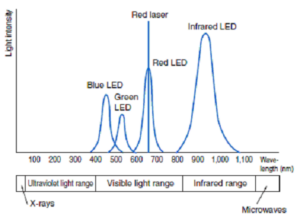
Most photoelectric sensors use infrared or visible light (commonly red, green, or blue for color detection).



Key Features of Photoelectric Sensors
- Long sensing distance
- Minimal restrictions on sensing objects
- Fast response time
- High resolution
- Non-contact sensing
- Color identification capability
- Easy installation and adjustment
Operating Principles
1. Properties of Light
- Rectilinear propagation (light travels in straight lines)
- Refraction
- Reflection
- Polarization of light
2. Light Sources
- Light generation methods
- Pulse-modulated light
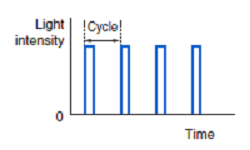

- Non-modulated light
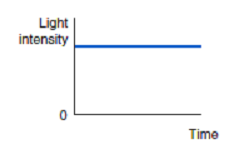

- Light source color and type

3. Triangulation Principle
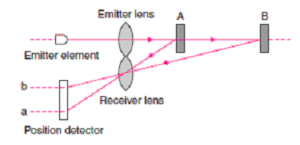

Some advanced photoelectric sensors determine object distance using the triangulation method, where the position of reflected light helps calculate the object’s distance.
Classification of Photoelectric Sensors
1. Through-beam Sensors
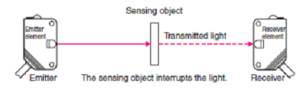
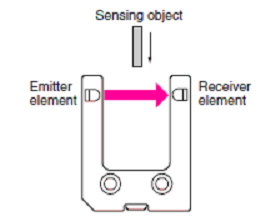
In Through-beam Sensors, the emitter and receiver are installed opposite each other. The emitted light travels directly to the receiver. When an object passes between them, it interrupts the light beam, reducing the light intensity received. This reduction is used to detect the object.
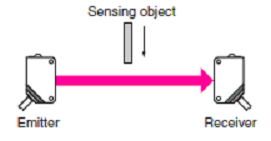

Some models, known as Slot Sensors, integrate both emitter and receiver into a single unit.

Features
- Stable operation
- Long sensing distances (from several centimeters to several tens of meters)
- Sensing position unaffected by object path changes
- Minimal effect from object gloss, color, or inclination
2. Diffuse-reflective Sensors
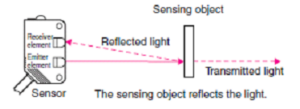
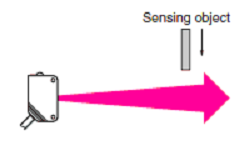
In Diffuse-reflective Sensors, the emitter and receiver are housed together. Normally, emitted light does not return to the receiver. When the emitted light strikes an object, it reflects back to the receiver, increasing the received light intensity. This increase is used to detect the object.

Features
- Sensing distance from several centimeters to several meters
- Easy mounting and alignment
- Performance varies depending on object color, surface smoothness, and reflectivity
3. Retro-reflective Sensors
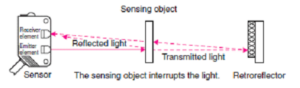
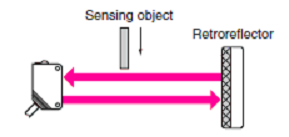
In Retro-reflective Sensors, the emitter and receiver are housed together, and a reflector is installed opposite the sensor. Light from the emitter reflects off the reflector and returns to the receiver. When an object interrupts the light beam, the received light intensity decreases, indicating object detection.

Features
- Sensing distance from several centimeters to several meters
- Simple wiring and optical axis adjustment
- Less affected by object color or angle
- Suitable for detecting transparent objects (light passes twice through the object)
- May not detect mirror-finished objects due to excessive reflection
- Has a dead zone at close distances
4. Distance-settable Sensors
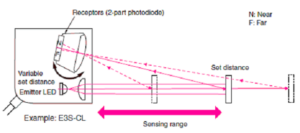
Distance-settable Sensors use a 2-part photodiode or position detector. The reflected light is focused onto the receiver. Based on the triangulation principle, the position of the focused light depends on the object’s distance.
The photodiode has two ends:
- N (Near) end
- F (Far) end
When the object reaches the preset position, light is evenly distributed between both ends. If the object is closer, more light concentrates at the N end. If farther, more light concentrates at the F end. The sensor calculates the difference to determine the object’s position.

Features
- Not greatly affected by object surface color
- Not significantly influenced by background conditions
5. Limited-reflective Sensors
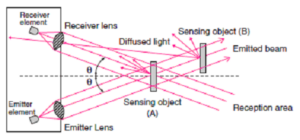
Limited-reflective Sensors operate similarly to Diffuse-reflective Sensors but restrict the light emission and reception area. Only objects located within a specific detection zone (where emission and reception overlap) can be detected. Objects within the defined sensing area are detected, while objects outside this area are ignored.

Features
- Can detect small height differences
- Detection limited to a specific area
- Less affected by object color
- Performance may be affected by object glossiness or inclination
Conclusion
Photoelectric sensors are versatile, high-speed, and reliable sensing devices widely used in industrial and automation systems. With multiple types available—Through-beam, Diffuse-reflective, Retro-reflective, Distance-settable, and Limited-reflective—they can be selected based on the application requirements such as distance, object type, environmental conditions, and detection accuracy.