

Introduction
Pneumatic actuators are devices that use pressurized air or gas to convert energy into mechanical motion. They are highly reliable, efficient, and safe motion control devices that can produce either rotary or linear movement. These actuators are particularly suitable for repetitive valve operations such as opening and closing valves.
They are widely used in industrial environments where the use of electricity could pose a risk of fire or ignition. In chemical and process industries, pneumatic actuators are commonly used to control valves that regulate the flow of fluids. Because of their safety and reliability, pneumatic actuators are considered essential in hundreds of industrial applications.
What is a Pneumatic Actuator?
A pneumatic actuator is a device that converts the energy of compressed air into mechanical motion. Depending on the design, the motion produced may be linear or rotary.

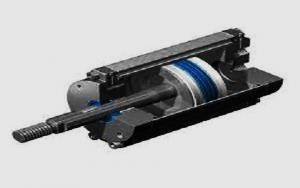

Different manufacturers produce various types of pneumatic actuators. Some convert compressed air into rotary motion, while others produce linear motion. In industrial environments, these actuators are often referred to as air cylinders, pneumatic cylinders, or air actuators.
How Does a Pneumatic Actuator Work?
The working of a pneumatic actuator mainly depends on compressed air or pressurized gas. When compressed air enters the actuator chamber, it creates pressure that moves mechanical components such as pistons or gears. When the air pressure inside the chamber becomes greater than the external atmospheric pressure, it generates controlled kinetic motion.
This motion can either be linear or rotational depending on the design of the actuator. Pneumatic actuators are widely used in modern industries because compressed air can be controlled easily and provides reliable and repeatable motion.
Pneumatic Actuator Construction and Working
A pneumatic actuator typically consists of several components including:
- Compressor
- Reservoir (air storage tank)
- Flow control valve
- Spring
- Diaphragm
In this system, the compressor compresses atmospheric air and stores it in the reservoir. The compressed air contains energy that will later be converted into mechanical motion. A flow control valve regulates the direction and speed of the air flow. The spring unit controls airflow between different sections of the actuator and also provides a return stroke to the piston.
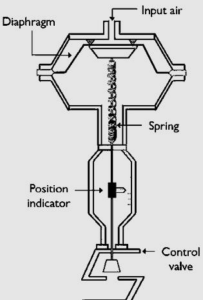

Initially, when there is no air supply, the control valve remains open and the diaphragm is lifted upward by the spring. Air is then drawn from the atmosphere, cleaned, and sent to the compressor where it is compressed. When air is compressed, both its pressure and temperature increase. Therefore, air coolers are used to keep the temperature within safe limits. The compressed air is then stored in the reservoir.
The stored compressed air transfers energy to the diaphragm inside the pneumatic actuator. When the air pressure becomes greater than the force of the spring, the diaphragm moves downward, closing the control valve.
If the air pressure continues to increase, the diaphragm moves further downward until the valve is completely closed. When the air pressure decreases, the spring force becomes stronger than the air pressure, pushing the diaphragm upward and reopening the control valve. The position of the control valve is therefore controlled by air pressure. In automated systems, actuators receive signals from controllers that adjust the air pressure, allowing the actuator to perform the required action.
Types of Pneumatic Actuators
Piston Pneumatic Actuator
This type of pneumatic actuator uses a piston placed inside a cylinder. The movement of the piston is produced by applying air pressure to one or both sides of the piston. In a single-acting piston actuator, air pressure acts on one side of the piston while a spring returns it to its original position.
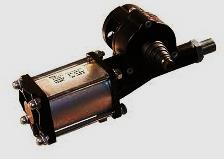

In a double-acting piston actuator, compressed air is applied to both sides of the piston, allowing greater control of movement. The linear motion of the piston can also be converted into rotational motion using mechanisms such as rack and pinion systems.
Rotary Vane Pneumatic Actuator
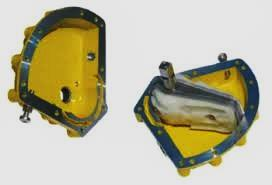

A rotary vane actuator operates similarly to a piston actuator but produces rotational motion. It contains two pressurized chambers separated by a vane attached to an output shaft. When the pressure difference between the chambers changes, the vane rotates the shaft, typically producing rotation up to 90 degrees.
Spring or Diaphragm Pneumatic Actuator
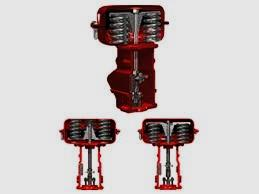

This type of actuator uses compressed air to push a diaphragm against a spring. When air pressure decreases, the spring returns the diaphragm to its original position. By adjusting the air pressure, the position of the actuator can be controlled precisely. When air pressure is removed completely, the spring moves the actuator to a predefined safe position such as fail-open or fail-close.
Advantages of Pneumatic Actuators
- Provide high force and fast movement in linear motion applications.
- Highly durable and long-lasting.
- Reliable and easy to control.
- Suitable for clean environments.
- Cost-effective compared to many other actuator systems.
- Simple to install and maintain.
- Capable of operating in temperatures ranging from 0°C to 200°C.
- Safe for explosive or fire-prone environments.
- Lightweight compared to many other mechanical systems.
Disadvantages of Pneumatic Actuators
- Lower output power compared to hydraulic actuators.
- Air does not provide natural lubrication for internal components.
- Output accuracy can be lower at very low speeds.
- Require properly designed compressed air systems.
- Air contamination from oil or lubrication can affect performance.
Applications of Pneumatic Actuators
- Air compressor systems
- Aviation and aerospace applications
- Railway systems
- Packaging and manufacturing machinery
- Automotive engines
- Industrial automation systems
- Transportation systems such as aircraft and trains
Pneumatic actuators are widely used in gasoline-powered engines where compressed gases move pistons and transfer energy to the crankshaft. They are also essential in packaging machines, industrial automation systems, and transportation equipment.