

Introduction
A Soil Moisture Sensor is an electronic device used to measure the amount of water present in soil. It helps determine whether the soil is dry, moist, or wet. These sensors are widely used in agriculture, irrigation systems, gardening, and environmental monitoring.
The sensor measures the volumetric water content of soil indirectly. Instead of directly measuring the water present in the soil, it detects changes in certain soil properties such as dielectric constant, electrical resistance, or capacitance, which vary depending on moisture levels.
What is a Soil Moisture Sensor?
A soil moisture sensor is designed to measure the amount of moisture present in soil. Traditionally, soil moisture measurement required drying the soil sample and weighing it. However, this method is time-consuming and impractical for continuous monitoring.

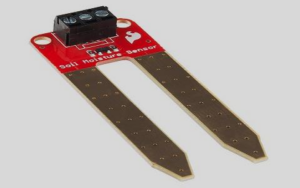

Modern soil moisture sensors estimate moisture levels indirectly by measuring physical properties of soil that change with water content. These properties include:
- Dielectric constant
- Electrical resistance
- Interaction with neutrons
- Microwave emission reflection
The measured values may vary depending on environmental conditions such as:
- Temperature
- Soil type
- Electrical conductivity
Soil moisture sensors are widely used in agriculture and hydrology for irrigation management and environmental monitoring.
Types of Soil Moisture Measurement Sensors
There are two main types of sensors used for measuring soil moisture:
1. Volumetric Water Content Sensors
These sensors measure the amount of water present in the soil volume. Most modern electronic soil sensors fall into this category.
2. Soil Water Potential Sensors
These sensors measure the energy required by plants to extract water from soil. Common examples include:
- Gypsum block sensors
- Tensiometers
Soil Moisture Sensor Pin Configuration
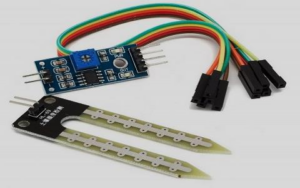

| Pin | Description |
|---|---|
| VCC | Power supply input |
| A0 | Analog output signal |
| D0 | Digital output signal |
| GND | Ground connection |
The module also includes a potentiometer used to adjust the threshold value. The threshold is compared using an LM393 comparator. Based on the set value, the indicator LED turns ON or OFF.
Working Principle of Soil Moisture Sensor
The soil moisture sensor works mainly on the principle of capacitance. It measures the dielectric permittivity of the soil, which changes depending on the water content. The working process is as follows:
- The sensor probes are inserted into the soil.
- The sensor detects changes in electrical properties caused by moisture.
- The sensor converts the detected signal into an analog or digital output.
- The microcontroller reads the output and determines the soil moisture percentage.
The higher the moisture content, the higher the sensor output value.
Soil Moisture Sensor Features and Specifications
- Operating Voltage: 3.3V to 5V DC
- Operating Current: 15 mA
- Analog Output: 0V to 5V
- Digital Output: 0V to 5V
- Adjustable trigger level using onboard potentiometer
- Comparator IC: LM393
- PCB Dimensions: 3.2 cm × 1.4 cm
- Compatible with microcontrollers and development boards
- Low cost and easy to use
- Small size and widely available
Applications of Soil Moisture Sensor
Soil moisture sensors are widely used in various fields for monitoring soil conditions and improving irrigation efficiency.
- Automatic irrigation systems
- Smart agriculture and precision farming
- Greenhouse monitoring
- Garden and lawn irrigation
- Plant growth monitoring
- Scientific experiments
- Environmental monitoring
- Soil testing
- Weather station monitoring systems
In advanced weather monitoring systems, soil moisture sensors can be combined with other sensors such as:
- Wind speed sensor
- Wind direction sensor
- Rain gauge
- Solar radiation sensor
- UV sensor
- Atmospheric pressure sensor
Conclusion
The Soil Moisture Sensor is an important device for monitoring soil conditions and improving water management in agriculture. It helps farmers and gardeners maintain optimal soil moisture levels, resulting in better crop growth and water conservation. Because of its low cost, simple design, and compatibility with microcontrollers such as Arduino, this sensor is widely used in irrigation automation systems and environmental monitoring projects.