

Market Leaders Including Cisco, MediaTek, NVIDIA, and Samsung Foundry Demonstrate Measurable Impact, Advancing the Shift from Overdesign to Co-design

Key Highlights
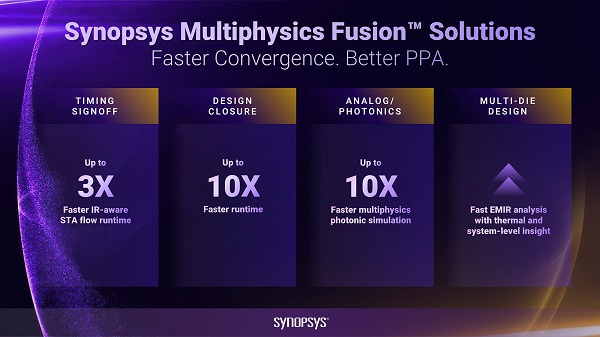
· Integrates golden signoff multiphysics analysis directly into timing signoff, design closure, multi-die, and analog workflows, enabling earlier, more accurate design decisions
· Enables SPICE-accurate multiphysics timing analysis with up to 3x faster runtimes
· Delivers up to 10x faster design closure with higher ECO success rates and improved PPA
· Provides concurrent power integrity, electromagnetic, and thermal analysis across dies and packaging, enabling early system-level insights from exploration to signoff
Sunnyvale, Calif., June 17, 2026 – Synopsys, Inc. (NASDAQ: SNPS) today announced availability of its first Multiphysics Fusion™ solutions for customer deployment. As chip complexity increases, physics-related challenges including signal integrity, power integrity, thermal integrity, electromagnetic effects, and co-packaged optics are becoming critical constraints at advanced nodes and in multi-die architectures, requiring a unified EDA and multiphysics approach. The Multiphysics Fusion portfolio combines Synopsys’ AI-powered EDA solutions with Ansys golden signoff analysis across timing signoff, design closure, multi-die design, and analog workflows. Validated by market leaders, these solutions improve predictability and accelerate convergence for AI and high-performance computing systems.
“Multiphysics is fundamentally reshaping how advanced semiconductor designs are engineered, driving a shift from costly overdesign to integrated, system-aware co-design,” said Sanjay Bali, Senior Vice President of EDA Product Management and Strategy at Synopsys. “Our Multiphysics Fusion portfolio unifies Synopsys and Ansys technologies to embed physics directly into digital and analog workflows, enabling engineering teams to design across domains with fewer iterations, improved productivity and more optimized silicon for next-generation systems.”



ADVERTISEMENT