

By Saneesh Menon, Field Application Engineer at Murata Electronics and Jerin Joseph Koshy, Team leader, Automotive Connectivity Module at Murata Electronics
As cities become more connected, ensuring the safety of vulnerable road users like cyclists is more important than ever.
Extending connectivity beyond the car
Vehicle-to-everything (V2X) communication is a key enabler of safer, more efficient transport systems, allowing vehicles to exchange real-time data with their surroundings, including other vehicles, infrastructure (traffic lights and road works), mobile network (traffic updates), and pedestrians. By sharing information such as position, speed, and direction, V2X creates a connected awareness layer between road users.



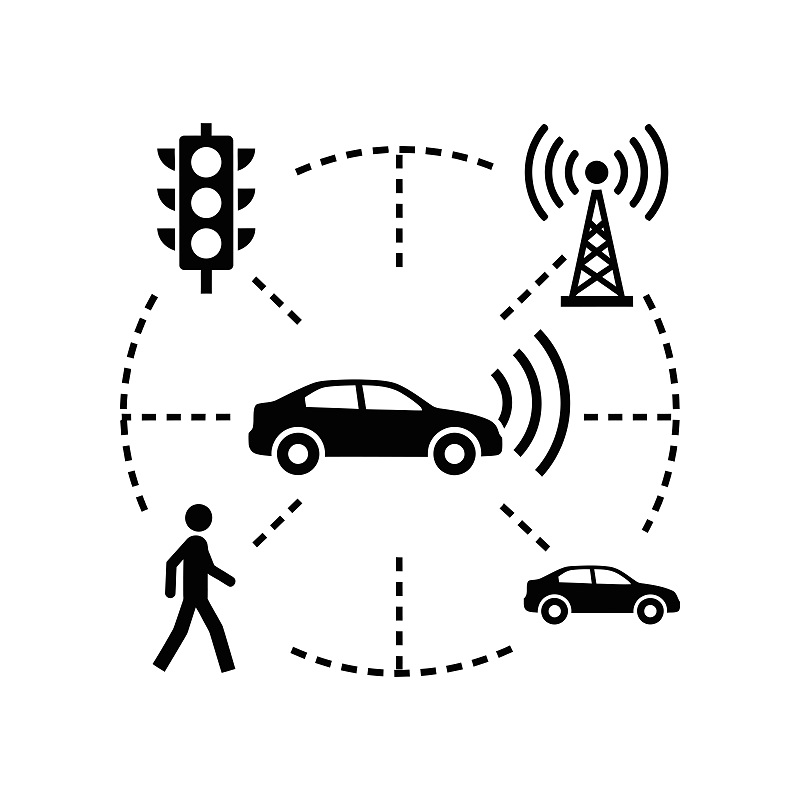
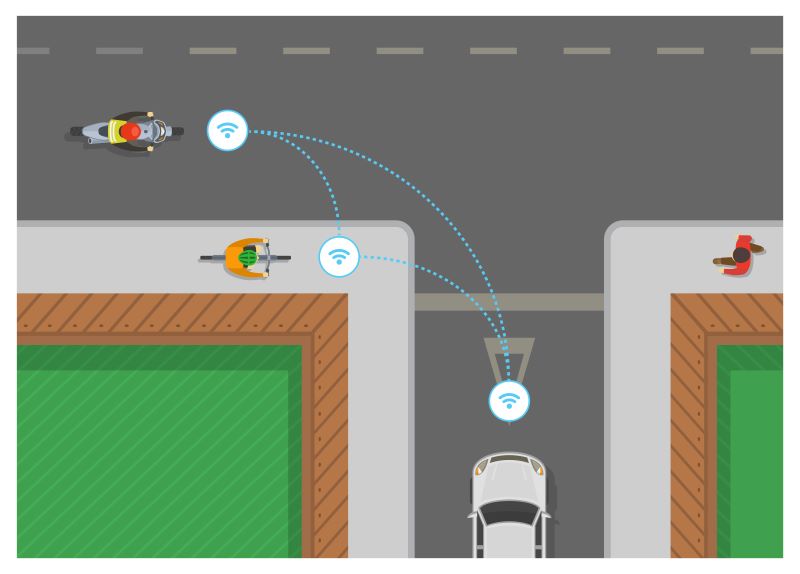
Unlike conventional safety systems that rely on line-of-sight detection, V2X enables direct communication between road users, allowing detection of potential hazards even when they are not yet visible. This earlier awareness supports faster decision-making and helps reduce the risk of collisions. For example, when a cyclist approaches a blind intersection, nearby vehicles detect it in advance.

While originally developed for automotive applications, the growth of micromobility is driving the need to extend this connectivity to cyclists and other vulnerable road users, particularly in complex urban environments (Figure 2).

Understanding V2X technologies
V2X communication is built on two primary, non-interoperable technologies: Dedicated Short-Range Communication (DSRC) and Cellular V2X (C-V2X). Both operate in the 5.9 GHz spectrum and are designed to deliver low-latency, highly reliable communication for safety-critical applications.
DSRC is based on the IEEE 802.11p standard and evolved from Wi-Fi. It enables direct communication between nearby road users without relying on cellular infrastructure. This makes it particularly effective for time-critical scenarios where messages must be exchanged within milliseconds.
C-V2X, defined by 3GPP standards, extends this capability by supporting both direct communication and network-based communication via cellular infrastructure. Safety-critical messages can be delivered directly (device-to-device) using sidelink communication, while additional data can be transmitted via the network, providing greater flexibility and scalability across connected environments.
The evolution of C-V2X continues with NR-V2X, the 5G-based standard designed to deliver higher reliability, lower latency, and increased data throughput. These capabilities support more advanced applications, including autonomous driving and coordinated traffic systems.
Murata’s V2X module brings automotive-grade communication capability into micromobility. Built on Autotalks’ CRATON2 and PLUTON2 chipsets, the module supports both IEEE 802.11p-based DSRC and 3GPP Release 14/15/16-compliant C-V2X within a single hardware platform. This provides flexibility across deployments through software configuration, while also enabling a future-ready pathway to NR-V2X.
The module also integrates a dual-core ARM® Cortex®-A7 processor that can run V2X middleware and applications directly on the device, enabling low-latency processing at the edge. Combined with support for automotive interfaces such as CAN, Ethernet, and UART, as well as an embedded hardware security module, it provides a complete, integration-ready solution.
A collaborative solution for micromobility
The collaboration between Murata, Canyon, nfiniity and Vector demonstrates how V2X can be extended to micromobility. At the heart of this integration is Canyon’s concept e bike integration, Canyon’s V2X-enabled safety technology, which connects the bike to surrounding traffic and infrastructure. Powered by Murata’s V2X module and nfiniity’s cube:nano platform, Canyon’s e bike integration enables real-time awareness and early warning capabilities designed specifically for cyclists (Figure 3).

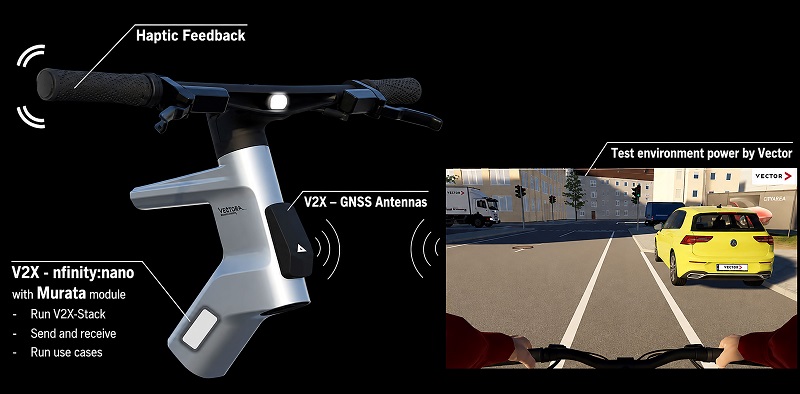
The cube:nano platform provides the hardware and software foundation required for micromobility applications, enabling real-time communication and processing of safety messages. Murata’s V2X module delivers reliable, low-latency connectivity in a compact, power-efficient form factor suited to space-constrained designs. Canyon ensures seamless integration into the bike, without compromising ride quality or design.
This integration transforms the bicycle into an active, connected road user, capable of sharing its position, speed, and movement in real time with surrounding traffic.
Thanks to Vector’s V2X test environment, various scenarios and use cases can be tested and demonstrated. This gives users a realistic experience of how V2X technology enhances safety.
How the system works in practice
Canyon’s concept e bike integration system operates through the continuous exchange of standardised safety messages. Cooperative Awareness Messages (CAM) are transmitted periodically to share information such as position, speed, and heading, ensuring that nearby road users maintain an up-to-date view of each other’s movements. Decentralised Environmental Notification Messages (DENM) are triggered by specific events, such as hazards or unusual conditions, to alert surrounding road users and enable faster responses.
Within Canyon’s concept e bike integration system, this communication is translated into intuitive rider feedback. The rider is alerted via haptic feedback in the handlebars, indicating either a general collision risk (when both grips vibrate) or the direction of a potential hazard (when only one grip vibrates). At the same time, a cyclist approaching an obscured intersection can be detected by nearby vehicles before coming into view. This early, bidirectional awareness improves reaction times and supports safer interactions between road users.
Unlocking the potential of connected micromobility
V2X is uniquely capable of integrating bicycles and scooters into the wider vehicle safety network, extending connected safety beyond cars. This creates new opportunities to improve safety, optimise traffic flow, and enhance urban mobility.
As cities continue to adopt Cooperative Intelligent Transport Systems (C-ITS), incorporating micromobility will be essential to building fully connected and inclusive transport ecosystems. Enabling all road users to share information in real time supports safer interactions and more efficient use of infrastructure. Through solutions such as Canyon’s concept e bike integration, bicycles become connected road users, addressing a critical gap in the safety ecosystem and ensuring that cyclists are no longer overlooked within traffic systems.
As V2X continues to evolve, particularly with the advancement of 5G-based NR-V2X, it will play an increasingly important role in shaping safer, smarter, and more inclusive mobility. The result is a connected environment where every road user is visible, informed, and better protected.
About Canyon, Murata, nfiniity and Vector
Canyon Bicycles GmbH is a German bike manufacturer known for innovation in performance and design. https://www.canyon.com Contact: Ben Hilson, Director of Communications, bhillsdon@canyon.com
Murata Manufacturing is a global leader in electronic components and wireless solutions, enabling reliable, automotive-grade V2X communication. https://www.murata.com
nfiniity GmbH provides a full-stack V2X platform for connected mobility, with cube:nano enabling real-time communication and safety applications for micromobility. https://www.nfiniity.com
Vector Informatik GmbH provides advanced tools for analysis, simulation and testing of V2X communication between bicycles, vehicles and infrastructure. https://www.vector.com/v2x