



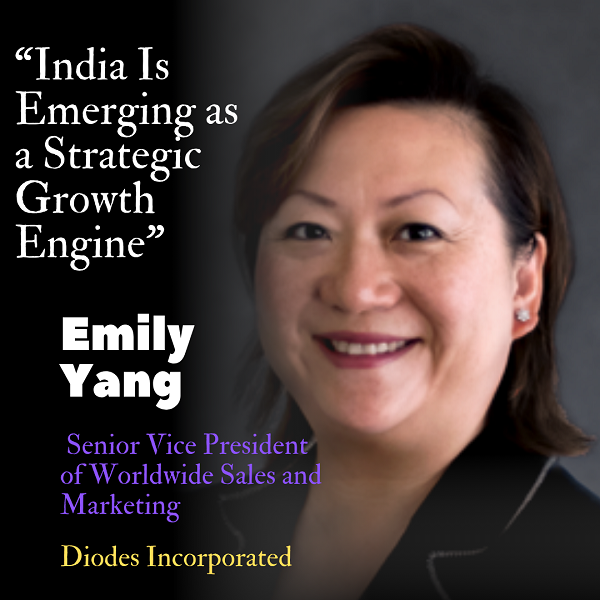
Vaishali Umredkar, Editor of Semiconductor For You, interviews Emily Yang, Senior Vice President of Worldwide Sales and Marketing at Diodes Incorporated. Yang highlights solution-focused innovations for automotive, industrial, AI data centers, and computing; hybrid global manufacturing; explosive India growth; and bold targets like $2B revenue by 2028 amid evolving tech demands.
Vaishali Umredkar: Which recent product innovations have delivered the most impact across automotive, industrial and computing applications?

Emily Yang: Our strategy remains strongly application-focused across five major market segments—automotive, industrial, computing, consumer and communications. Rather than one individual product, the strongest impact comes from continuously introducing technologies that match evolving customer requirements such as lower power consumption, higher speed, reduced latency and cost efficiency. In automotive, for example, zonal architectures are creating entirely new requirements, while computing and AI systems demand higher signal integrity and advanced power management.
Vaishali Umredkar: Which product features make your solutions particularly suitable for these advanced applications?
Emily Yang: In AI servers and data centres, high-speed interconnect products such as redrivers, multiplexers, PCIe Gen 5 and Gen 6 clock generators and buffers are becoming increasingly important. At the same time, voltage transitions from 12V to 48V, and now toward 400V and 800V systems, require highly efficient power management devices. Across applications, our portfolio combines signal integrity, analog power solutions and discrete protection devices to support complete system-level architectures.
Vaishali Umredkar: AI data centres are facing rising energy demand. How is Diodes enabling low-power and energy-efficient operation in this space?
Emily Yang: Energy efficiency is one of the defining requirements for AI infrastructure today. We are supporting this through silicon carbide-based power solutions for higher-voltage environments and packet switch products that expand PCIe connectivity inside AI servers. As board sizes increase and trace lengths become longer, signal conditioning products such as redrivers also play a critical role in maintaining performance while reducing system inefficiencies.

Vaishali Umredkar: Are application design trends changing across different regions?
Emily Yang: Regional priorities differ, but the semiconductor industry today is highly globalised. Europe remains heavily focused on automotive and industrial applications, Asia is strong in computing and consumer electronics, while North America leads hyperscaler-driven infrastructure demand. However, most major customers now design and manufacture across multiple regions, so the real focus is understanding applications and supporting customers globally rather than by geography alone.
Vaishali Umredkar: What role do packaging and process technologies play in your roadmap?
Emily Yang: Packaging is becoming central to performance improvement. Low power, smaller size and cost efficiency all depend on advanced packaging approaches such as multi-die integration and flip-chip designs. These technologies help us improve power efficiency while meeting the compact requirements of next-generation electronics.
Vaishali Umredkar: How does your manufacturing footprint support supply chain resilience?
Emily Yang: We operate a hybrid manufacturing model with front-end fabs across Europe, the US and Asia, while most back-end operations remain Asia-based. This multi-region presence gives us flexibility to respond to geopolitical changes, policy shifts and supply chain disruptions while reducing risk through diversified sourcing.
Vaishali Umredkar: How do you view India’s semiconductor market opportunity?
Emily Yang: India is a very important growth market for Diodes. Automotive is currently our fastest-growing segment, and India is showing strong momentum across two-wheelers, three-wheelers and automotive electronics design. We are seeing increasing customer engagement and significant demand growth, making India a strategic focus for our future expansion.
Vaishali Umredkar: What are Diodes’ business priorities over the next three to five years?
Emily Yang: Our goal is to grow revenue to $2 billion by 2028 while maintaining strong momentum in automotive, industrial, and high-end compute markets. We are focused on continuous new product introductions, manufacturing efficiency improvements and deepening long-term customer partnerships. Automotive alone has already been growing at over 20% year-on-year, and we intend to build on that momentum.