

Introduction
The heart of an industrial automation system is the PLC (Programmable Logic Controller). A PLC is a rugged industrial computer designed to monitor inputs, execute control logic, and control outputs in real time. A Programmable Logic Controller continuously monitors the state of input devices, makes decisions based on a user-defined program, and controls output devices accordingly. PLCs are widely used in industries to automate machinery, production lines, and building systems.
What is a PLC?
A Programmable Logic Controller (PLC) is an industrial electronic device used to control and monitor manufacturing processes and automation systems. It replaces traditional relay-based control systems with programmable, reliable, and flexible digital logic.

With the advancement of semiconductor technology, PLCs now use powerful microprocessors capable of 32-bit and 64-bit processing. These controllers are specifically designed for industrial environments and provide high reliability, safety, and long operational life.
Operations Performed by a PLC

A PLC can perform a wide range of control and processing operations, including:
- Mathematical operations
- Logical processing
- Serial communication
- Wireless communication
- Reading analogue and digital inputs
- Controlling motors, valves, sensors, and actuators
- Pre-processing industrial data for Machine Learning
- DIY smart home and automation applications
Why PLC is Preferred Over Microcontrollers?
User-Friendly
PLCs are easy to learn and operate due to their simple programming structure. The most commonly used PLC programming language is Ladder Logic Diagram, which is graphical and resembles electrical relay circuits. This makes PLC programming easy for electricians and maintenance engineers. Each PLC comes with a detailed user manual, allowing users to quickly understand and utilize the controller’s full capabilities.
Ease of Programming
Ladder Logic is a pictorial programming language consisting of rungs connected between two vertical power rails. Each rung represents a logical operation. Unlike microcontrollers that require low-level programming languages like C or Assembly, PLCs offer predefined functions that can be easily arranged to form control logic without memorizing complex code.
Modular Design
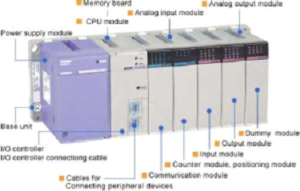
Modern PLCs follow a modular design approach. Various modules such as CPU, power supply, input/output modules, memory, and communication modules can be plugged into the PLC rack. This plug-and-play design makes system expansion quick and easy. If a fault occurs, the faulty module can be replaced without shutting down the entire system, improving system uptime and reliability.
Safety Systems
PLCs include built-in diagnostic and safety features that detect system errors even before startup. Redundant PLC systems are used in critical industries to ensure:
- Continuous operation during system failure
- Zero production loss
- Monitoring and recording of operations
- Password-protected programs for security
Robustness
PLCs are industrial-grade devices enclosed in rugged protective casings. They are designed to withstand harsh conditions such as:
- Dust and moisture
- High temperature
- Power fluctuations
- Electromagnetic interference
Because of this robustness, PLCs offer long service life even in extreme industrial environments.
Low Maintenance
PLCs require minimal maintenance due to their durable construction. Maintenance engineers can easily troubleshoot systems using readable programs and standardized wiring practices.
Historical Reliability
PLCs have been used in industries for decades and have proven their reliability over time. They replaced complex relay systems and evolved to support modern communication technologies like Ethernet and industrial networks. Backward compatibility ensures that new PLC equipment works seamlessly with older systems, making PLCs cost-effective in the long run.
Cost Efficiency
Although PLCs have higher initial costs than microcontrollers, they offer lower long-term costs due to reduced downtime, low maintenance, and higher productivity. Industries prioritize reliability and performance over low-cost hardware, making PLCs the preferred choice.
How Does a PLC Work?
The working of a PLC follows a simple cycle known as the Scan Cycle:
- Reads input signals from sensors and switches
- Executes the user program stored in memory
- Updates output devices based on program logic
- Repeats the cycle continuously
Conclusion
Programmable Logic Controllers remain the backbone of industrial automation. Their simplicity, robustness, reliability, and scalability make them superior to microcontroller-based systems for industrial applications. Although microcontrollers are useful for specialized applications, PLCs continue to dominate the automation industry due to their durability, safety features, and cost-effectiveness over long-term operation.