

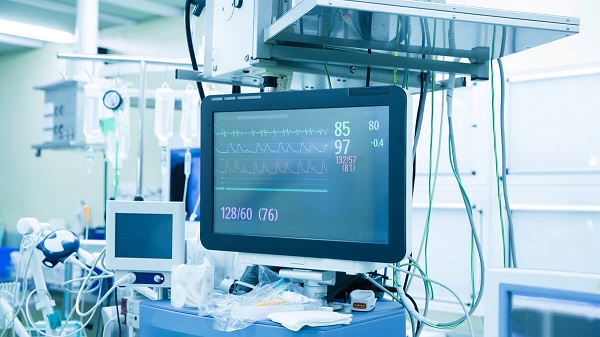

In an intensive care unit (ICU), a multiparameter patient monitor continuously tracks a stream of physiological data—ECG, oxygen saturation (SpO2), blood pressure (BP) and other vital signs. Every measurement offers an ongoing view of a patient’s condition.


Behind every waveform lies a silent requirement: precise temporal alignment. When physiological changes and alarms are recorded across bedside monitors and other connected systems, clinicians rely on sequence-of-events logging to understand what occurred and when. If clocks between those systems disagree, the timestamps associated with an ECG change, SpO2 event or alarm may not align precisely, making the timeline more difficult to reconstruct.

Supporting clinical care and information integrity extends beyond the software used to display and store medical data. Accurate event logging and timestamping begin at the hardware level, where stable frequency references help devices sustain consistent operation.
Connected Patient Monitoring
Modern patient monitoring increasingly relies on medical device connectivity. Patient data can move between equipment, central nursing stations, hospital networks and electronic health records (EHR), creating a comprehensive profile that clinicians use to assess shifts in a patient’s state.
Maintaining that record demands time synchronization between devices. The IHE Consistent Time Integration Profile (CT) specifies a median synchronization error of less than one second and uses Network Time Protocol (NTP) to establish a common time base. Between synchronization updates, however, each device relies on its local clock to maintain time. Clock drift can gradually move that reference away from the time base, allowing error to accumulate before the next update.
Network availability adds another consideration. Patient monitors exchange data through wired and wireless interfaces, but connectivity may be intermittent. When a device is temporarily off-network, idle or in standby, its local clock must continue keeping time until synchronization resumes. This period of independent operation is known as holdover, making the stability of the timing reference critical to sustaining accuracy as monitoring information moves between the endpoints clinicians rely on for evaluation.
Engineering for Reliability
Accurate timing is only one part of medical device design. The components inside a patient monitor must preserve their behavior within hardware designed for extended use and evolving real-world environments.
These devices can operate under varying thermal conditions—from cool clinical spaces to warmer bedside settings and equipment enclosures. As temperatures fluctuate, the frequency of a timing reference can shift. The practical impact becomes clearer when expressed as accumulated clock error. For example, a 32.768 kHz TCXO with a ±20 ppm frequency error can drift as much as 1.73 seconds over 24 hours. At ±5 ppm, that falls to 0.43 seconds. Greater frequency stability can limit deviation between synchronization updates, reducing uncertainty when the timestamps of physiological changes and alarms are later compared.
Movement and repositioning can subject portable and cart-mounted equipment to vibration and mechanical stress (increasing the importance of vibration resistance), while nearby electronics can generate electromagnetic interference (EMI). These factors create further pressures on circuitry responsible for reliable signal delivery.
Portable patient monitors introduce additional constraints. Battery-driven architectures must balance runtime with the energy necessary for sensing, processing, display, wireless communication and other tasks. Internal real-time clocks (RTCs) must also keep accurate time in standby and other low-power states, requiring clock sources to remain consistent while drawing very little current.
SiTime: Advancing Medical Timing
SiTime Precision Timing gives engineers greater flexibility in addressing environmental, electrical and integration constraints at the component level. Within patient monitors, SiTime parts offer stable local clock references that help limit drift between network synchronization updates. SiTime’s portfolio combines versatile frequency options with compact, resilient architectures suited for medical electronics.
- Frequency Stability: MHz MEMS oscillators (e.g., SiT1602, SiT8008, SiT8021) provide stable reference frequencies for analog-to-digital conversion (ADC), microcontroller unit (MCU)/digital signal processor (DSP) functions and communication interfaces, depending on each application’s clock requirements. They support reliable local clocking, while synchronization across connected devices is handled by system-level mechanisms.
- Energy Efficiency: A low-power 32.768 kHz temperature-compensated oscillator (TCXO), such as the SiT1552, delivers a stable reference for local timekeeping, while low-power RTCs, such as the SiT95901, maintain time, date and alarm functions with battery-backup support. These distinct capabilities enable accurate, energy-efficient timekeeping in power-constrained designs.
- Smaller Footprint: Compact components can reduce the PCB area devoted to timing, leaving more room for other capabilities within space-constrained medical equipment. SiTime’s Titan™ MEMS resonators combine an ultra-small form factor with robust mechanical reliability, allowing integration of high-performance frequency control without compromising valuable board space.
Looking Ahead
Every timestamp in a patient record depends on a local clock that keeps time between synchronization updates. As monitoring platforms connect more devices, more clocks have to agree. Explore SiTime’s Precision Timing solutions for medical applications and patient monitors.