


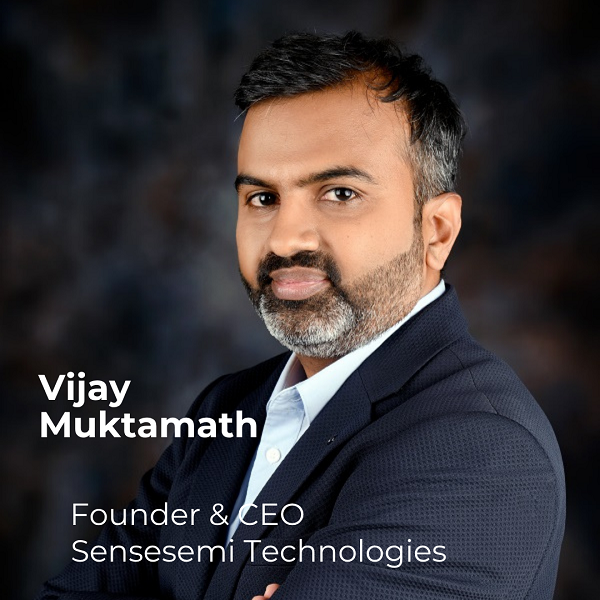
As India’s semiconductor ecosystem gains momentum, startups are playing a pivotal role in driving innovation in edge AI, sensing, and wireless technologies. In this exclusive conversation with Semiconductor For You, Vijay Muktamath, Founder & CEO of Sensesemi Technologies, shares his entrepreneurial journey, the company’s vision for intelligent edge devices, and the opportunities shaping India’s semiconductor future.
You have spent nearly two decades transforming innovative ideas into semiconductor and embedded technology products. What inspired you to establish Sensesemi Technologies, and what gap in the market were you aiming to address?
I have been working in the semiconductor industry for the past 23 years, and my passion for the field continues to grow. One of the key motivations behind establishing Sensesemi was the need to bring intelligence closer to the sensor node within edge devices.
As we move toward a future where billions of devices are connected, the amount of data and token-based communication between devices will increase exponentially. If every device relies heavily on cloud-based processing, it will create enormous demands on data centers, which is neither practical nor sustainable. This realization led us to focus on combining low-power computing with intelligence at the edge, enabling devices to process data efficiently where it is generated.


Sensesemi has built a strong reputation for product innovation and execution. Could you walk us through the company’s journey so far, highlighting some of its key milestones and achievements?
Sensesemi is building a family of SoCs that integrate wireless connectivity and AI capabilities into a unified platform.

Some of our major milestones include:
- Receiving acceptance under the Design-Linked Incentive (DLI) scheme, which has been a significant achievement for us.
- Successfully securing seed funding, reflecting investor confidence in our vision and our ability to solve critical customer challenges.
- Reaching the tape-out-ready stage for our test chips, marking a key step in our product development journey.
These achievements have strengthened our foundation as we continue to develop next-generation semiconductor solutions.
How have your R&D and product development capabilities evolved over the years, and what role do they play in helping Sensesemi compete in a rapidly changing semiconductor landscape?
For a semiconductor company, developing every IP in-house is not always a practical approach to bringing products to market efficiently. Success requires a balanced strategy that combines IP licensing with internal innovation and development.
Building a strong R&D team is essential for driving innovation and maintaining competitiveness. At Sensesemi, we are making significant investments in developing our own IP portfolio to support our SoC roadmap. This approach allows us to differentiate our products while accelerating development and ensuring long-term technological leadership.
As a startup founder with a strong focus on lean execution, how do you balance innovation, resource optimization, and speed-to-market while developing semiconductor solutions?
Balancing innovation, resource optimization, and speed-to-market is one of the biggest challenges for any semiconductor startup. With limited capital and aggressive timelines, it is essential to remain focused on solving the right problems while maintaining execution discipline.
Strategic partnerships play a crucial role in accelerating development, expanding capabilities, and reducing upfront investment requirements. Equally important is building and nurturing the right team. Addressing people-related challenges with transparency and care helps create a strong culture capable of delivering results under pressure.
For us, being lean does not mean compromising on quality. Quality must be embedded from the very beginning. Our approach is to establish a strong foundation, develop a focused Minimum Viable Product (MVP), validate it quickly with customers, and then scale based on market feedback. This enables us to optimize resources, foster innovation, and accelerate time-to-market while maintaining high standards.
Can you share insights into Sensesemi’s key products, target customer segments, and the markets that are currently driving the company’s growth?
One of the biggest challenges we foresee is the exponential growth of data generation and tokenization, potentially reaching zettabytes and quintillions of transactions. This level of growth is not sustainable using traditional approaches.
To address this, Sensesemi is developing chips that bring intelligence directly to the sensor. In essence, we are enabling sensor fusion combined with optimized AI, often referred to as Physical AI.
Our primary focus areas include healthcare sensors and Industrial IoT applications, as we believe the future lies in both health and wealth creation. In addition, automotive and camera-compute applications are rapidly emerging opportunities where power-optimized sensor fusion can deliver significant value.
India’s semiconductor sector is witnessing unprecedented momentum. What opportunities do you see for indigenous semiconductor startups, and what challenges still need to be addressed to build a globally competitive ecosystem?
India’s semiconductor industry has a tremendous opportunity to create globally competitive products in AI, sensing, automotive, industrial IoT, and healthcare.
However, semiconductor innovation is highly capital-intensive and requires patient, long-term investment. Unlike software startups, semiconductor companies often require years of development before generating meaningful revenue. NVIDIA is a prime example—it invested heavily in GPU technology and AI for decades before becoming a global leader.
For India to build similar success stories, startups need greater access to deep-tech capital, prototyping infrastructure, and broader ecosystem support. With sustained funding and a long-term vision, Indian semiconductor companies can create world-class products and emerge as global technology leaders.
With initiatives such as Make in India and the India Semiconductor Mission gaining traction, how is Sensesemi contributing to the country’s ambition of becoming a global semiconductor and electronics hub?
An important aspect of advanced computing is communication and trust. The combination of wireless connectivity and computing plays a crucial role in strengthening India’s position as a trusted global technology hub.
Sensesemi is contributing to this vision through continuous innovation and a strong focus on self-reliance in Edge AI computing technologies. Our vision is to develop wireless IPs in India that can compete globally and contribute significantly to India’s semiconductor success story on the world stage.
Looking ahead, what is your long-term vision for Sensesemi Technologies, and what can we expect from the company in terms of technology innovation, market expansion, and future growth?
Sensesemi is aiming to become a leader in AI-enabled wireless chips for edge devices. Through continuous innovation and the development of a comprehensive family of SoCs, we are working toward realizing our vision of creating world-class semiconductor technologies from India for the global market.
Collaboration and partnerships across geographies will be key to achieving this vision while supporting global expansion. With continued support from the Government of India and customers worldwide, we are confident about Sensesemi’s future growth and its ability to make a meaningful impact on the global semiconductor industry.