

What is Antenna Polarization?
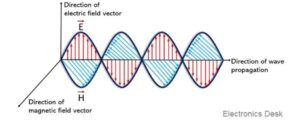
Polarization is a special property of electromagnetic waves that describes the relationship between the direction and magnitude of the vibrating electric field as it changes with time.



Importance of Antenna Polarization
Proper polarization is important for efficient communication between transmitting and receiving antennas. If both antennas have the same polarization, maximum signal transfer occurs. If the polarizations are different, signal loss takes place.

Types of Antenna Polarization
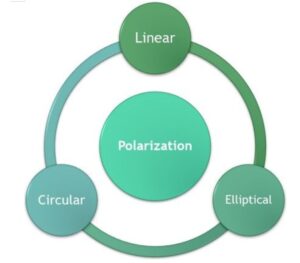
- Linear Polarization
- Circular Polarization
- Elliptical Polarization

1. Linear Polarization
Linear polarization occurs when the electric field vector of the electromagnetic wave remains in a single plane while propagating. In this type of polarization, all waves maintain the same alignment in space, either vertically, horizontally, or at a specific angle.
a) Vertical Polarization
Vertical polarization is a type of linear polarization in which the electric field is perpendicular to the surface of the Earth. The electromagnetic wave travels vertically relative to the ground.
b) Horizontal Polarization
Horizontal polarization is a type of linear polarization in which the electric field is parallel to the surface of the Earth. The electromagnetic wave travels horizontally with respect to the ground.
c) Slant Polarization
In slant polarization, the electric field is oriented at an angle, usually +45° or –45°, with respect to the Earth’s surface. This type of polarization is commonly used in modern wireless communication systems.
2. Circular Polarization
Circular polarization occurs when the electric field vector rotates continuously with constant magnitude in a plane perpendicular to the direction of wave propagation. It is produced when:
- Two perpendicular electric field components have equal magnitude
- The components differ in phase by exactly 90°
Types of Circular Polarization
1. Right-Hand Circular Polarization (RHCP)
In right-hand circular polarization, the electric field vector rotates in the clockwise direction when viewed in the direction of wave propagation.
2. Left-Hand Circular Polarization (LHCP)
In left-hand circular polarization, the electric field vector rotates in the counterclockwise direction when viewed in the direction of wave propagation.
3. Elliptical Polarization
Elliptical polarization occurs when two perpendicular linearly polarized waves of unequal amplitudes combine together. As a result, the electric field vector traces an elliptical path during wave propagation. Elliptical polarization is considered the most general form of polarization because linear and circular polarizations are special cases of elliptical polarization.
Co-Polarization and Cross-Polarization
Co-Polarization
Co-polarization occurs when both the transmitting antenna and receiving antenna have the same polarization. This provides maximum signal reception and efficient communication.
Cross-Polarization
Cross-polarization occurs when the transmitting and receiving antennas have different polarizations. This results in reduced signal strength and communication losses.
Applications of Antenna Polarization
- Satellite communication systems
- Mobile communication networks
- Radar systems
- Wireless communication systems
- Television broadcasting
- Radio communication systems
- GPS systems
Advantages of Proper Polarization
- Improves signal strength
- Reduces signal interference
- Enhances communication quality
- Improves antenna efficiency
- Provides reliable wireless transmission
Conclusion
Antenna polarization describes the orientation of the electric field of an electromagnetic wave. Understanding different types of polarization such as linear, circular, and elliptical polarization is essential for designing efficient wireless communication systems. Proper matching of antenna polarization improves signal transmission, reception, and overall communication performance.