
Introduction
An Arbitrary Waveform Generator, commonly known as an AWG or ARB, is an advanced electronic test instrument capable of generating almost any waveform defined by the user.
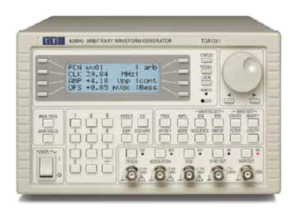

Unlike standard function generators, which are limited to basic waveforms such as sine, square, or triangle waves, AWGs can generate both repetitive and single-shot waveforms. For single-shot operation, a triggering mechanism is required to activate the AWG and, in some cases, the measuring instrument.
The waveform is defined by a set of values or waypoints, which specify the waveform’s amplitude at specific time intervals. These waveforms can be either digital or analogue. Many modern oscilloscopes include a built-in AWG, allowing waveform generation and measurement to work together seamlessly.
AWG vs Function Generator
Arbitrary waveform generators are similar to function generators but offer much greater flexibility. They allow the creation of complex and custom waveforms, making them more sophisticated and generally more expensive than traditional function generators.
Arbitrary Waveform Generator Techniques
AWGs are based on digital techniques and are commonly implemented using one of the following approaches:
Direct Digital Synthesis (DDS)
This technique is based on DDS frequency synthesis and is often referred to as an Arbitrary Function Generator (AFG). DDS-based AWGs offer excellent frequency resolution and stability.
Variable-Clock Arbitrary Waveform Generator
In this method, the clock frequency can be varied to generate waveforms. These AWGs are more flexible than DDS types but may have certain limitations. They are typically referred to simply as AWGs.
Combined Arbitrary Waveform Generator
This type combines both DDS and variable-clock techniques, allowing the benefits of both methods to be realized within a single instrument. Advances in digital technology and affordable DDS chips have made modern AWGs easier to design and manufacture.
Software-Based AWGs
Some PC-based software solutions allow users to generate arbitrary waveforms at very low cost. However, the output performance is often limited by the computer’s audio or output circuitry.
Resolution and Speed of an AWG
The resolution and speed of an arbitrary waveform generator are critical specifications that determine waveform accuracy.
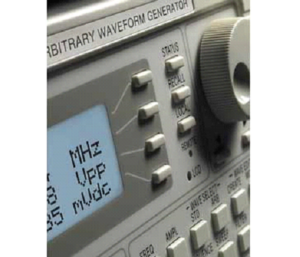

The amplitude resolution depends on the Digital-to-Analog Converter (DAC). It is defined by the number of bits used. For example, a 12-bit DAC provides 4096 discrete amplitude levels. The speed of an AWG determines the maximum waveform repetition rate and depends on:
- Number of waveform samples
- Maximum clock frequency
For example, if an AWG has a 25 MHz clock frequency and a waveform length of 1000 points, the maximum repetition rate will be 25 kHz.
Waveform Capture Methods
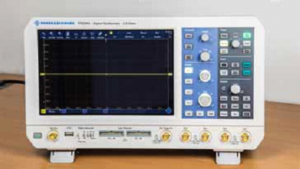

Before generating a waveform, the waveform data must be entered into the AWG. This can be done using several methods:
- Capturing a real waveform using a digitizer or digital oscilloscope
- Built-in waveform editing provided by the AWG
- PC-based waveform creation using specialized software
The digital waveform data is then uploaded to the AWG, enabling it to reproduce the desired signal.
Applications of Arbitrary Waveform Generators
AWGs are widely used in applications requiring specialized and complex waveforms. Common applications include:
- Generation of polyphase sine waves
- I-Q modulation and constellation testing
- Simulation of mechanical systems such as jet engines
- Complex digital and analogue modulation testing
- Communication system design and verification
Conclusion
Although not as commonly used as oscilloscopes or multimeters, arbitrary waveform generators are powerful and versatile instruments. Modern AWGs provide exceptional flexibility and precision, making them invaluable in advanced testing, research, and development applications. Today, AWGs are frequently integrated into digital oscilloscopes, further enhancing their usefulness in modern electronic testing.