

What is EEPROM?
EEPROM (Electrically Erasable Programmable Read-Only Memory) is a type of non-volatile memory that retains stored data even when the power supply is turned off. Unlike conventional ROM, EEPROM allows data to be erased and reprogrammed electrically without removing the chip from the circuit. This makes it highly useful in applications where data needs to be updated frequently.
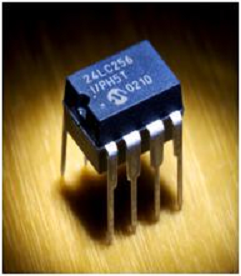



EEPROM can be programmed and erased multiple times, making it a flexible and reliable storage device for embedded systems and electronic equipment. One of the major advantages of EEPROM is that specific memory locations can be modified without affecting the data stored in other locations. The stored data remains intact until it is intentionally erased or overwritten.
In EEPROM devices, write and erase operations are generally performed on a byte-by-byte basis using an external power supply. Among the various EEPROM families available, the 24CXX series (24C02, 24C04, and 24C08) is one of the most widely used. These devices share similar characteristics and differ mainly in memory capacity.
Features of EEPROM
- Non-volatile memory that retains data without power.
- Low-voltage and standard-voltage operation.
- Supports 100 kHz and 400 kHz communication speeds.
- Schmitt trigger inputs for improved noise immunity.
- Available in memory sizes from 1 Kbit to 16 Kbit.
- Two-wire serial communication interface.
- Bidirectional data transfer protocol.
- Write-protect pin for hardware data protection.
- Supports page-write operations.
- Partial page writes are allowed.
- Self-timed write cycle operation.
- High endurance and long data retention capability.
- Automotive-grade versions available.
Principle of Operation of EEPROM
EEPROM operates on a principle similar to EPROM (Erasable Programmable Read-Only Memory). Data is stored using a floating-gate transistor structure. The memory cell contains a floating gate that can trap electrons. The presence or absence of trapped electrons determines whether a logic “0” or logic “1” is stored. A typical EEPROM memory cell consists of two transistors:
- Storage Transistor – Contains the floating gate where electrons are trapped.
- Access Transistor – Controls access to the storage cell during read and write operations.
When electrons are trapped inside the floating gate, the electrical characteristics of the transistor change, representing stored data. Unlike EPROM, which requires ultraviolet light for erasing, EEPROM can electrically remove electrons from the floating gate, allowing individual memory locations to be erased and rewritten.
Types of EEPROM
EEPROM devices are broadly classified into two categories:
- Serial EEPROM
- Parallel EEPROM
Parallel EEPROM
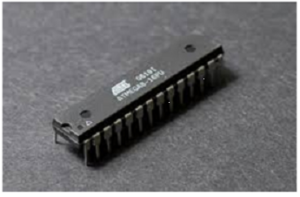

Parallel EEPROM devices provide high-speed memory access and are available in larger memory capacities, typically greater than 256 Kbits. These devices are highly reliable and are commonly used in military, aerospace, telecommunications, and industrial applications. Parallel EEPROMs are generally pin-compatible with EPROM and Flash memory devices.
Features of Parallel EEPROM
- High-speed parallel access.
- High endurance and reliability.
- Suitable for direct code execution.
- Supports page-write operations.
- Software-based data protection.
- Memory capacities ranging from 64 Kbit to 4 Mbit.
- Available in 2.7V and 5V versions.
- Available in PDIP, PLCC, SOIC, and TSOP packages.
Applications of Parallel EEPROM
- Telecommunications systems.
- Avionics equipment.
- Military electronics.
- Industrial control systems.
- Reliable code storage applications.
Serial EEPROM
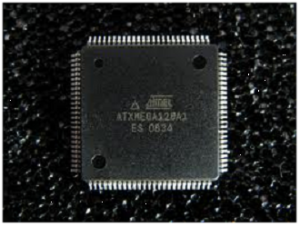

Serial EEPROMs are smaller, slower, and less expensive than parallel EEPROMs. They are widely used in consumer electronics and embedded systems. Typical memory capacities range from 256 bits to 256 Kbits.
Features of Serial EEPROM
- Operating voltage range from 1.8V to 5.5V.
- Operating frequency up to 2 MHz.
- Supports sequential reading.
- Protection against accidental writes.
- High endurance of up to 1 million write cycles.
- Data retention up to 100 years at 25°C.
- Lead-free and environmentally friendly packaging.
Memory Capacities
| Device | Memory Capacity |
|---|---|
| S-93C46B | 1 Kbit |
| S-93C56B | 2 Kbit |
| S-93C66B | 4 Kbit |
Memory Organization of EEPROM
AT24C02 EEPROM
The AT24C02 EEPROM is internally organized into 32 pages with 8 bytes per page.
- Memory Capacity: 2 Kbit
- Page Size: 8 Bytes
- Address Width: 8-bit
AT24C04 EEPROM
The AT24C04 EEPROM is internally organized into 32 pages with 16 bytes per page.
- Memory Capacity: 4 Kbit
- Page Size: 16 Bytes
- Address Width: 9-bit
AT24C08 EEPROM
The AT24C08 EEPROM is internally organized into 64 pages with 16 bytes per page.
- Memory Capacity: 8 Kbit
- Page Size: 16 Bytes
- Address Width: 10-bit
Advantages of EEPROM
- Data is retained even when power is removed.
- Can be electrically erased and reprogrammed.
- Supports multiple write and erase cycles.
- Byte-level data modification is possible.
- Low power consumption.
- High reliability and durability.
- No need to remove the chip for reprogramming.
- Long-term data retention.
Disadvantages of EEPROM
- Slower write speed compared to RAM.
- Limited write/erase cycles.
- More expensive than standard ROM.
- Lower storage capacity compared to Flash memory.
Applications of EEPROM
- Telecommunication equipment.
- Consumer electronic devices.
- Automotive control systems.
- Industrial automation systems.
- Microcontroller-based projects.
- Storage of configuration settings.
- Calibration data storage for test equipment.
- Remote control learning functions.
- BIOS and firmware storage.
- Data logging applications.
Conclusion
EEPROM is a versatile non-volatile memory technology that allows data to be electrically erased and reprogrammed without removing the device from the circuit. Its ability to retain data without power, support multiple write cycles, and provide reliable storage makes it widely used in embedded systems, automotive electronics, industrial automation, and consumer devices. Although Flash memory has replaced EEPROM in some high-capacity applications, EEPROM remains an excellent choice for storing configuration data, calibration values, and system settings.