

Recognition highlights industrial-scale recovery of solar PV materials and advancement of circular domestic manufacturing
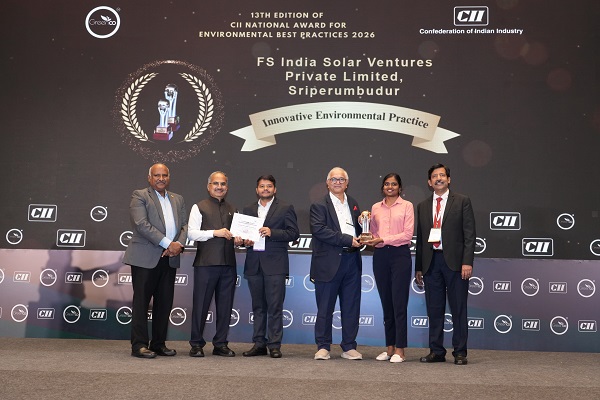

Chennai, October 15, 2026: First Solar has won the CII National Award for Environmental Best Practices 2026 under the Resource Efficiency & Circular Economy category for its project, Solar Module Recycling with Closed-Loop Semiconductor Recovery: Enabling Circular Domestic PV Manufacturing. The recognition by the Confederation of Indian Industry (CII) acknowledges First Solar’s approach to high-value solar photovoltaic (PV) module recycling, which enables the recovery and productive reuse of materials while reducing waste sent to landfills.


Implemented at First Solar’s manufacturing facility in Sriperumbudur, Tamil Nadu, the initiative integrates recycling into manufacturing operations, moving beyond conventional, bulk-based recycling towards a closed-loop model that recovers the semiconductor materials for use in new solar modules. The project demonstrates how resource efficiency and circularity can be embedded into industrial processes at scale.

According to the project data submitted for the award, First Solar has diverted approximately 13,100 metric tonnes of PV waste from landfills as of FY2026, achieving a material recovery rate of approximately 95%. The facility has a designed annual processing capacity of 21,900 metric tonnes.
The recycling process involves controlled shredding, material separation, film removal and metals precipitation. Recovered glass is channeled for use in glass manufacturing, while semiconductor material is recovered for downstream separation, refining and reuse in new First Solar modules. This approach helps reduce landfill burden, retain the productive value of recovered materials and reduce dependence on virgin resources.
Unlike conventional recycling methods that can result in the loss or dilution of valuable semiconductor materials, First Solar’s process prioritizes domestic high-value recovery and traceable downstream material pathways. By integrating recycling into routine manufacturing operations, the company has established a standardized operating model supported by environmental, health and safety (EHS) controls, quality systems, performance monitoring and continuous improvement.
The project also demonstrates the importance of cross-functional collaboration in advancing industrial circularity. Teams across manufacturing, EHS, quality and recycling work together to ensure responsible material handling, efficient recovery and transparent tracking of recovered resources. The model has helped strengthen organizational capabilities and reposition manufacturing waste as a recoverable resource.
Mr. N Muthusezhiyan, Executive Director – Green Manufacturing, CII Green Business Centre, said, “First Solar’s achievement demonstrates how circularity can be integrated into manufacturing operations to deliver measurable environmental benefits while retaining the value of critical materials. By recovering and reusing semiconductor materials from solar PV modules, the company has established a compelling model for closed-loop recycling that reduces landfill waste and dependence on virgin resources. Such industry-led innovations are vital to advancing resource efficiency, strengthening domestic manufacturing capabilities and building a more sustainable solar value chain in India.”
The initiative also offers potential for replication across the solar PV industry. First Solar has established recycling as an integrated operating capability, supported by documented procedures, defined governance and performance indicators. Through industry forums and knowledge-sharing initiatives, the company is contributing practical insights to discussions on responsible solar module recycling and circular manufacturing.
The CII National Award for Environmental Best Practices 2026 recognizes the role of industry in advancing practical, measurable environmental solutions. First Solar’s achievement illustrates how technological innovation, operational integration and closed-loop semiconductor recovery can help strengthen circularity in domestic PV manufacturing and supply chains, while supporting the development of a more resource-efficient solar industry.