

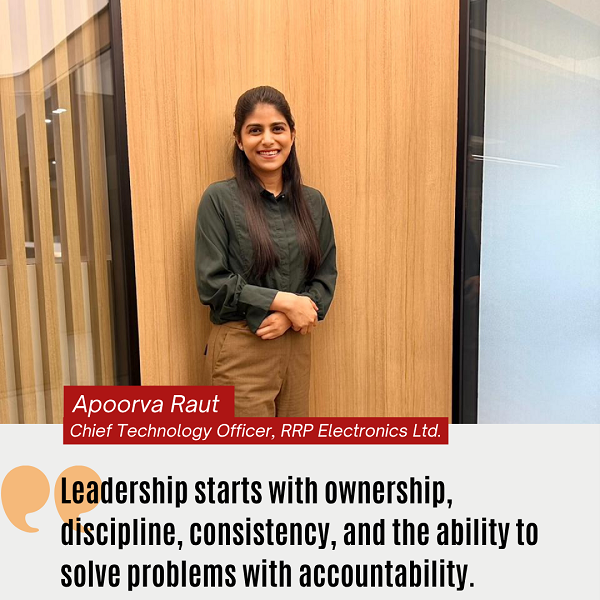

In this exclusive Women in Tech Leadership interview, Vaishali Umredkar, Editor of
Semiconductor For You, speaks with Apoorva Raut, Chief Technology Officer,
RRP Electronics Ltd., about India’s semiconductor ambitions, technology leadership, and why discipline, patience, and technical excellence are the true drivers of innovation.


Your career journey has spanned advanced technology domains and now the rapidly evolving semiconductor industry. Could you share the key milestones that shaped your path to becoming CTO at RRP Electronics?
My journey has been shaped by a strong grounding in electronics, a hands-on approach to engineering, and a consistent focus on building technology-driven solutions. After completing my Bachelor of Engineering in Electronics, I began working in domains that demanded precision, systems thinking, and execution discipline. Over time, I built experience across opto-mechanical design, project execution, and system-level engineering, which gave me a solid foundation in both product development and manufacturing.

A defining phase of my career was at RRP S4E Innovation, where I led Electro-Optics and Quality Control and was closely involved in R&D and product development for defence-grade weapon sights and surveillance systems. That experience sharpened my understanding of reliability, quality, and the discipline required to develop mission-critical technologies.
At RRP Electronics, I had the opportunity to be part of the company’s semiconductor journey from the ground up—contributing to the setup of the facility, process integration, production planning, and quality systems. Building the manufacturing foundation, mentoring teams, and helping scale operations into production have been key milestones in my path to becoming CTO.
Semiconductor manufacturing is entering a transformative phase in India. As CTO of RRP Electronics, what excites you most about being part of this journey, and what role do you see your organization playing in strengthening India’s semiconductor ecosystem?
India’s semiconductor journey has moved from ambition to execution, and that is what makes this moment so exciting. We are seeing a strong convergence of policy support, industrial intent, infrastructure creation, and talent development. Being part of this transition is both professionally exciting and strategically important for the country.
At RRP Electronics, we are focused on strengthening India’s semiconductor ecosystem through advanced packaging, process development, and manufacturing excellence. Packaging is a critical part of the semiconductor value chain, and building this capability in India is essential for reducing dependency, improving supply chain resilience, and supporting domestic innovation.
Our role is to create reliable, scalable, and quality-driven manufacturing capability while investing in talent, process maturity, and long-term technology readiness. We want to contribute not just as a manufacturer, but as a technology-led organization helping shape India’s semiconductor future.
In one of your recent interactions, you highlighted the importance of patience in R&D and innovation. How has this mindset influenced your leadership approach, particularly when managing long-term technology development projects?
In advanced technology development, progress is rarely linear. Innovation demands experimentation, iteration, and the ability to stay committed even when outcomes take time. For me, patience is not passive—it is a strategic discipline.
This mindset shapes how I lead teams and projects. I encourage a strong focus on fundamentals, rigorous problem-solving, and structured learning from every stage of development. In long-term projects, not every phase delivers immediate visible results, but those phases often build the foundation for future breakthroughs.
Patience also helps create a culture where teams are comfortable tackling complexity without compromising quality. As a leader, I believe in balancing urgency with depth—moving decisively, while giving technology development the rigor it truly requires.
Women continue to be underrepresented in many core engineering and manufacturing roles. What challenges have you encountered throughout your career, and how did you overcome them to establish yourself as a technology leader?
One of the common challenges for women in core engineering and manufacturing is the need to constantly establish technical credibility in environments that have historically been male-dominated. In sectors such as defence and semiconductors, there can also be assumptions about who is best suited for technical or operational leadership.
I addressed this by staying deeply focused on competence, execution, and ownership. Over time, technical depth, consistency, and the ability to deliver under pressure build credibility far more effectively than anything else. I have also learned the importance of speaking with clarity, taking decisions confidently, and remaining steady in high-responsibility environments.
At the same time, I believe organizations must actively create more pathways for women in technical leadership. The talent is there; what often needs to evolve is access, visibility, and encouragement.
As someone who advocates for greater participation of women in STEM, what advice would you offer to young women engineers who aspire to build careers in semiconductor technology and eventually take on leadership positions?
My first advice would be to build strong technical fundamentals. Semiconductor technology is a highly demanding field, and depth in electronics, manufacturing processes, quality systems, and problem-solving will always set you apart.
Second, stay hands-on. Some of the most valuable learning comes from real engineering environments—labs, shop floors, testing, and process challenges. Do not hesitate to take on difficult assignments; that is where confidence and capability are built.
Most importantly, do not wait for leadership to come with a title. Leadership starts with ownership, discipline, consistency, and the ability to solve problems with accountability. The semiconductor industry needs more women not just as participants, but as innovators, builders, and decision-makers.
Global partnerships are becoming increasingly important for India’s semiconductor ambitions. From your perspective, how can international collaborations accelerate technology transfer, skill development, and innovation within the country’s semiconductor sector?
Global partnerships are vital because semiconductors are built on deep process expertise, manufacturing discipline, and ecosystem collaboration. For India, international collaborations can accelerate capability building by bringing in technical know-how, best practices, quality systems, and exposure to global standards.
Technology transfer is not just about equipment or documentation—it is about building the ability to absorb, adapt, and improve. That requires collaboration in training, process development, engineering problem-solving, and manufacturing execution.
Such partnerships also create opportunities for co-development, stronger talent development, and faster integration into global supply chains. If approached with a long-term vision, they can significantly strengthen India’s semiconductor ecosystem.
Beyond technology and business goals, what motivates you personally as a leader? Are there any mentors, philosophies, or life lessons that have significantly influenced your professional journey?
What motivates me most is the opportunity to build something meaningful—whether it is a technology platform, a manufacturing capability, a team, or a larger ecosystem contribution. I am driven by the challenge of solving complex problems and by the larger goal of strengthening India’s technological self-reliance.
A principle that has consistently guided me is that quality and credibility are built through discipline, consistency, and integrity in execution. In engineering and manufacturing, there are no shortcuts to excellence, and that belief has shaped my professional journey.
I also believe leadership is ultimately about responsibility—creating clarity in uncertain situations, enabling teams to perform at their best, and staying resilient through challenges.
Leadership often demands balancing intense responsibilities with personal well-being. How do you spend your time outside work, and what hobbies or interests help you stay inspired, creative, and focused?
Outside work, I value time that helps me stay grounded and mentally reset. I enjoy reading, spending time with family, and taking moments to step back from the intensity of day-to-day operations. These breaks are important because they create space for reflection, perspective, and fresh thinking.
I believe creativity and focus are closely linked to balance. For me, staying inspired is about maintaining that balance—continuing to learn, staying curious, and making time for the people and experiences that keep me centered.