

Executive Insight
From a late-80s bet that microelectronics would become the automotive industry’s heartbeat to today’s push into robotics and digital health, Melexis has built its growth on a “people- and planet-centric” innovation philosophy.
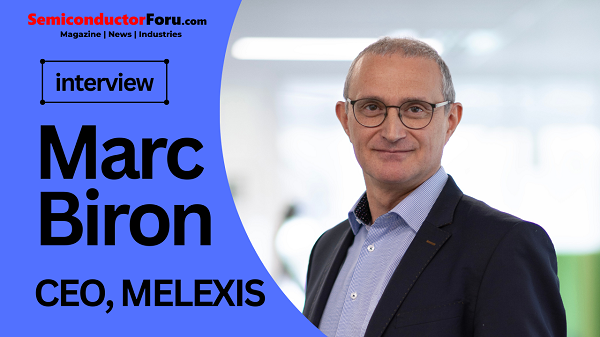
In this exclusive interview with Semiconductor For You, CEO Marc Biron discusses the company’s mastery of Triaxis® and inductive sensing, its expanding India strategy with a new Pune office, breakthrough technologies such as the SiRC Snubber and Tactaxis tactile sensors, and his vision for Melexis as the “senses and nerves of an electrified, robotized world.”
Melexis has established itself as a leader in automotive semiconductors. What key factors have driven the company’s success and growth over the years?
Long before modern cars became computers on wheels, the founders of Melexis had a vision. In the late 80s, when electronics in cars were virtually non-existent, they bet on their belief that microelectronics would become the heartbeat of the automotive industry. That futuristic vision laid the foundation for what Melexis is today.
Over the years, our success and growth have been driven by transforming that initial spark into a thriving business model built on our “people- and planet-centric” global innovation filter. We deliberately focus our engineering on solving universal human challenges through a “full-scene” sensing and driving portfolio. By mastering both Magnetic Hall-based Triaxis® and Inductive sensing, we deliver the high-precision, space-efficient, and robust solutions that modern vehicle architectures demand. Additionally, our growth is propelled by customer co-creation. We maintain a dedicated force of application engineers who develop solutions directly alongside our partners. We have grown significantly to ensure we are big enough to serve, yet we have fiercely protected the entrepreneurial spirit of our founders, ensuring we remain small enough to care.
How is Melexis positioning itself to capitalize on major industry trends such as electrification, autonomous driving, and AI-enabled systems?
We are positioning ourselves right at the center of these transitions by heavily investing in sensing and driving innovations:
- Electrification & high-voltage architectures: The transition to rapid-switching wide bandgap components like silicon carbide (SiC) in traction inverters requires advanced protection. We developed the Melexis SiRC Snubber specifically to serve as a critical safeguard for high-voltage EV powertrains. Our current monitoring sensors also ensure maximum battery life and extend the operating range.
- Autonomous driving & safety: Regulations and advanced safety are accelerating the adoption of ADAS. Our high-precision pressure, position and current sensors are vital for advanced, safety-critical steering and braking systems.
- Intelligence & integration: To combat the heavy thermal loads, complex wiring, and bulky components of modern vehicles, our smart drivers integrate intelligence directly into electric motors, thermal valves, and animated LED lighting systems. This eliminates the need for separate, bulky electronic control units (ECUs), shrinking the physical footprint and dramatically reducing cable weight.
India is emerging as a major automotive and electronics hub. How important is the Indian market to Melexis’ future growth strategy?
Melexis has been active in India through distribution partners since 2010. Over that period, the market has grown to become Melexis’ eleventh-largest market today. Next month we are opening our new office in Pune, which marks the next stage of this development, moving from a distribution-led presence to a dedicated local operation designed to bring Melexis closer to customers and application requirements in India. The move supports Melexis’ growth opportunities in two-wheeler mobility, vehicle electrification, and smart energy metering in India.
What are the biggest opportunities and challenges you foresee for the semiconductor industry over the next five years?
Looking ahead, we navigate a mix of global macro-dynamics:
- Challenges: The primary challenges stem from the geopolitical situation and increased global fragmentation. Dissolving trade ties and rising regulatory overhead increase operational expenses across the industry, making market agility more critical than ever.
- Opportunities: The biggest opportunities lie in universal electrification, the shift towards high-end premium safety and comfort features trickling down to mass-market vehicles, and the explosive growth of advanced automation and robotics..
Melexis has been expanding beyond automotive into industrial, robotics, and healthcare applications. What is driving this diversification?
This expansion is the natural evolution of our founders’ vision. Just as they foresaw the microelectronics revolution in automotive four decades ago, we see the exact same pattern repeating today in new frontiers. Our goal is to be the leader in sensor and driver solutions for an electrified and robotized world. We can bring tremendous value to any segment requiring advanced current, motor control, position, pressure, or temperature sensing.
For Melexis, the advanced automation and robotics sector represents the “car of the future.” Whether equipping automated “dark factories” or humanoid robots, these applications require the exact same onboard electronic sophistication that drove our original automotive success. We are also successfully porting automotive-grade reliability into digital health, such as integrating temperature sensors into wearables for continuous body temperature monitoring.
Could you highlight some of Melexis’ recent innovations that you believe will have a significant impact on next-generation electronic systems?
Several recent breakthroughs stand out across our core sectors:
- In mobility: The Melexis SiRC Snubber technology is a major breakthrough for EV power conversion, providing essential protection for high-voltage architectures utilizing fast-switching SiC components.
- In robotics: Our Tactaxis tactile sensors are making waves by giving robots an authentic sense of touch. A great example of this in action is our 2026 partnership with Chinese robot hand manufacturer OYMotion, which showcases how these sensors enable collaborative robotics to assist aging or working populations worldwide.
- In smart actuation: Our highly integrated motor and LED drivers are actively reshaping next-generation electronic systems by embedding intelligence directly into end-components, discarding the need for heavy, localized ECUs.
Sustainability is increasingly shaping technology development. How is Melexis incorporating sustainability into its products and business strategy?
At Melexis, sustainability is not an afterthought; “People- and Planet-centric” acts as our global innovation filter. We incorporate this into our business strategy in two distinct ways:
- Product innovation: We prioritize technologies that directly contribute to global green initiatives, like the EU’s Green Deal. Our sensors and drivers are engineered to maximize EV battery life and optimize thermal management so vehicles and industrial systems run cooler and use less energy.
- Operational footprint: Through our regional expansion strategy (including India), we localize our footprint to build a resilient regional supply chain, drastically lowering the logistical carbon footprint required to deliver our products.
How do you foster a culture of innovation and leadership within Melexis to stay ahead in a rapidly evolving market?
We foster leadership by maintaining an agile culture that balances global scale with local attentiveness. A major focus of our organizational culture right now is increasing the pace of innovation at all levels, not only in product development. As part of this, we are progressively introducing AI agents across domains like engineering and software development. We use tools like Google Workspace, Claude, and code assistants to automate repetitive knowledge work and optimize coding.
Strategically, we follow a controlled approach focused on value, data security, and always maintaining a human-in-the-loop; AI is an augmentation lever to enhance productivity, not replace jobs. Furthermore, we empower our teams to pursue innovation with heart, motivating them to design technologies that actively improve human safety, well-being, and planet health.
Looking ahead, what is your vision for Melexis, and what role do you see the company playing in shaping the future of mobility and intelligent electronics?
My vision for Melexis is to be the pioneer of an electrified and robotized world, driven by continuous, purposeful innovation. We want to be the senses and the nerves behind the smartest systems on earth. While we remain highly execution-focused on our long-term growth targets, our ultimate success will be measured by our impact. Melexis will actively shape the future by ensuring that next-generation mobility, humanoid robotics, and intelligent electronics are not just smarter and more connected, but fundamentally safer, highly energy-efficient, and built with heart for the shared good of both people and the planet.