



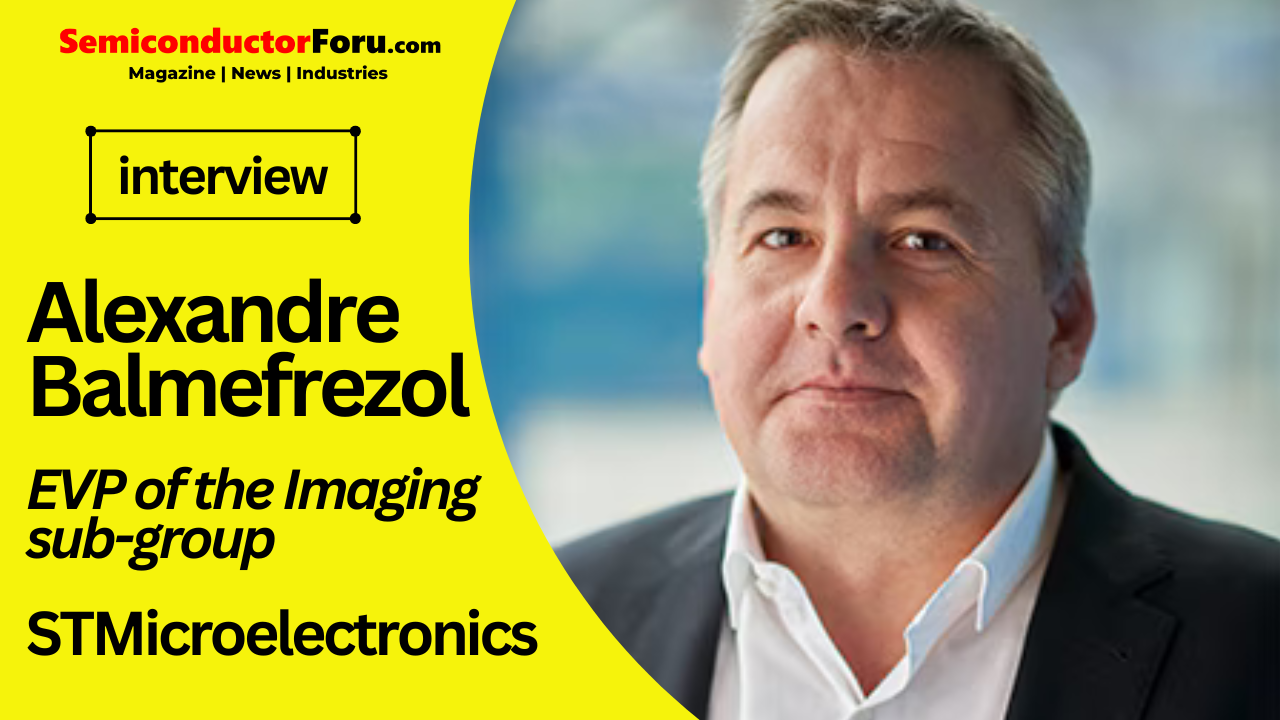



STMicroelectronics recently hosted a global media briefing, “ST Imaging is turning light into trusted data,” bringing together journalists from across Asia-Pacific and beyond, including Semiconductor For You. The session covered the company’s imaging strategy and technology roadmap, headlined by the launch of the VL53L9, a compact direct Time-of-Flight (dToF) 3D LiDAR module for Edge AI systems, alongside a new 5-megapixel CMOS image sensor series. Leading the strategic overview was Alexandre Balmefrezol, Executive Vice President of the Imaging Sub-Group. In this exclusive Q&A, he explains ST’s three focused product families, why the company positions itself as a systems provider rather than simply a component supplier, and how it plans to compete as Physical AI and Edge AI reshape the future of intelligent sensing.
Question 1
Edge AI is changing the way intelligent systems perceive the world. How do you see imaging sensors evolving in this new era?
Alexandre Balmefrezol: Traditionally, imaging sensors were designed mainly to capture images. Today, their role has expanded significantly. Modern sensors are becoming intelligent perception devices capable of providing depth information, contextual awareness, encrypted sensing, and machine vision that extends beyond human eyesight.
At ST, we believe sensors should generate trusted data that enables independent, intelligent, safe, and efficient AI systems. Rather than simply producing images, they are becoming the foundation of Edge AI by delivering the information machines need to understand and interact with their environment.
Question 2
STMicroelectronics has introduced several imaging technologies over the years. What is the company’s broader strategy in this space?
Alexandre Balmefrezol: Our strategy is to focus on areas where we can create strong differentiation and deliver complete system value rather than compete solely in high-volume conventional image sensors.
Our imaging portfolio is built around three major families:
- FlightSense for advanced depth sensing
- BrightSense for computer vision and Edge AI imaging
- SafeSense for automotive vision applications
Each addresses different markets while sharing the common objective of enabling intelligent sensing systems. We continue expanding from our leadership in consumer electronics into industrial automation, robotics, automotive, and emerging AI applications.
Question 3
What differentiates ST’s approach from many other imaging companies?
Alexandre Balmefrezol: One of our biggest strengths is our integrated device manufacturer (IDM) model. Very few companies have complete control over the entire imaging chain—from pixel design and CMOS technology to optics, packaging, software integration, and system-level optimization.
This “pixel-to-system” approach allows us to innovate faster, optimize performance across the entire sensing chain, and provide customers with complete solutions instead of standalone components. It also gives customers greater resilience and manufacturing independence.
Question 4
Privacy has become increasingly important in AI applications. How is ST addressing this challenge?
Alexandre Balmefrezol: Privacy is becoming a fundamental design requirement. Rather than transmitting large amounts of identifiable image data to the cloud, Edge AI systems should process information locally whenever possible.
Question 5
ST recently introduced the VL53L9 3D LiDAR module. What makes this product particularly significant?
Alexandre Balmefrezol: The VL53L9 represents an important milestone because it combines high-performance direct Time-of-Flight sensing with an all-in-one, compact module that is easy to integrate.
It delivers over 2,300 ranging zones, operates up to nine metres, supports frame rates of up to 100 fps, and provides infrared and depth information simultaneously while remaining compatible with low-power microcontrollers.
This enables developers to build sophisticated AI applications without requiring large processors or complex external hardware.
Question 6
Beyond the hardware itself, where do you see the biggest opportunities for intelligent imaging?
Alexandre Balmefrezol: We believe the greatest opportunity lies in enabling machines to perceive and understand their surroundings.
Applications include robotics, industrial automation, smart buildings, medical devices, drones, smart agriculture, AR/VR systems, and next-generation consumer electronics.
Our objective is to provide developers with sensing technologies that combine high performance, low power consumption, straightforward integration, and AI-ready data streams.
Question 7
ST often talks about combining sensing with AI. Why is this integration becoming so important?
Alexandre Balmefrezol: AI systems are only as effective as the data they receive.
Future sensors must perform more intelligence at the edge, reducing unnecessary data transfer while providing meaningful information directly to embedded processors. Instead of simply capturing high-resolution images, sensors increasingly need to deliver context-aware data that AI algorithms can process efficiently.
This is why Edge AI is
Question 8
ST is competing with several global imaging companies. Where do you believe your competitive advantage lies?
Alexandre Balmefrezol: We don’t position ourselves as a traditional imaging company. ST is a broad semiconductor company with a unique portfolio that combines imaging sensors, MEMS technologies, microcontrollers, AI processing capabilities, and software.
This allows us to provide complete system solutions built around platforms such as STM32 rather than individual components.
Our specialised approach, supported by our IDM manufacturing model, has enabled us to establish leadership across several sensing technologies.
Question 9
Looking ahead, what is your long-term vision for ST’s Imaging business?
Alexandre Balmefrezol: Our vision is to transform imaging sensors into AI enablers.
We want to continue converting optical information into trusted data that enables smarter, safer, and more autonomous systems.
By combining innovations in sensing, processing, optics, packaging, and software, we aim to help customers accelerate product development while reducing complexity and enabling entirely new Edge AI applications across consumer, industrial, and automotive markets.