


Driving Ecosystem Innovation: Murata Expands Its Local Footprint, Engineering Support and Application Capabilities in India
Interview with Murata Leadership | electronica India 2026


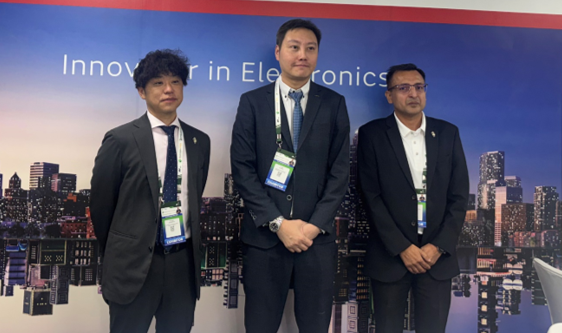
At electronica India 2026, Vaishali Umredkar, Editor of Semiconductor For You, met with key leadership from Murata Electronics to discuss the company’s evolving strategy in India, localized engineering support, supply chain expansion and collaboration with the regional electronics ecosystem.

The conversation featured:
- Gary Han – Director, ASEAN & India Sales & Marketing, Murata Electronics Singapore
- Takeshi Hashimoto – Managing Director, Murata Electronics India
- Parmod Singla – Deputy General Manager, Sales, Murata Electronics India
Watch the Video

India’s Growing Role in Murata’s Global Semiconductor Strategy
Reflecting on Murata’s journey, Gary Han explained how India’s role within Murata’s ASEAN and global strategy has expanded significantly over the last 15 years.
Originally established as a liaison sales office in 2010, Murata India has developed into a dynamic market driven by strong domestic demand, high-volume hardware and software design activity, and a rich pool of engineering talent.
Supported by favourable government manufacturing incentives, Murata views India as a vital global hub. Its key focus areas include:
- AI data centres
- 5G and 6G communications
- Industrial automation
- Automotive electrification
India’s growing engineering talent and expanding design ecosystem are strengthening its position as an important hub in Murata’s global strategy.
Strengthening Local Infrastructure and Customer Support
To support local OEM partners and design centres, Takeshi Hashimoto highlighted Murata’s investments in local operational infrastructure.
Beyond sales and application engineering, Murata established local warehousing in 2020 and recently launched an MLCC (Multi-Layer Ceramic Capacitor) taping facility in India.
Hashimoto emphasised Murata’s ambition to act as a long-term strategic partner by engaging with customers during the early design phase. This approach enables faster adaptation to technological changes while improving local logistics and supply chain reliability.
Moving Beyond Components to System-Level Innovation
Parmod Singla detailed how Murata’s showcase at electronica India focused on system-level demonstrations rather than individual passive components.
Showcasing real-time solutions for data centres, mobility, humanoids and IoT, Murata works directly with engineers at the architectural level to address some of the industry’s complex challenges, including:
- Advanced miniaturisation
- Thermal management
- Power efficiency
By aligning global component technologies with local design requirements, Murata continues to support India’s growing semiconductor design ecosystem and local hardware manufacturing initiatives.
Featured Solution Demonstrations at electronica India 2026
Murata also showcased application-focused technologies across data centre and humanoid ecosystems, highlighting how its component expertise supports emerging system-level requirements.
1. Data Center Zone: Enabling High-Density Computing
In the Data Center Zone, Lynn presented Murata’s rack-to-rack hardware solutions, including:
- Server components
- Optical transceivers
- Power shelves
- Lithium battery backup units
These solutions are designed to support the efficiency requirements of high-density computing environments.
Watch the Video

2. Humanoid Zone: Advancing Intelligent Interaction
In the Humanoid Zone, Michael demonstrated Murata’s technologies supporting next-generation humanoid applications, including:
- Spatial Voice Interaction: Technology for speaker localisation.
- Picoleaf™ piezoelectric film sensors: Sensor technology for advanced applications.
- Edge AI compute modules: Supporting intelligent edge computing.
- Motion control components: Enabling movement and control applications.
Watch the Video

Interview by: Vaishali Umredkar
Publication: Semiconductor For You
Event: electronica India 2026