

Introduction
A PIR (Passive Infrared) Sensor is an electronic device used to detect the presence and movement of humans or animals by sensing infrared (IR) radiation emitted from their bodies. PIR sensors are widely used in security systems, automatic lighting systems, motion detectors, and smart home applications.
Typically, a PIR sensor can detect human movement within a range of 5 to 12 meters, with an average detection distance of approximately 10 meters. The sensor contains pyroelectric elements that can detect changes in infrared radiation levels within its field of view. PIR sensors are popular because they consume very little power, offer a wide detection range, are easy to interface with microcontrollers, and require minimal maintenance.


Construction of a PIR Sensor
Most PIR sensors have a three-pin connection located at the bottom or side of the module. The three pins are:

- VCC – Power Supply
- OUT – Output Signal
- GND – Ground
The sensor generally operates on a 5V power supply. Some larger PIR modules may include relay outputs instead of direct signal outputs for controlling external devices.
Working Principle of a PIR Sensor
PIR sensors work by detecting changes in infrared radiation levels within their detection area. Every human body emits infrared energy in the form of heat. When a person enters the sensor’s field of view, the PIR sensor detects the change in infrared radiation and generates an electrical signal. The output of a PIR sensor is digital, making it easy to interface with microcontrollers such as Arduino, 8051, PIC, and AVR controllers.
When no motion is detected, the output remains LOW. Once motion is detected, the output becomes HIGH for a specific period and then returns to LOW. If movement continues, the output repeatedly switches HIGH until no motion is detected within the sensor’s range.
PIR Sensor Warm-Up Time
A PIR sensor requires a short warm-up period before it can operate accurately. During this time, the sensor calibrates itself according to the surrounding environmental conditions. The warm-up time typically ranges from 10 to 60 seconds, depending on the sensor model. During this period, movement within the sensor’s field of view should be minimized to ensure proper calibration.
PIR Sensor IC and Interface
The PIR sensor module consists of three primary pins:
- VCC – Power Supply
- GND – Ground Connection
- OUT – Digital Output Signal
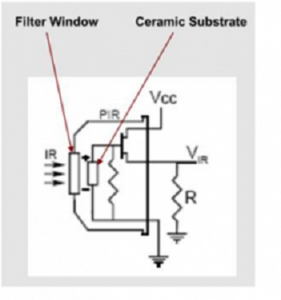
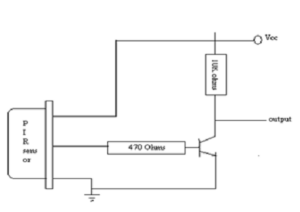
When infrared radiation from a human body is detected, the sensor converts it into electrical pulses. These pulses are processed through an internal amplifier and inverter circuit.


Features of PIR Sensor
- Built-in PIR motion detection technology.
- Dual-element sensor for high sensitivity and low noise operation.
- Wide motion detection range.
- Low power consumption.
- Easy interfacing with microcontrollers and embedded systems.
- Standard TTL-compatible output.
- Operates on a 5V power supply.
- Adjustable delay time for output control.
- Reliable and maintenance-free operation.
Applications of PIR Sensors
1. Outdoor Lighting Systems
PIR sensors are widely used in outdoor lighting systems to automatically switch lights ON when motion is detected and OFF when no movement is present.
2. Lift Lobbies
These sensors help automate lighting and improve energy efficiency in elevator waiting areas.
3. Apartment Complexes
PIR sensors are used in common areas to control lighting and enhance security.
4. Staircases and Corridors
Automatic lighting in staircases and hallways is commonly controlled using PIR sensors to reduce electricity consumption.
5. Basement and Covered Parking Areas
Motion detection systems improve safety and energy efficiency in parking facilities.
6. Shopping Malls
PIR sensors are used for automatic doors, security systems, and smart lighting applications.
7. Garden Lighting Systems
Garden lights can automatically activate when movement is detected, improving convenience and security.
8. Security and Alarm Systems
PIR sensors are one of the most commonly used motion detection devices in home and commercial security systems.
Advantages of PIR Sensors
- Low power consumption.
- Compact and lightweight design.
- High sensitivity to human motion.
- Easy installation and integration.
- Cost-effective solution for motion detection.
- Reliable performance in various environments.
Conclusion
A PIR (Passive Infrared) Sensor is an efficient and cost-effective motion detection device widely used in automation, security, and energy-saving applications. By detecting changes in infrared radiation emitted by living beings, PIR sensors provide reliable motion sensing capabilities. Their low power consumption, high sensitivity, and simple interfacing make them an essential component in modern electronic and embedded systems.