
Introduction
Accurate current measurement is essential for power monitoring, motor protection, and battery management systems. The ACS712 Current Sensor is a widely used, fully integrated Hall-effect-based linear current sensor IC designed to measure both AC and DC currents with high accuracy and built-in galvanic isolation.
What is the ACS712 Current Sensor?
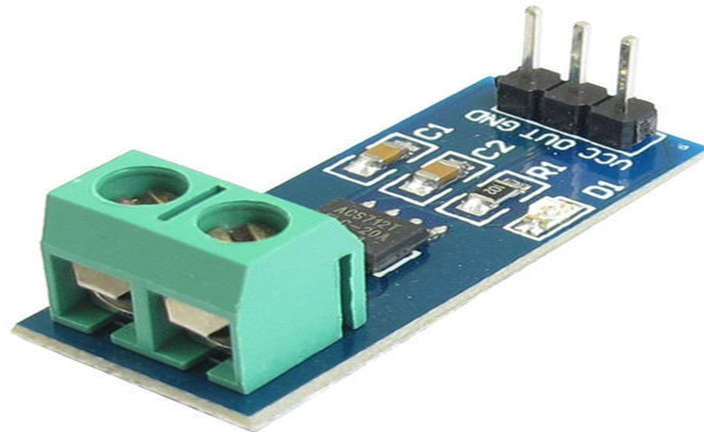

The ACS712 is an analog current sensor IC developed by Allegro MicroSystems. It converts input AC or DC current flowing through its internal copper conduction path into a proportional output voltage. Because the primary conduction path is electrically isolated from the sensor circuitry, the ACS712 offers 2.1 kV RMS voltage isolation, making it safe for low-voltage microcontrollers (like Arduino or ESP32) to monitor high-voltage circuits.
How Does the ACS712 Work? (Hall-Effect Principle)
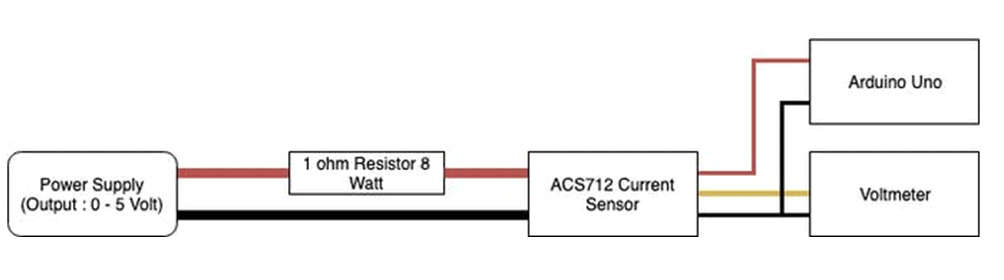
The ACS712 operates based on the Hall Effect principle:
- Conduction Path: The current to be measured passes through an internal low-resistance copper path (approx. $1.2\text{ m}\Omega$) inside the IC package.
- Magnetic Field Generation: As current flows through this copper path, it generates a proportional magnetic field around the conductor.
- Hall IC Detection: An integrated Hall sensor converts this magnetic field into a proportional differential voltage.
- Analog Voltage Output: Internal low-noise amplifier stages process the signal to output a clean analog voltage at the OUT pin.
Because the copper path has extremely low internal resistance, the sensor consumes very little power and introduces minimal insertion loss into the monitored circuit.
ACS712 Variants and Sensitivity
The ACS712 comes in three common current-range models, each operating at a 5V DC supply voltage with a quiescent zero-current output voltage centered at 2.5V ($V_{CC} / 2$):
| Model Variant | Current Range | Sensitivity Rate | Zero-Current Output Voltage |
|---|---|---|---|
| ACS712-05B | -5A to +5A | 185 mV / Ampere | 2.50 V |
| ACS712-20A | -20A to +20A | 100 mV / Ampere | 2.50 V |
| ACS712-30A | -30A to +30A | 66 mV / Ampere | 2.50 V |
When positive current flows from IP+ to IP-, the output voltage rises above 2.5V; when reverse or negative current flows, the voltage drops below 2.5V.
ACS712 Pinout Description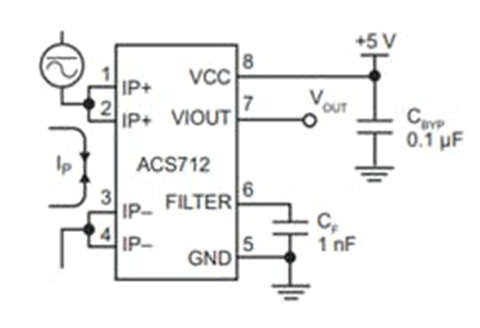
SOIC-8 IC Package Pins:
- Pins 1 & 2 (IP+): Terminals for connected current input (internally connected).
- Pins 3 & 4 (IP-): Terminals for connected current output (internally connected).
- Pin 5 (GND): Signal Ground terminal.
- Pin 6 (FILTER): Connection for an external capacitor to set output bandwidth and noise filtering.
- Pin 7 (VIOUT): Analog Output voltage pin proportional to sensed current.
- Pin 8 (VCC): Device Power Supply input (+5V DC).
3-Pin Module Breakout Pins (For Arduino / Microcontrollers):
- VCC: Connects to +5V power supply.
- GND: Ground connection.
- OUT / VOUT: Connects to an Analog Input pin (e.g., A0 on Arduino).
- Screw Terminal Block (IP+ / IP-): Wired in series with the load whose current is being measured.
Key Features & Advantages
- Dual AC & DC Sensing: Capable of measuring direct and alternating currents accurately.
- Galvanic Isolation: $2.1\text{ kV RMS}$ isolation protects sensitive control microcontrollers from power surges.
- Low Power Loss: $1.2\text{ m}\Omega$ internal conductor resistance minimizes heat generation and voltage drop.
- High Bandwidth: Adjustable bandwidth up to 80 kHz via the external filter capacitor.
- Ratiometric Output: Output voltage scales proportionally with supply voltage variations.
Limitations of ACS712
- External Magnetic Interference: Stray magnetic fields near the sensor can introduce measurement offset errors.
- 5V Operation Dependency: Requires a stable 5V supply for maximum accuracy (requires signal attenuation for 3.3V logic microcontrollers like ESP32 or STM32).
Applications of ACS712 Current Sensor
The ACS712 current sensor is widely deployed across industrial, automotive, and consumer electronics applications:
- Motor Control Circuits: Monitoring motor load current to detect stalling or overload states.
- Overcurrent Fault Protection: Tripping circuit relays when current exceeds safe operational limits.
- Switched-Mode Power Supplies (SMPS): Providing feedback signals for closed-loop current regulation.
- Solar Power & Battery Management: Monitoring charge and discharge currents in renewable energy systems.
- Automotive Electronics: Sensed current monitoring in automotive power distribution networks.