

Introduction
A sinusoidal waveform is a mathematical curve defined by the sine trigonometric function. It represents a smooth, continuous, and periodic waveform that appears frequently in mathematics, physics, electrical engineering, signal processing, and many other scientific fields.
A sine wave is a type of continuous wave characterized by smooth oscillations above and below a central axis. Due to its regular and predictable nature, it is widely used to represent alternating quantities such as AC voltage and current.

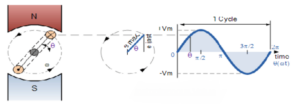
When an electric current flows through a conductor, it produces a circular magnetic field around the conductor. The strength of this magnetic field is directly related to the magnitude of the current flowing through it.

If this conductor is moved or rotated within a stationary magnetic field, an electromotive force (EMF) is induced in the conductor due to its motion through the magnetic flux. This phenomenon demonstrates the close relationship between electricity and magnetism.
This principle was discovered by Michael Faraday and is known as electromagnetic induction. It forms the fundamental operating principle of electrical machines such as generators and alternators, which produce sinusoidal waveforms for AC power generation.
Sine Wave Mathematics
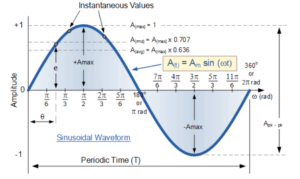
The general mathematical expression of a sinusoidal waveform as a function of time is given by:
y(t) = A sin(ωt + φ)
Where:
- A = Amplitude, the maximum peak value of the waveform from zero
- f = Frequency, measured in cycles per second (Hertz, Hz)
- ω = Angular frequency in radians per second, given by ω = 2πf
- φ = Phase angle (in radians), which indicates the position of the waveform at time t = 0
This equation describes how the instantaneous value of a sine wave varies with time.
Generation of Sinusoidal Waveforms

There are several methods used to generate sinusoidal waveforms, depending on the application and required frequency stability. Some common methods are listed below:
- Quartz Crystal Oscillator
- Negative Resistance Oscillator
- Basic Single-Coil AC Generator
- Phase Shift Oscillator
- Wien Bridge Oscillator
Among these, crystal oscillators are preferred for high frequency stability, while oscillators like the Wien bridge are commonly used in audio-frequency applications.
Applications of Sinusoidal Waveforms
- AC power generation and transmission
- Communication systems
- Signal processing and filtering
- Electrical machines and transformers
- Audio and sound systems