

Introduction
The Sun plays a critical role in influencing radio communication on Earth. Various solar activities such as solar flares and solar wind significantly affect radio wave propagation by altering atmospheric conditions.
What is a Solar Flare?
A solar flare is an intense and localized eruption of electromagnetic radiation in the Sun’s atmosphere. These flares typically occur in active regions of the Sun and are often, but not always, associated with:


- Coronal Mass Ejections (CMEs)
- Solar particle events
- Other solar phenomena
Solar flares release large amounts of energy across a wide range of the electromagnetic spectrum, including radio waves, visible light, X-rays, and gamma rays.

Influence of the Sun on Earth’s Atmosphere
The Sun is the central body of our solar system and a continuous source of energy for all planets. Its influence on Earth extends beyond sunlight and includes:
- Electromagnetic radiation (RF, heat, light, X-rays)
- Gravitational forces
- High-speed subatomic particles such as electrons and protons
Scientists have extensively studied the relationship between solar activity and atmospheric conditions on Earth. Many atmospheric changes are directly or indirectly influenced by solar phenomena.
What is Solar Wind?
Solar wind refers to the continuous stream of charged particles emitted by the Sun into space. These particles originate from the Sun’s outermost layer, known as the corona. Solar wind is often released due to events such as:
- Coronal Mass Ejections (CMEs)
- Coronal holes
These charged particles travel at extremely high speeds and carry significant kinetic energy.
Effects of Solar Energy on Radio Propagation
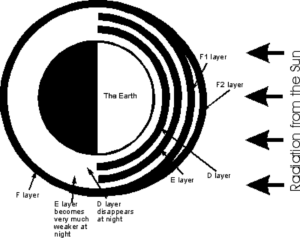

When solar wind and other solar emissions are directed toward Earth, they interact with the planet’s atmosphere and magnetic field. This interaction can have both positive and negative effects on radio communication.
Major Effects Include:
- Auroras: Beautiful light displays near the polar regions caused by charged particles interacting with atmospheric gases.
- Signal disruption: High-energy solar events can disturb the ionosphere, leading to communication blackouts.
- Interference: Radio signals may experience noise, fading, or distortion.
- Enhanced propagation: In some cases, solar activity can improve long-distance communication.
Structure and Nature of the Sun
The Sun is a massive celestial body composed primarily of hot gases (plasma). It acts as a giant thermonuclear reactor.
- Core temperature: Approximately 15–16 million °C
- Surface temperature: Around 5,500–6,000 °C
Unlike Earth, which is solid, the Sun is a fluid mass. Its immense gravitational force holds the plasma together and prevents it from dispersing into space. The Sun’s mass is about 100 times greater than that of Earth, resulting in a significantly stronger gravitational force.
Conclusion
Solar activity has a profound impact on radio propagation and communication systems. While phenomena like solar flares and solar wind can enhance signal transmission in some cases, they can also cause severe disruptions. Understanding these effects is essential for improving the reliability of communication technologies.