


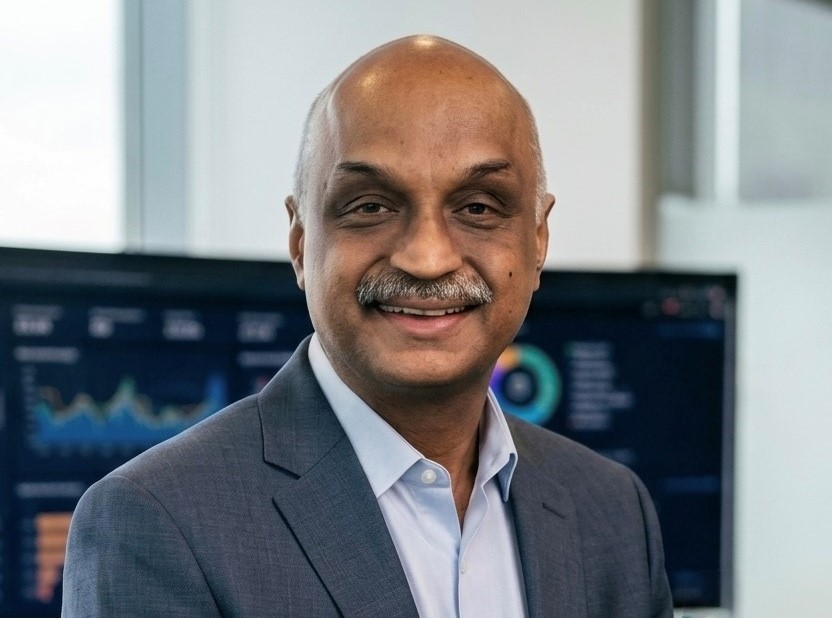

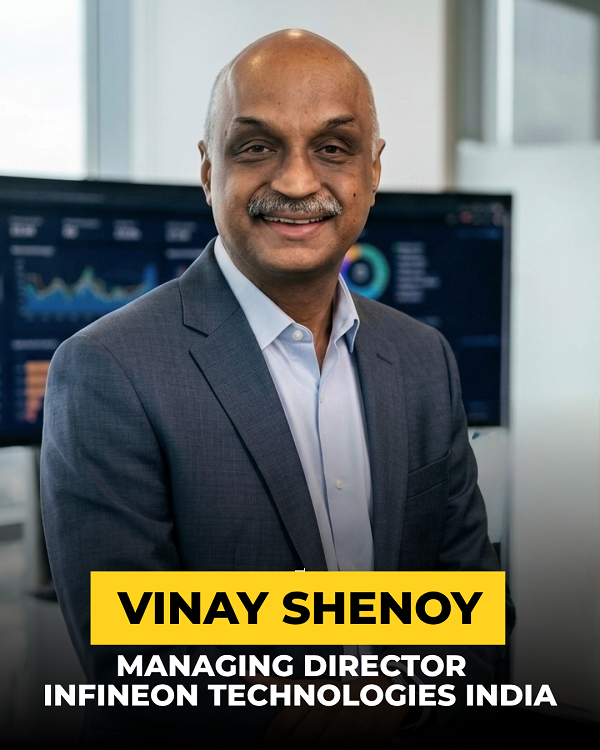
Vaishali, Editor at Semiconductor For You, speaks with Vinay Shenoy, Managing Director of Infineon Technologies India, on leadership, innovation and India’s semiconductor rise. Drawing on 35+ years across startups and multinationals, Vinay discusses the principles that guide him through disruptive cycles, Infineon India’s evolution into an R&D and innovation hub, the country’s strategic opportunities in power electronics and AI infrastructure, and the role of GCCs, academia and startups in building talent and global impact by 2030.
Q1. As a leader in the semiconductor industry, what leadership principles have guided you through periods of rapid technological change and market transformation?
The semiconductor industry has always been continuously disrupting. Over the past three and a half decades, I have witnessed multiple waves of transformation—from consumer electronics to personal computing to mobile communications, to the Internet of Things, and now to artificial intelligence.


A few principles have stayed constant for me across US multinationals, a Silicon Valley startup, European MNCs, and now Infineon India.

First Principle: Stay close to first principles, not the last winning playbook. Every downturn or disruption — and I’ve lived through several — punishes Leaders who optimise for the previous cycle. What worked in the PC era didn’t work in mobile; what worked in mobile doesn’t fully work in the AI/electrification era we’re in now.
Second Principle: Build teams that can disagree with you. The best calls I’ve been part of came from rooms where engineers and business leaders pushed back hard. Silence in a room is the most expensive thing in a rapidly changing industry.
Third Principle: Treat talent development as a business strategy, not an HR function. Having lived in the deep tech industry for 30+ years, I your real moat is the depth and judgment of your people, not any single product.
Last Principle: Be transparent in times of uncertainty. Semiconductor cycles are brutal and public — supply gluts, shortages, geopolitical shocks. Teams perform better when they’re told the truth about where the business stands, even when it’s uncomfortable.
Q2. How has your vision for Infineon India evolved over the years, and what role do you see the organisation playing in Infineon’s global growth story?
We started as a competence centre. Over the past decade, that has fundamentally shifted. Infineon India today is a genuine R&D and innovation hub contributing to global product roadmaps in automotive, IoT and more recently, power electronics.
The recent expansion makes that concrete. We’re building a new Bengaluru campus designed to house up to 4,500 employees by 2030, with 170,000 square feet of advanced lab space, which will open early next year. Alongside that, our new GCC in Ahmedabad’s GIFT City, which opened last year, is nearly 200-strong across chip design, software, IT, and supply chain — a deliberate bet on Gujarat’s emerging ecosystem.
My vision for Infineon is an integral role in Infineon’s global growth story with co-ownership of innovation.
India’s semiconductor ecosystem is at an inflection point. What are the most critical opportunities and challenges that industry leaders must address to ensure long-term success?
The shift the government itself has signalled with ISM 2.0 was a clear inflection point: a move from capacity creation to ecosystem depth. That’s the more important transition, and it’s where I’d focus industry leaders’ attention:
Opportunities
- India’s chip design talent has always been world-class; the Design Linked Incentive scheme has already helped seed over 20 design startups, and some are likely to see early successful exits as well! The opportunity is to convert design talent into IP ownership.
- The materials, equipment, and speciality chemicals supply chain is almost entirely import-dependent today. This is a massive opportunity for Indian companies willing to invest in a deep-tech manufacturing supply chain.
- A genuinely large domestic demand base — India’s semiconductor market is projected to roughly double to $100–110 billion by 2030 — gives India a demand-pull advantage most hubs in Asia don’t have.
Challenges
- Execution speed. There is a strong opportunity to accelerate execution, with clear potential to improve site readiness, power and water infrastructure, and regulatory coordination across centre and state.
- Depth versus breadth. We have a broad and promising project pipeline, with a high chance to convert selected initiatives into world-class, referenceable successes.
- Workforce specialisation. While general engineering talent is widely available, there is a significant opportunity to build specialized expertise in many areas across the semiconductor supply chain creating a strong competitive advantage as this talent base grows.
Q3. In your view, what distinguishes a successful Global Capability Centre today from a traditional engineering or support centre?
This is a distinction I think about constantly, because Infineon India itself made this transition over the last 5 years. A traditional support centre is measured by cost arbitrage and SLA adherence — how low-cost and reliable you can execute a roadmap. A successful Global Capability Centre is measured by its influence: how many global product, architecture, or strategy decisions actually originate there.
The markers I look for:
- Ownership of outcomes, not just tasks. Our Bangalore Centre owns chip design and product software workstreams end-to-end.
- Career paths that don’t require relocation to “prove yourself. If your best engineers still feel they need to move to headquarters to be taken seriously, you haven’t built a real capability centre yet.
- Innovation contribution that’s visible and attributable – product features, architecture decisions that can be traced back to the India team specifically.
The GCC model in India continues to mature — from cost centres to innovation centres. The next phase of that maturity, frankly, is India-based GCCs originating products for the world, not just adapting global products for India.
Q4. AI, electrification, and sustainability are reshaping industries worldwide. Which technology trends do you believe will create the biggest opportunities for India over the next decade?
If I had to rank where India has a genuine structural advantage rather than just participation:
- Power electronics for electrification: EVs, renewable energy infrastructure, grid modernisation — all of this runs on power semiconductors, and India sits at the intersection of massive domestic demand (EV adoption, solar/wind buildout, green hydrogen) and growing local manufacturing capability. This is, not coincidentally, Infineon’s core business.
- AI infrastructure power demand. Everyone talks about AI compute; far fewer talk about the fact that AI data centres are becoming power-constrained, not just compute-constrained. The semiconductors that manage power delivery, thermal efficiency, and grid interface for AI infrastructure are an enormous and underappreciated opportunity — and squarely within India’s growing strength in power semiconductor design.
- Automotive semiconductors, given India’s position as both a manufacturing base and a fast-growing EV and connected-vehicle market.
- Chip design and full-stack IP, riding the Government’s Design Linked Incentive (DLI) scheme and RISC-V momentum
The connecting thread across all of these is that India doesn’t need to win the “most advanced node” race to capture enormous value. Mature and speciality nodes — power, analogue, sensing — are where India’s near-term competitive advantage genuinely lies, and they happen to be exactly where electrification and AI infrastructure growth is concentrated.
Q5. Infineon has been actively engaging with startups, academia, and ecosystem partners. How important are such collaborations in driving innovation and nurturing future semiconductor talent?
Innovation in this industry, which spends about 15% of its sales on R&D, has never come from any single company working in isolation, and that’s truer in India than almost anywhere, because the talent pipeline itself depends on it.
We’ve made this a deliberate part of our India strategy — committing, alongside our Ahmedabad GCC launch, to developing the local innovation ecosystem of universities, startups, and SMEs. The logic is straightforward:
Academia is where the next decade’s engineers are being shaped right now. If our curriculum and lab partnerships lag the technology by five years, we will inherit that gap as a hiring problem later.
Startups move faster on narrow problems than large organisations can, and schemes like the DLI program — now supporting over 20 chip design startups with meaningful VC backing — are proof that India’s fabless ecosystem is becoming genuinely investable, not just government-subsidised.
Q6. Building high-performance teams is a key aspect of leadership. What qualities do you look for when developing the next generation of leaders within your organization?
After three and a half decades watching people rise — and stall — in this industry, the pattern is fairly consistent. The engineers and managers who become genuine leaders share a few traits, and technical brilliance alone is rarely the differentiator:
- Being comfortable with ambiguity. Semiconductor cycles don’t hand you clean problems. The leaders I bet on are the ones who can make good decisions with 70% of the information, not the ones who wait for 100%.
- Ownership beyond their function. The engineers who ask, “Is this good for the product?” instead of “Is this good for my deliverable?” are the ones I watch closely.
- The ability to develop other people. Individual brilliance has a ceiling, multiplying other people’s capability doesn’t. I look for this even in early-career engineers — do they make the people around them better?
- Resilience without defensiveness. This industry will hand you failures — a tape-out that doesn’t work, a customer escalation, a downturn. The leaders who last treat failure as data, not identity.
- Cross-cultural fluency. Given how global our teams are — Munich, Bengaluru, San Jose, Ahmedabad, our customers worldwide — leaders who can genuinely operate across cultural and organisational contexts, not just tolerate them, go much further.
Q7. Looking ahead, what is your vision for Infineon India by 2030, and what legacy would you like to create as a leader in India’s semiconductor journey?
By 2030, I would like Infineon India to be recognised as one of the company’s most influential global Competence & Leadership Hub, developing breakthrough technologies, shaping product strategies and producing global leaders who make an impact across the organisation.
Equally important, I hope we continue to contribute meaningfully to India’s semiconductor ecosystem by strengthening university partnerships, nurturing startups, supporting research and helping develop world-class talent.
On a personal level, legacy is not about the positions one has held. It is about the institutions one helps build and the people one develops. So, if I can look back knowing that I helped create an organisation where innovation thrives, leaders grow, and India became a stronger contributor to the global semiconductor industry, I would consider that my greatest achievement.