


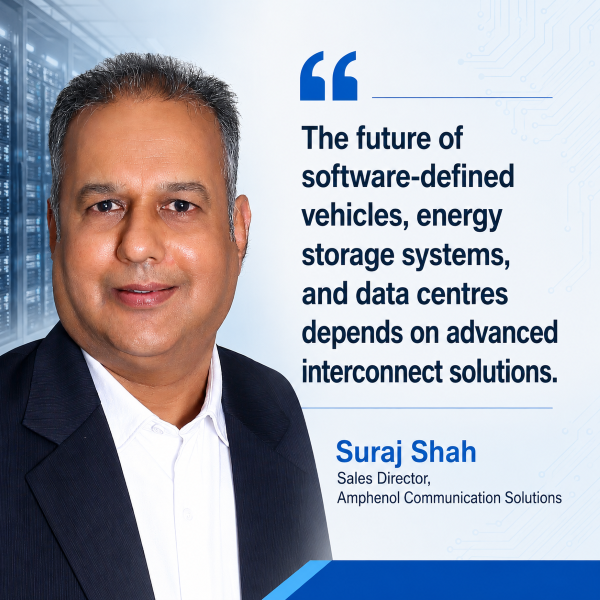
At electronica India 2025 in Greater Noida, Vaishali Umredkar, Editor of Semiconductor For You spoke with Suraj Shah, Sales Director, Amphenol Communication Solutions, about India’s growing opportunities in electric mobility, data centres, and industrial applications. He discussed the company’s localisation strategy, emerging market trends, and how advanced interconnect solutions are enabling the next generation of connected vehicles, energy storage systems, and digital infrastructure.
“Without connectivity, you cannot connect the ECUs together. The future of software-defined vehicles, energy storage systems, and data centres depends on advanced interconnect solutions.”
Amphenol has established a strong global presence. Could you tell us about the company’s operations in India?
Suraj Shah: Amphenol is a US-headquartered company founded in 1932 and has grown significantly through acquisitions over the years. Today, we serve multiple market segments including military and aerospace, IT and datacom, wireless, automotive, industrial, and consumer markets. In India, we started with a manufacturing facility focused on military applications and have grown exponentially since then. Our Cochin facility is a fully integrated manufacturing plant with stamping, moulding, plating, assembly, tooling and testing capabilities under one roof


Does the Cochin facility serve only the Indian market?
Suraj Shah: No. Cochin has become a major manufacturing hub for both domestic and international markets. Due to the China-plus-one strategy adopted by many global customers, exports from Cochin have increased significantly. At the same time, the facility supports India’s localisation requirements by manufacturing products specifically for local customers.
What market opportunities make India unique for your business?
Suraj Shah: Electric two-wheelers and three-wheelers are unique opportunities in India. We have developed specialised connector solutions for charging and discharging applications in these vehicles. The automotive industry is also expanding rapidly, with local OEMs increasing their market presence and seeking localised support. Additionally, the data centre market is emerging as a significant growth area.
What products are you showcasing at electronica India this year?
Suraj Shah: We are focusing on two key segments. The first is data centres, where we are displaying power distribution solutions, cable assemblies, board-level connectors and interconnect systems. The second is the automotive and EV segment, where we are showcasing connector solutions for battery-swapping, charging and vehicle connectivity applications.
What major trends are you seeing in the connector and interconnect industry?
Suraj Shah: In India’s EV market, connector standardisation has not yet happened. Different OEMs use different battery architectures—fixed, removable or swappable. Therefore, we have developed a broad portfolio of connector solutions to support all these requirements. Flexibility and adaptability are becoming increasingly important.
What differentiates your solutions in the data centre market?
Suraj Shah: The architecture of data centres has changed dramatically in recent years. Modern facilities are becoming more modular and require advanced AC and DC power distribution systems. This creates demand for board-level connectors, cable assemblies, busbar connection systems and other interconnect technologies. Many of these products are now being localised in India to support both domestic and global customers.
How important is localisation to your growth strategy?
Suraj Shah: Localisation is becoming increasingly important because customers want products manufactured closer to their operations. Government initiatives are also encouraging local production across industries. We are continuously expanding our local manufacturing capabilities to support both Indian and international markets.
Which sectors do you see driving future growth in India?
Suraj Shah: We see strong growth opportunities in three major segments. The first is industrial applications, particularly Battery Energy Storage Systems (BESS). The second is automotive, where software-defined vehicles, autonomous technologies, radar and lidar systems are increasing connectivity requirements. The third is data centres, which continue to expand due to growing digital infrastructure needs.
What are your expectations from electronica India?
Suraj Shah: We want visitors to experience our technologies firsthand. We are demonstrating real-world applications such as battery-swapping solutions, automotive connectivity technologies and a complete data centre rack. The objective is to help customers understand how these technologies work and how they can be applied in future products and platforms.