

What is a Thermoelectric Generator?
The term thermoelectric combines “thermal” (heat energy) and “electric” (electrical energy). A Thermoelectric Generator (TEG) is a device that converts a temperature difference between two points into electrical energy. These devices operate based on thermoelectric phenomena, which involve the interaction of heat flow and electric current through solid materials.
Construction of Thermoelectric Generator
Thermoelectric generators are solid-state heat-to-electricity devices consisting of two key junctions: p-type and n-type semiconductors. The p-type junction has a higher concentration of positively charged carriers (holes), while the n-type junction has a higher concentration of negatively charged carriers (electrons).
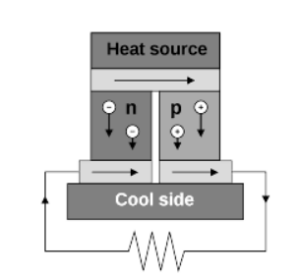


Thermoelectric Generator Working
P-type materials are doped to produce a positive Seebeck coefficient, whereas n-type materials are doped to produce a negative Seebeck coefficient. Common materials used in TEGs include lead telluride, bismuth telluride, tin telluride, indium arsenide, and germanium telluride.
Working of Thermoelectric Generator
When a temperature difference exists between the two junctions, charge carriers begin to move: positive carriers move toward the n-junction and negative carriers move toward the p-junction. This movement generates a potential difference (voltage), producing electrical power.
Lead telluride (PbTe) is the most commonly used material in thermoelectric generator design. The generated output is DC power, which can be converted into AC using inverters. Voltage levels can also be increased through transformers.
Working Principle – The Seebeck Effect
The working principle of a thermoelectric generator is based on the Seebeck Effect. When two dissimilar conductors or semiconductors are connected to form a loop, and their junctions are maintained at different temperatures, an electromotive force (emf) is generated. This emf drives current through the circuit.
Block Diagram Explanation
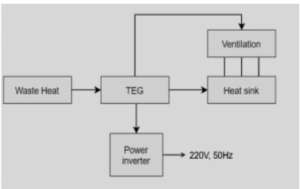

A typical TEG consists of:
- A heat source maintained at a high temperature.
- A heat sink maintained at a lower temperature.
The temperature difference between the source and sink drives the flow of current through the load. This is a direct energy conversion process, meaning no intermediate energy transformation occurs. The generated power is single-phase DC, represented as I²RL, where RL is the load resistance.
Improving Output Voltage and Power
There are two methods to increase output voltage and power:
- Increase the temperature difference (ΔT) between the hot and cold junctions.
- Connect multiple TEGs in series to raise the total voltage output.
Key Equations
The voltage generated by a thermoelectric generator is given by:
V = αΔT
Where:
- V = Generated voltage
- α = Seebeck coefficient
- ΔT = Temperature difference between junctions
The current through the circuit is:
I = V / (R + RL)
The power delivered to the load is:
Pload = (αΔT / (R + RL))² × RL
Maximum power occurs when R = RL:
Pmax = (αΔT)² / (4R)
Thermoelectric Generator Efficiency Equation
The efficiency of a TEG is the ratio of the electrical power output to the heat input:
Efficiency = (Generated Power at RL) / (Heat Flow Q)
Substituting values:
η = (αΔT / (R + RL))² × (RL / Q)
Types of Thermoelectric Generators
Based on the heat source, power capability, and application, TEGs are classified into three types:
1. Fossil Fuel Generators
These use heat sources such as kerosene, propane, natural gas, wood, or jet fuel. Output power ranges from 10 to 100 watts for commercial use. They are ideal for remote applications like navigation systems, communication networks, and cathodic protection for pipelines and marine systems.
2. Nuclear-Fueled Generators
These use radioactive isotopes as a long-lasting heat source. The high-temperature decay heat from isotopes powers the TEG, making it suitable for space missions and remote applications where maintenance is impossible.
3. Solar Source Generators
Solar thermoelectric generators use solar heat to generate electricity. They are used for small-scale irrigation pumps in remote areas and to power spacecraft in orbit.
Advantages of Thermoelectric Generators
- Highly reliable due to solid-state construction (no moving parts).
- Compatible with a wide range of heat sources.
- Scalable power output from milliwatts to kilowatts.
- Direct energy conversion with no mechanical components.
- Silent operation and compact size.
- Can operate under zero gravity or harsh environments.
Disadvantages of Thermoelectric Generators
- More expensive compared to conventional generators.
- Relatively low efficiency.
- Low thermal conductivity materials limit performance.
- Require high output resistance for better results.
Applications of Thermoelectric Generators
- Improving automobile fuel efficiency by converting waste heat into electrical energy.
- Powering spacecraft through Seebeck power generation systems.
- Providing energy to remote stations such as weather stations, relay towers, and communication hubs.