

Introduction
A capacitor motor is an improved form of a split-phase induction motor. When a capacitor is connected in series with the starting winding of the motor, the split-phase induction motor is referred to as a capacitor motor. The main advantage of capacitor motors over conventional split-phase motors is their higher starting torque and improved running performance.
What Is a Capacitor Motor?
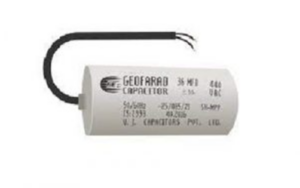

A capacitor motor is a type of single-phase AC induction motor that uses a capacitor to create a phase difference between motor windings. This phase difference produces a rotating magnetic field, which helps the motor start and run efficiently. The capacitor modifies the current flow in one or more windings, allowing the motor to develop sufficient starting torque.

Construction of Capacitor Motor
A single-phase capacitor motor consists of two windings:
- Main (running) winding
- Auxiliary (starting) winding
The main winding is connected directly to the power supply, while the auxiliary winding is connected through a capacitor.
Working Principle of Capacitor Motor
When the power supply is switched on, current flows through both windings. Due to the presence of the capacitor, the current in the auxiliary winding leads the current in the main winding. This phase difference between the two currents creates a rotating magnetic field, which produces starting torque and causes the motor to rotate. The capacitor stores electrical energy and releases it during operation. A capacitor with higher capacitance can store more energy, thereby improving motor performance. If the capacitor is damaged or has reduced capacitance, the motor may fail to start or run inefficiently.
Capacitor Motor Connection Diagram and Working
The circuit diagram of a single-phase capacitor start motor consists of a start capacitor, main winding, auxiliary winding, and a centrifugal switch. The power supply is connected across terminals L1 and L2. When the motor starts, the centrifugal switch remains closed, allowing current to flow through the start winding and capacitor. Once the motor reaches a sufficient speed, the centrifugal switch opens, disconnecting the start capacitor and auxiliary winding.
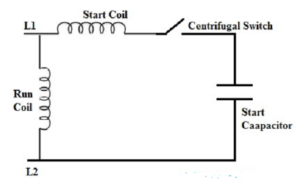

Single Phase Capacitor Start Motor Circuit
After this, the motor continues to run using only the main winding. When the power supply is turned off, the motor slows down, and the centrifugal switch returns to its normally closed position, preparing the motor for the next start.
Advantages of Capacitor Motor
- High starting and running torque
- Improved efficiency
- Better power factor when the capacitor remains connected
- High pull-out torque
- Long capacitor life, often up to 10 years
- Low cost compared to other energy storage devices
Disadvantages of Capacitor Motor
- Paper capacitors are costly and bulky
- Lower starting torque compared to capacitor-start capacitor-run motors
Applications of Capacitor Motors
- Water pumps and compressors
- Refrigerators and freezers
- Fans and blowers
- Oxygen concentrators
- Conveyors and machine tools
- Forced-air furnaces
- Motorized gates
- Hot tubs and jacuzzi pumps
- Air-conditioning compressor systems
Conclusion
Capacitor motors are widely used single-phase induction motors known for their high starting torque, efficiency, and reliability. Their simple construction and wide range of applications make them ideal for domestic, commercial, and industrial uses.