

Introduction
A Manual Transfer Switch (MTS) is an electrical switching device that allows users to safely transfer electrical loads between two power sources, such as the utility mains and a backup generator. It requires manual operation and is commonly used in residential, commercial, and small industrial applications where automatic switching is not essential. A transfer switch is used to safely switch an electrical load between two different power sources. Depending on its operation, a transfer switch can be classified as either a Manual Transfer Switch (MTS) or an Automatic Transfer Switch (ATS).
An Automatic Transfer Switch (ATS) automatically transfers the electrical load to a backup power source during a power outage. In contrast, a Manual Transfer Switch (MTS) requires an operator to manually switch the load from the main power supply to a generator. A manual transfer switch is generally suitable for homes, small offices, and small commercial buildings, whereas an automatic transfer switch is preferred for hospitals, data centers, industries, and other facilities where uninterrupted power is critical.


What is a Manual Transfer Switch?
A Manual Transfer Switch (MTS) is an electrical switch that manually transfers power from the main utility supply to a backup generator during a power failure. To restore power, the operator must start the generator and move the switch handle or lever from the utility position to the generator position. This ensures that only one power source supplies electricity to the load at any given time, preventing back-feeding and improving electrical safety.

Working Principle of a Manual Transfer Switch
The working principle of a manual transfer switch is simple. Under normal conditions, electrical power is supplied by the utility mains. When a power outage occurs, the operator manually starts the backup generator and changes the switch position to transfer the electrical load to the generator.
Once the utility power is restored, the operator moves the switch back to the main supply and shuts down the generator. Manual transfer switches can be installed indoors or outdoors depending on the application and environmental conditions.
Manual Transfer Switch Circuit Diagram
A manual transfer switch electrically isolates one power source before connecting the other. This prevents both power sources from being connected simultaneously.
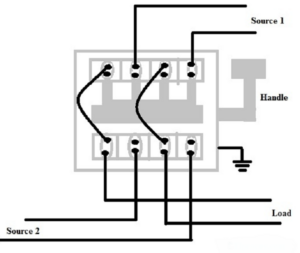

Manual Transfer Switch Circuit Diagram
In a typical manual transfer switch:
- The switch contains eight terminals—four arranged vertically and four horizontally.
- The terminals are internally connected using movable metallic contacts.
- The switch includes an earthing (grounding) terminal for electrical safety.
- One input is connected to the utility power supply.
- The second input is connected to the generator.
- The output terminals are connected to the building’s electrical load.
The switch has three operating positions:
- Source 1 – Utility (Main Supply)
- OFF – Load disconnected from both power sources
- Source 2 – Generator (Backup Supply)
Changing the switch handle disconnects the load from one source before connecting it to the other, ensuring safe operation.
Advantages of a Manual Transfer Switch
- Simple and economical design.
- Lower installation cost compared to automatic transfer switches.
- Compact size.
- No control wiring is required.
- High short-circuit withstand capability.
- Quick make-and-break switching mechanism.
- Robust and durable construction.
- Suitable for operation in harsh environmental conditions.
- Easy to install and maintain.
Disadvantages of a Manual Transfer Switch
- Requires manual operation during every power outage.
- The generator must be started manually.
- Power restoration takes longer than with an automatic transfer switch.
- Not suitable for applications requiring uninterrupted power.
- Requires the presence of an operator during emergencies.
Applications of a Manual Transfer Switch
- Residential homes.
- Small commercial buildings.
- Retail shops.
- Workshops.
- Agricultural facilities.
- Construction sites.
- Manufacturing units.
- Automotive workshops.
- Emergency backup power systems.
- Temporary power installations.
Manual transfer switches are widely used wherever backup power is required but fully automatic switching is not necessary.
Manual Transfer Switch vs Automatic Transfer Switch
| Feature | Manual Transfer Switch (MTS) | Automatic Transfer Switch (ATS) |
|---|---|---|
| Operation | Manual | Automatic |
| Power Restoration | Requires an operator | Automatic |
| Installation Cost | Low | High |
| Generator Start | Manual | Automatic |
| Response Time | Slower | Very fast |
| Best For | Homes and small businesses | Hospitals, industries, and data centers |
Conclusion
A Manual Transfer Switch is a reliable and cost-effective solution for transferring electrical loads between the utility supply and a backup generator. Although it requires manual operation, it provides a safe method of switching power sources while preventing back-feeding. Due to its simple design, low cost, and dependable operation, it is widely used in residential, commercial, and small industrial backup power systems.