

Introduction
In compact electronics and embedded systems, controlling power or toggling between circuit modes within limited board space is a common design requirement. A slide switch is a mechanical switch that uses a linear sliding actuator to bridge or disconnect electrical contacts, regulating current flow within a circuit.
What is a Slide Switch?
A slide switch is a manually operated, maintained-contact switch that changes states when its knob or handle is pushed horizontally along a slide path. Unlike momentary switches that return to their original state when released, a slide switch remains securely in its selected ON, OFF, or multi-position state until manually moved again.


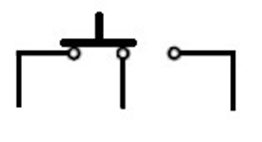


Because of their compact surface-mount (SMD) and through-hole (THT) form factors, slide switches are widely integrated into PCB power circuits, battery-operated consumer gadgets, network devices, and test equipment.
Slide Switch Pin Configuration (SPDT)
The most common slide switch configuration is a Single Pole Double Throw (SPDT) arrangement featuring three terminal pins:
- Pin 1 (Output A): The first selectable output terminal connected to Load 1 or Signal Path A.
- Pin 2 (Common / COM): The central input terminal where the incoming power source or logic signal is connected.
- Pin 3 (Output B): The second selectable output terminal connected to Load 2 or Signal Path B (or left unconnected for a simple ON/OFF setup).
Internal Construction and Key Components
A slide switch consists of precision miniature parts that ensure consistent contact pressure and tactile position detents:
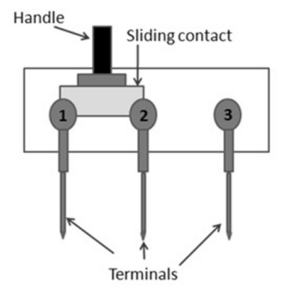

- Slide Handle (Actuator Bar): The external raised or flat knob pushed by the user to select the switch state.
- Sliding Contact Arm: A movable conductive leaf made of phosphor bronze or silver-plated alloy that slides across fixed base contacts.
- Internal Spring & Seesaw/Detent Mechanism: A spring-loaded mechanism that creates a tactile “click” at each position and maintains constant pressure between contacts.
- Stationary Terminal Pins: Silver- or gold-plated brass pins mounted into the insulating base to connect directly to PCBs or wiring harnesses.
- Protective Frame / Case: A metal or high-temperature plastic outer shell protecting internal contacts against dust and mechanical stress.
Standard Technical Specifications
| Parameter | Typical Specification Range |
|---|---|
| Max Operating Voltage | 12V to 24V DC (Logic/Low-voltage circuits) |
| Contact Current Rating | 200 mA at 12V DC / up to 500 mA max |
| Contact Resistance | < 50 mΩ |
| Insulation Resistance | > 100 MΩ at 500V DC |
| Dielectric Strength | 500V AC (50 Hz) for 1 minute |
| Operating Temperature | -10°C to +60°C |
| Mechanical Lifespan | 5,000 to 10,000 switching operations (Min) |
Working Principle of a Slide Switch
The operating mechanism of a slide switch relies on linear mechanical displacement to change circuit paths:
- Position 1 (COM to Output A): When the slider handle is pushed toward Pin 1, the internal sliding contact bridges COM (Pin 2) and Pin 1. Current flows through Output A, while Pin 3 remains electrically isolated.
- Position 2 (COM to Output B): Shifting the handle toward Pin 3 slides the conductive arm across the base plate to bridge COM (Pin 2) and Pin 3. Power shifts to Output B, breaking the connection to Pin 1.
- Maintained Contact: Internal detent notches hold the slider firmly in place, preventing unwanted toggling due to light vibrations or movement.
Comparison of Compact Circuit Switches
| Switch Type | Actuation Style | Tactile Indication | Primary Use Case |
|---|---|---|---|
| Slide Switch | Horizontal linear slide | Visual slider position + light detent | PCB main power control, mode selection |
| DIP Switch | Array of tiny levers/sliders | Binary ON/OFF state per pin | Hardware configuration, address setting |
| Toggle Switch | Vertical lever flip | Strong mechanical snap & click | Panel control, high-current heavy machinery |
Advantages and Disadvantages
Advantages:
- Extremely Compact Footprint: Ideal for ultra-thin consumer gadgets and high-density PCB layouts.
- Clear Visual Status: The physical position of the slider knob instantly reveals whether the switch is ON or OFF without needing power.
- Low Energy Consumption: Operates purely as a mechanical bridge, consuming zero quiescent standby power.
- Cost-Effective: Inexpensive to manufacture and easy to assemble via automated surface-mount (SMT) pick-and-place lines.
Disadvantages:
- Mechanical Wear: Repeated sliding friction can cause contact degradation or loose detents over thousands of cycles.
- Dust Ingress: Open slider slots can accumulate dust or moisture over time if unsealed.
- Low Current Capacity: Limited primarily to signal switching and low-power DC applications (< 500 mA).
Applications of Slide Switches
Slide switches are widely deployed in consumer, industrial, and networking equipment:
- Consumer Electronics: Power switches on Wireless earbuds cases, TV remote controls, Bluetooth speakers, and smartphones.
- Networking Equipment: Hard reset switches and mode selectors on Wi-Fi routers, modems, and network switches.
- Power Tools & Hardware: Speed setting and power locks on orbital sanders, handheld drills, and rotary tools.
- Test & Measurement Rigs: Input voltage range switches (e.g., 110V/220V power supply selectors) and multimeter function modes.
- Smart Home Devices: Wall thermostat controls, sensor configuration panels, and smart lighting hubs.