

Introduction
An electric generator is a device that converts mechanical energy into electrical energy through the principle of electromagnetic induction. Generators play a crucial role in producing electricity for residential, commercial, industrial, and transportation applications. They are widely used in power plants, backup power systems, automobiles, ships, and various industrial facilities.
Electric generators were developed before the complete relationship between electricity and magnetism was fully understood. Early generators operated using electrostatic principles, employing moving belts, plates, and discs that transported electrical charges to high-potential electrodes. Electrostatic generators produce electrical charge through two primary methods:


- Triboelectric Effect
- Electrostatic Induction
Due to the complexity and inefficiency of insulation systems, electrostatic generators produce very high voltages but relatively low currents. Because of their low power output, they are generally not used for large-scale power generation. However, they are still used in specialized applications such as X-ray machines and particle accelerators.

What is an Electric Generator?
An electric generator, also known as a dynamo, is a machine that converts mechanical energy into electrical energy. The electricity generated is transmitted through power distribution networks for residential, commercial, and industrial applications.
Electric generators are used in power stations, ships, automobiles, trucks, and various industrial systems. The mechanical energy required to operate a generator is supplied through a rotating shaft. The output mechanical power is equal to the shaft torque multiplied by its rotational speed. Mechanical energy can be obtained from various sources, including:
- Steam turbines
- Gas turbines
- Wind turbines
- Hydraulic turbines
- Diesel engines
- Gasoline engines
- Nuclear power plants
The design and operating speed of the generator depend on the characteristics of the prime mover. Electric generators operate based on Faraday’s Law of Electromagnetic Induction, which states that whenever a conductor experiences a changing magnetic field, an electromotive force (EMF) is induced in the conductor.
According to Faraday’s law, the magnitude of the induced EMF is directly proportional to the rate of change of magnetic flux linkage. The two essential requirements for electricity generation are:
- A magnetic field
- Relative motion between the conductor and the magnetic field
Construction of Electric Generator
An electric generator consists of several important components that work together to convert mechanical energy into electrical energy efficiently.
Alternator
The alternator is the primary component responsible for generating electrical energy. It contains stationary and rotating components that interact to create magnetic fields and induce electrical current.
Fuel System
The fuel system supplies the energy required to operate the generator engine. It typically consists of:
- Fuel tank
- Fuel pump
- Fuel injector
- Fuel filter
- Fuel supply and return pipes
The fuel filter removes contaminants before the fuel enters the combustion chamber.
Engine
The engine provides the mechanical power required to rotate the generator shaft. The power rating of the engine determines the electrical output capacity of the generator.
Voltage Regulator
The voltage regulator controls the output voltage of the generator and ensures a stable voltage supply. In certain applications, it can also regulate AC-to-DC conversion processes.
Cooling and Exhaust System
Generators produce significant heat during operation. Therefore, cooling systems are used to maintain safe operating temperatures, while exhaust systems remove combustion gases and fumes.
Lubrication System
Generators contain several moving components that require continuous lubrication. Engine oil reduces friction, minimizes wear, and ensures smooth operation. The lubrication level should be checked regularly, typically after every eight hours of operation.
Battery Charger
The battery charger continuously supplies a low-level charging voltage to maintain the generator battery in a ready-to-use condition.
Control Panel
The control panel manages all generator operations, including startup, monitoring, protection, and shutdown functions. Modern generators often feature automatic start and stop capabilities.
Frame or Main Assembly
The frame forms the outer structure of the generator and supports all internal components while providing mechanical strength and protection.
Working Principle of Electric Generator
The working principle of an electric generator is based on electromagnetic induction. Generators contain coils of tightly wound electrical conductors, usually copper wire, which rotate inside a strong magnetic field. When a conductor moves through a magnetic field, the magnetic flux interacts with the electrons in the conductor, causing an electric current to flow.
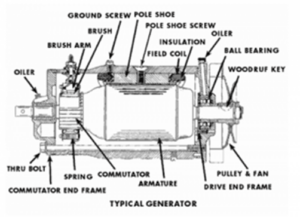

Electric Generator
The conductor coil is connected to a mechanical power source through a rotating shaft, allowing it to rotate at high speed within the magnetic field. The rotating conductor and its iron core are collectively known as the armature. Initially, a weak magnetic field exists in the field poles. As the armature rotates, voltage begins to develop in the conductors. A portion of the generated voltage is supplied to the field windings through the voltage regulator, which strengthens the magnetic field.
The stronger magnetic field induces a larger voltage in the armature, further increasing the field current and magnetic strength. This process continues until the generator reaches its operating voltage. The direction of current flow in the field windings determines the polarity of the magnetic poles. Incorrect polarity can result in improper current flow and reduced generator performance.
Advantages of Electric Generators
- Provides a reliable source of electrical power.
- Can generate electricity using various energy sources.
- Suitable for backup and emergency power applications.
- Available in a wide range of power capacities.
- Offers efficient energy conversion.
- Can be used in remote locations.
- Supports industrial, commercial, and residential applications.
Disadvantages of Electric Generators
- Requires regular maintenance.
- Produces noise during operation.
- Fuel-powered generators emit pollutants.
- Installation and operating costs can be high.
- Mechanical components experience wear over time.
Applications of Electric Generators
- Electric power generation stations.
- Residential backup power systems.
- Commercial and industrial facilities.
- Transportation systems.
- Ships and marine applications.
- Construction sites.
- Laboratories and research facilities.
- Electric motor drive systems.
- Emergency power supply systems.
- Portable power generation units.
Conclusion
An electric generator is one of the most important electrical machines used for converting mechanical energy into electrical energy. Operating on the principle of electromagnetic induction, generators provide reliable power for a wide range of applications, including power plants, transportation systems, industries, homes, and laboratories. With advancements in technology and energy-efficient fuel sources, electric generators continue to play a vital role in modern power generation systems.