

GSM Frame Structure – The Basics
The GSM frame is the most fundamental unit in the GSM time-division multiple access (TDMA) system. Each GSM frame consists of eight time slots, and each slot is assigned to a different user. Transmission and reception slots are time-shifted so that a mobile device does not transmit and receive simultaneously.
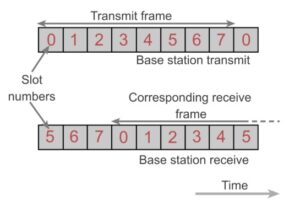

The basic unit of time in GSM is a burst period, which lasts approximately 0.577 ms. Eight burst periods together form a TDMA frame, which lasts about 4.615 ms. Each TDMA frame corresponds to one physical channel and forms the basis for all GSM signalling and communication. In GSM, two main types of channels are transmitted:

- Traffic Channels (TCH) – Used for voice and data transmission
- Control Channels (CCH) – Used for signalling and system control
Accordingly, the GSM frame structure is divided into traffic frames and control frames.
GSM Multi frame
Multiple GSM frames are grouped together to form a multi frame, which helps in scheduling and synchronization within the network.
Types of Multi frame

1. Traffic Multi frame
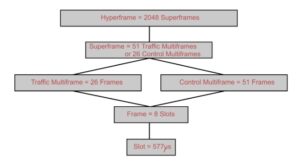
A traffic multi frame consists of 26 TDMA frames and has a duration of 120 ms.
- 24 frames are used for traffic (voice/data)
- 1 frame is used for SACCH (Slow Associated Control Channel)
- 1 frame remains idle
The SACCH frame position alternates between frame numbers 12 and 25.
2. Control Multi frame
A control multi frame consists of 51 TDMA frames and lasts approximately 235.4 ms. It is typically transmitted on the beacon frequency in time slot 0, but can also appear in other slots such as 2, 4, and 6. Control multi frame supports several logical channels, including:
- Frequency Correction Channel (FCCH)
- Synchronization Channel (SCH)
- Broadcast Control Channel (BCCH)
- Paging and Access Grant Channel (PAGCH)
- Standalone Dedicated Control Channel (SDCCH)
GSM Super frame
Multi frames are grouped into a super frame, which lasts approximately 6.12 seconds. A super frame consists of:
- 51 traffic multi frames
- 26 control multi frames
The different lengths of traffic (26 frames) and control (51 frames) multi frames align again within the super frame interval, ensuring synchronization.
GSM Hyper frame
A hyper frame is the largest time structure in GSM. It consists of 2048 super frames and repeats every 3 hours, 28 minutes, and 53.76 seconds. Each time slot in the hyper frame is assigned a unique sequence number, which helps maintain synchronization across the network.
Functions of Hyper frame
- Frequency Hopping: Allows the system to change frequencies to reduce interference and fading. This requires precise synchronization between transmitter and receiver.
- Encryption: Security processes are synchronized using the hyper frame counter. Encryption patterns repeat every hyper frame cycle.
Power Control in GSM
Power control is essential in GSM systems to improve performance and reduce interference. The base station continuously adjusts the transmission power of mobile devices.
- Reduces battery consumption
- Minimizes interference with nearby users
- Ensures better signal quality for distant users
GSM defines different power classes for mobile devices to standardize transmission levels.
Conclusion
The GSM frame structure is a hierarchical system consisting of frames, multi frames, super frames, and hyper frames. This structured approach ensures efficient communication, synchronization, and resource management in 2G GSM networks.