Semiconductor for You
  • Home
  • Semiconductor News
  • Semiconductor Magazine
  • Technology
    • Automotive
    • Consumer Electronics
    • IoT
    • Test and Measurement
    • Lighting
    • Power Management
    • Wireless
    • Personal Electronics
    • Hardware & Software
    • Research
    • Medical Electronics
    • Embedded Design
    • Aerospace & Defence
    • Artificial Intelligence
  • Interview
  • Industries
  • Market
  • Knowledge Base
  • Events
  • Tools
    • Resistor Color Code Calculator
No Result
View All Result
  • Home
  • Semiconductor News
  • Semiconductor Magazine
  • Technology
    • Automotive
    • Consumer Electronics
    • IoT
    • Test and Measurement
    • Lighting
    • Power Management
    • Wireless
    • Personal Electronics
    • Hardware & Software
    • Research
    • Medical Electronics
    • Embedded Design
    • Aerospace & Defence
    • Artificial Intelligence
  • Interview
  • Industries
  • Market
  • Knowledge Base
  • Events
  • Tools
    • Resistor Color Code Calculator
No Result
View All Result
Semiconductor for You
No Result
View All Result
Home Knowledge Base

Split Phase Induction Motor: Construction, Working, Theory, Advantages & Applications

Komal Ganvir by Komal Ganvir
March 27, 2026
in Knowledge Base
0
ADVERTISEMENT

What is a Split Phase Induction Motor?

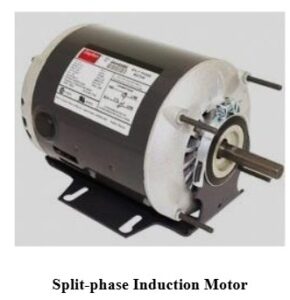
A Split Phase Induction Motor is a type of single-phase induction motor that uses two windings to produce a rotating magnetic field for self-starting. It is also known as a resistance start motor. The motor consists of a stator and a squirrel-cage rotor. The stator contains two windings:

  • Main Winding
  • Auxiliary (Starting) Winding

ADVERTISEMENT

These windings are placed 90° apart in space. Based on design, split-phase motors are classified into:

  • Resistance split-phase motor
  • Capacitor start motor
  • Capacitor run motor
  • Permanent capacitor motor

Basic Principle

A single-phase supply produces a pulsating magnetic field, which is not sufficient to start the motor. To overcome this, phase splitting is used to create an approximate rotating magnetic field, allowing the motor to start like a two-phase motor.

Theory of Split Phase Induction Motor

The motor consists of:

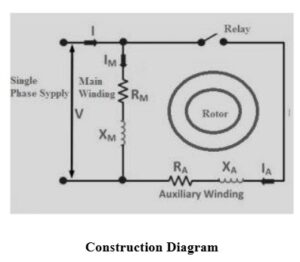
  • Main winding resistance (Rm) and reactance (Xm)
  • Auxiliary winding resistance (Ra) and reactance (Xa)
  • A centrifugal switch or relay (S)

The main winding has low resistance and high inductive reactance, while the auxiliary winding has high resistance and low reactance. This difference causes a phase shift between the currents in the two windings. Both windings are connected in parallel at the time of starting. The auxiliary winding helps in producing the starting torque.

Working of Split Phase Induction Motor

When the motor is switched ON, current flows through both the main and auxiliary windings. Due to the difference in their electrical characteristics, the currents are out of phase, creating a rotating magnetic field. When the motor reaches about 70–80% of its synchronous speed, the auxiliary winding is disconnected automatically:

  • For higher power motors: a centrifugal switch is used
  • For lower power motors: a relay is used

After disconnection, the motor continues to run only on the main winding.

Phasor Explanation

The current in the main winding (IM) lags the supply voltage by nearly 90°, while the current in the auxiliary winding (IA) is nearly in phase with the voltage. The phase difference between these currents is approximately 30°, which is sufficient to create a rotating magnetic field and start the motor.

Advantages

  • Simple construction and low cost
  • Easy to install and maintain
  • Available in various sizes for different applications

Disadvantages

  • Low starting torque
  • Lower efficiency compared to three-phase motors
  • Limited power output (generally below 1 kW)
  • Not suitable for heavy-load applications

Applications

  • Fans and blowers
  • Washing machines
  • Drilling machines
  • Lathe machines
  • Grinding machines
  • Centrifugal pumps
  • Floor polishers
  • Mixer grinders
  • Conveyors (light-duty)

These motors are mainly used where moderate starting torque is sufficient and where a three-phase supply is not available.

Tags: Split Phase Induction Motor
Komal Ganvir

Komal Ganvir

Browse by Category

  • Aerospace and Defence
  • AI & Data Center
  • Articles
  • Automation
  • Automotive
  • Communication
  • Consumer-Electronics
  • Design & Manufacturing
  • Hardware & Software
  • Industrial Electronics
  • Interview
  • IoT
  • Knowledge Base
  • Lighting
  • Market
  • personal-electronics
  • Power Management
  • Research
  • Semiconductor Events
  • Semiconductor News
  • Sensors
  • Technology
  • Test and Measurement
  • Uncategorized
  • Wireless
Semiconductor For You

Semiconductor For You is a resource hub for electronics engineers and industrialist. With its blend of
technology features, news and new product information, Semiconductor For You keeps designers and
managers up to date with the fastest moving industry in the world.

Follow Us

Browse by Category

  • Aerospace and Defence
  • AI & Data Center
  • Articles
  • Automation
  • Automotive
  • Communication
  • Consumer-Electronics
  • Design & Manufacturing
  • Hardware & Software
  • Industrial Electronics
  • Interview
  • IoT
  • Knowledge Base
  • Lighting
  • Market
  • personal-electronics
  • Power Management
  • Research
  • Semiconductor Events
  • Semiconductor News
  • Sensors
  • Technology
  • Test and Measurement
  • Uncategorized
  • Wireless

Recent News

Infineon introduces RIC70115 radiation-hardened GaN HEMT driver for satellite and high-reliability space applications

Infineon introduces RIC70115 radiation-hardened GaN HEMT driver for satellite and high-reliability space applications

July 16, 2026
Cabinet Approves Semicon 2.0 with ₹1.27 Lakh Crore Outlay to Power India’s Semiconductor Future

Cabinet Approves Semicon 2.0 with ₹1.27 Lakh Crore Outlay to Power India’s Semiconductor Future

July 15, 2026
  • About
  • Advertise
  • Privacy & Policy
  • Contact

© 2026 Semiconductor For You

No Result
View All Result
  • Home
  • Semiconductor News
  • Technology
    • IoT
    • Wireless
    • Power Management
    • Automotive
    • Hardware & Software
  • Market
  • Interview
  • Knowledge Base
  • Tools
    • Resistor Color Code Calculator

© 2026 Semiconductor For You

Advertisement