

Agentic systems combine multiple CPU roles into a workflow. The latest AMD EPYC CPU generation lets customers optimize for each task – with flexibility for the future.

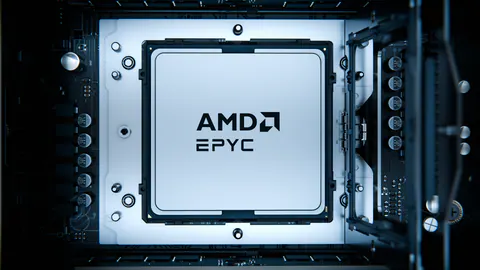
Two years ago, planning AI infrastructure largely meant sizing for training. Then inference took the lead in shaping requirements. Now agents turn a single request into a shifting chain of retrieval, tool calls, code execution and results, arguably creating a shape-shifting workflow that changes how much compute the AI task requires, and where that compute is needed with every execution.
Infrastructure built around a single point in time risks being the wrong shape for what’s next. Flexibility is no longer a feature. It is a requirement at every layer of the stack, including the CPUs supporting the agentic pipeline.


Enterprises already understand this. Databases, virtualization, analytics, web services, technical computing and AI have long required different system profiles. Agentic AI brings more of those profiles into one workflow.

In response to this, a new AMD white paper evaluates 6th Gen AMD EPYC™ 9006 “Venice” server CPUs across general-purpose, enterprise, cloud-native, AI and high-performance computing workloads rather than relying on a selected few.
In SPECrate® 2026 Integer testing, the AMD EPYC™ 9996 server CPU delivers 1.2 times the per-core performance of an Nvidia Vera-based platform1 and 2.24 times its platform-level performance.2 Across enterprise and cloud-native testing – including server-side Java, OpenSSL, MongoDB, Redis, NGINX and transaction processing – AMD testing reports gains of 2.4x to 3.7x.3
Against the Intel® Xeon® 6980P processor, the AMD EPYC 9996 server CPU delivers 1.8x to 3.13x performance advantages across molecular dynamics, materials modeling and weather forecasting.4 In a modeled 100-kilowatt rack, it delivers an estimated 3.4 times the throughput of a Vera-based platform.5
Strong loaded per-core performance can accelerate latency-sensitive work, while core density can support concurrency and improve rack-level throughput. A processor portfolio lets customers optimize for both without imposing the same compromise across the entire fleet.
“Venice” is one part of a portfolio designed around that principle: four families running on a common software foundation, spanning 8-core edge deployments, 256-core flagship processors and rack-scale AI host nodes. Each role in an agentic pipeline can use the processor profile that fits it without creating a separate operating environment.
“Venice” is in production today. Major OEM platforms are on track to launch, and leading cloud providers will begin deploying them later this year.
Agentic AI will keep adding diversity. The answer to a more varied workload has never been less choice.
More:
- Read the white paper, “AMD EPYC Server CPU Architecture and Performance Overview,” for architectural details, benchmark methodology and the complete workload set.
- Read “Building Infrastructure for an AI World in Motion” by Forrest Norrod, executive vice president and general manager of the Data Center Solutions Business Group at AMD.