


Introduction to Communication
Communication is the process of sharing information from one place or person to another with the help of a suitable medium. In everyday life, humans communicate using sound waves that travel through the air.
Long-Distance Communication
In long-distance communication, wireless or mobile communication systems are commonly used. In such systems, information is transmitted through electromagnetic (EM) waves.


What is an Antenna?
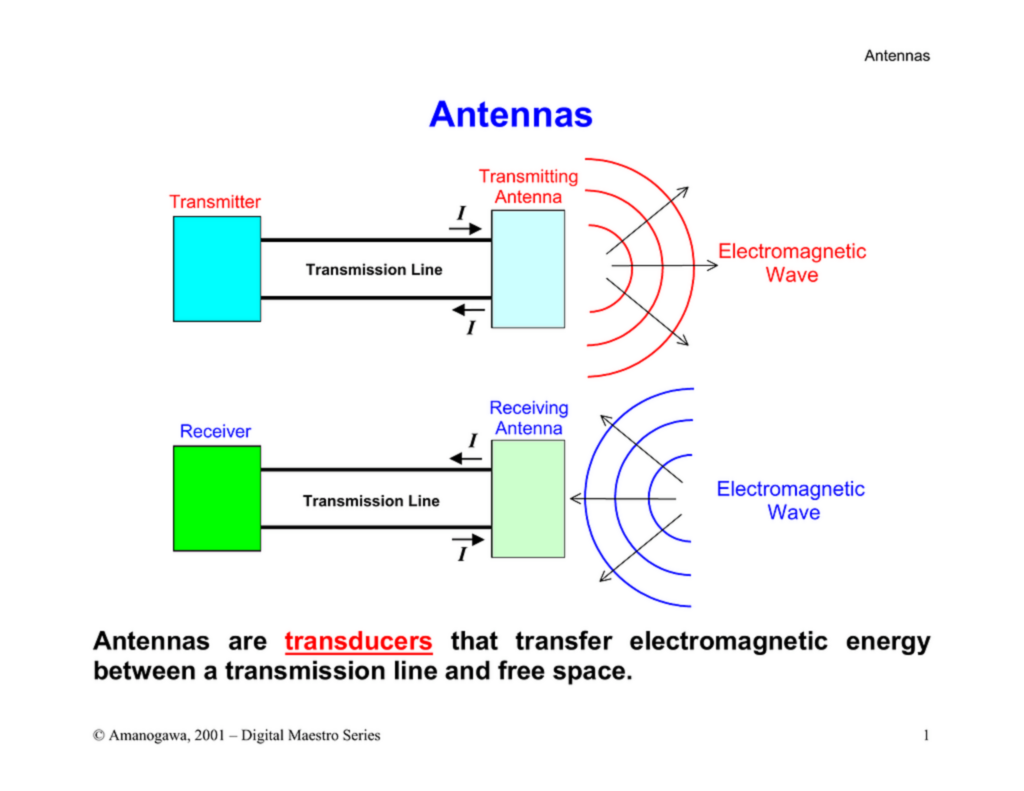
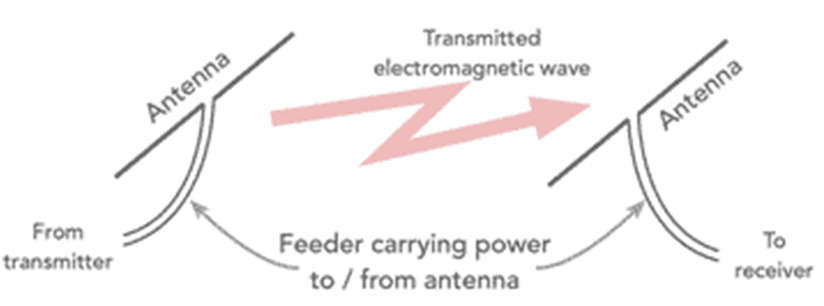
An antenna is a device that converts electrical signals into electromagnetic waves and transmits them through space. It enables wireless communication by transmitting information over long distances without the use of physical wires. An antenna also receives electromagnetic waves and converts them back into electrical signals.

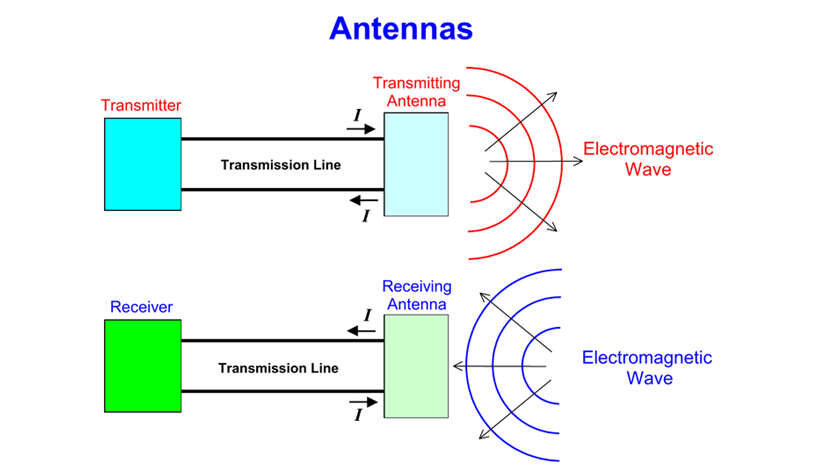

Antennas are transducers that transfer electromagnetic energy between a transmission line and free space.
Working of Antenna
- The information here is converted into electrical signals.
- These electrical signals can be transmitted wirelessly when a transmitter converts the signals into electromagnetic signals.
- The power applied to the antenna is in the form of radio frequency.
There are two antennas:
1. Transmitter Antenna:
- It converts electrical signals into electromagnetic waves and transmits them.
The transmission antenna is the basic source of radiofrequency (RF) radiation and the basic element of radio technology. - This type of antenna is composed of a conductor that carries an electric current whose intensity fluctuates over time and converts it into radiofrequency radiation that propagates in space.
2. Receiver Antenna:
- it receives the information in the form of electromagnetic waves which was transmitted by the transmitter and converts these waves back into electrical form.
- Receiving antenna is a device for the reception of radiofrequency (RF).
- It performs the reverse of the process performed by the transmission antenna. It receives radiofrequency radiation and converts it into electric currents in an electric circuit connected to the antenna.

Characteristics of Antenna
1. Radiation Pattern
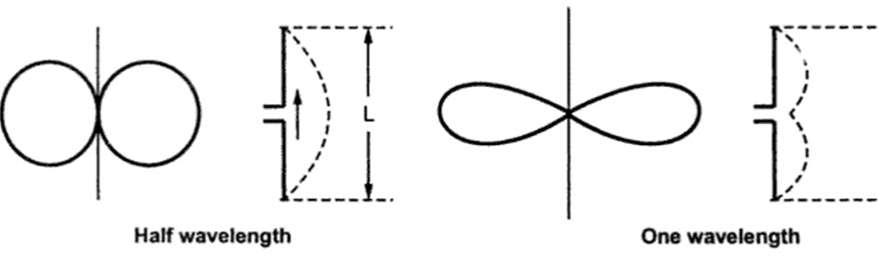
- A practical antenna cannot radiate energy in all directions with equal strength.
- Radiation from an antenna is usually found to be maximum in one direction whereas it is minimum or almost zero in other directions.
- Field Strength is the quantity that is used to represent the radiation pattern of an antenna. It is usually measured at a point located at a particular distance from the antenna.

2. Directivity
- Antennas can be designed to radiate energy equally in all directions or primarily along a single direction.
- Directivity D is a unitless measure of the uniformity of the radiation pattern plot.
- It is defined as the ratio of the maximum power density over the average power density.
- An antenna that radiates equally in all directions is called isotropic. An antenna that radiates equally in two, but not the third, directions are called omnidirectional direction.
- Isotropic antennas have
D=1
All other antennas have
D>1.
3. Polarization
- The direction of the electric field radiating from the antenna in areas sufficiently distant from the antenna (a distance of several wavelengths).
- A radio wave may be non-polarized or polarized (linear or circular/elliptical polarization).
4. Efficiency
- The ratio between the total power radiated by the antenna and the net electric power fed to the antenna.
- An ideal antenna has 100% antenna efficiency i.e., it transmits all the power fed to it. But in the real world, a good antenna radiates only 50 to 60% of the power supplied to it.


5. Bandwidth
- The width of a range of frequencies at which the antenna transmits its maximal radiation and intensity.
6. Antenna Array
- A systematic deployment of antennas that operate together. The individual antennas in an array are usually of the same type and are situated nearby and at a fixed distance from one another.
- An antenna array enables increasing the directionality and control of the main radiation beams and the lateral beams.
Applications of Antennas
- Mobile communication systems
- Radio broadcasting
- Television transmission
- Satellite communication
- Radar systems
- Wi-Fi and wireless networking
- GPS systems
- Military communication systems
Advantages of Antennas
- Enable wireless communication
- Support long-distance transmission
- Reduce the need for physical cables
- Provide high-speed communication
- Improve communication flexibility
Conclusion
Antennas are essential components of modern wireless communication systems. They convert electrical signals into electromagnetic waves for transmission and convert received electromagnetic waves back into electrical signals. Understanding the fundamentals, working principles, and characteristics of antennas is important for designing efficient communication systems.