

Introduction
Digital Logic Gates are the fundamental building blocks of all digital electronic circuits. They perform logical operations on one or more binary inputs to produce a single binary output. Logic gates are widely used in computers, microprocessors, communication systems, embedded devices, and digital control systems.
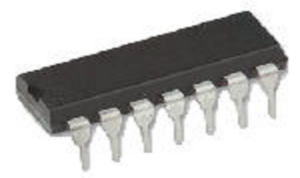



Digital logic gates form the foundation of modern digital electronics. A logic gate typically has one output and one or more inputs such as A, B, C, and D. Individual logic gates can be connected together to create more complex combinational and sequential circuits capable of performing arithmetic operations, data processing, memory storage, and control functions. The two most common logic gate technologies are:
- TTL (Transistor-Transistor Logic) – Used in the 7400 series integrated circuits.
- CMOS (Complementary Metal-Oxide-Semiconductor) – Used in the 4000 series integrated circuits.
Both technologies are implemented using integrated circuits (ICs), commonly known as chips.
What are Digital Logic Gates?
A Digital Logic Gate is an electronic circuit that performs a Boolean operation on one or more binary inputs to generate a single binary output. Logic gates process binary values represented by:
- Logic 1 (HIGH)
- Logic 0 (LOW)
These gates are the basic building blocks of digital systems including computers, calculators, communication devices, and embedded systems.
Types of Digital Logic Gate Technologies
1. TTL (Transistor-Transistor Logic)
TTL logic gates are constructed using Bipolar Junction Transistors (BJTs). Popular TTL IC families include:
- 7400 Series
- 74LS Series
- 74ALS Series
- 74HC Series
- 74HCT Series
- 74ACT Series
2. CMOS (Complementary Metal-Oxide-Semiconductor)
CMOS logic gates use MOSFET transistors for input and output circuitry. CMOS devices consume significantly less power than TTL devices and operate over a wider voltage range.
Other Logic Gate Technologies
Before TTL and CMOS became popular, digital logic circuits were implemented using different technologies such as:
- RTL (Resistor-Transistor Logic)
- DTL (Diode-Transistor Logic)
- ECL (Emitter-Coupled Logic)
These technologies are now largely obsolete because CMOS provides better speed, lower power consumption, and higher integration density.
Classification of Integrated Circuits (ICs)
Integrated Circuits are classified according to the number of transistors or logic gates integrated on a single chip.
| IC Classification | Number of Gates / Transistors | Typical Applications |
|---|---|---|
| SSI (Small Scale Integration) | Up to 10 transistors or a few gates | Basic AND, OR, NOT gates |
| MSI (Medium Scale Integration) | 10–100 transistors | Adders, Decoders, Counters, Multiplexers, Flip-Flops |
| LSI (Large Scale Integration) | 100–1,000 transistors | Memory chips, ALUs, I/O controllers |
| VLSI (Very Large Scale Integration) | 1,000–10,000 transistors | Processors, Memory Arrays, Programmable Logic Devices |
| SLSI (Super Large Scale Integration) | 10,000–100,000 transistors | Microcontrollers, PICs, Calculators |
| ULSI (Ultra Large Scale Integration) | More than 1 Million transistors | CPUs, GPUs, FPGAs, AI processors |
Digital Logic States
Digital systems operate using only two voltage levels.
| Boolean Algebra | Logic State | Voltage Level |
|---|---|---|
| Logic 1 | TRUE | HIGH |
| Logic 0 | FALSE | LOW |
A simple ON/OFF light switch is a practical example of digital logic.
- Switch ON = Logic 1
- Switch OFF = Logic 0
Positive Logic and Negative Logic
Positive Logic
Positive logic is the most commonly used logic system.
- Logic 0 = 0 V (Ground)
- Logic 1 = +5 V (or another positive voltage)
Negative Logic
In negative logic, the voltage assignments are reversed.
- Logic 0 = HIGH Voltage
- Logic 1 = LOW Voltage
Most digital electronic systems use positive logic.
TTL Logic Voltage Levels
TTL logic gates operate using a +5 V supply.
| Logic State | Voltage Range |
|---|---|
| Logic 0 | 0 V – 0.8 V |
| Logic 1 | 2.0 V – 5.0 V |
Voltages between 0.8 V and 2.0 V fall within the Indeterminate Region, where the output cannot be guaranteed.
CMOS Logic Voltage Levels
CMOS devices operate over a much wider voltage range.
| Logic State | Voltage Range |
|---|---|
| Logic 0 | 0 V – 1.5 V |
| Logic 1 | 3 V – 18 V |
TTL vs CMOS Logic Levels
| Technology | Logic 0 | Logic 1 |
|---|---|---|
| TTL | 0 – 0.8 V | 2 – 5 V |
| CMOS | 0 – 1.5 V | 3 – 18 V |
Noise Immunity in Digital Logic Gates
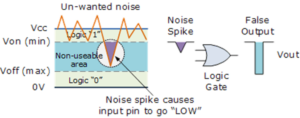

Noise immunity refers to a logic gate’s ability to reject unwanted electrical noise without changing its output. If the input voltage remains above the minimum HIGH threshold or below the maximum LOW threshold, the gate continues to operate correctly. However, if electrical noise shifts the input voltage into the indeterminate region, incorrect switching may occur.
Simple Digital Logic Gate Implementation
Basic logic gates can be constructed using discrete electronic components such as:
- Diodes
- Resistors
- Transistors
Examples include:
- Diode-Resistor Logic (DRL)
- Diode-Transistor Logic (DTL)
- Resistor-Transistor Logic (RTL)
However, modern digital systems rarely use these designs because integrated circuits provide better speed, reliability, lower power consumption, and higher fan-out capability.
Advantages of Digital Logic Gates
- High operating speed.
- Reliable operation.
- Easy integration into integrated circuits.
- Low power consumption (especially CMOS).
- High noise immunity.
- Compact circuit design.
- Suitable for large-scale integration.
Disadvantages of Digital Logic Gates
- Operate only with binary signals.
- Require stable power supplies.
- Noise may affect operation if voltage levels enter the indeterminate region.
- TTL circuits consume more power than CMOS circuits.
Applications of Digital Logic Gates
- Computers and laptops.
- Microprocessors and microcontrollers.
- Digital communication systems.
- Embedded systems.
- Industrial automation.
- Arithmetic Logic Units (ALUs).
- Memory circuits.
- Digital clocks.
- Calculators.
- Robotics.
- Medical electronic equipment.
- Consumer electronics.
Conclusion
Digital logic gates are the fundamental building blocks of all digital electronic systems. Whether implemented using TTL or CMOS technology, these gates perform the logical operations required for data processing, computation, storage, and communication. Their ability to process binary information efficiently has made them indispensable in modern computers, embedded systems, industrial automation, and digital communication devices.