

Introduction
A switch is an electrical device used to connect or disconnect the conducting path in an electrical circuit. Switches are manufactured in various configurations with different contact arrangements that can be controlled by a single actuator, such as a toggle, push button, or rocker. The contacts within a switch may operate simultaneously, alternately, or sequentially depending on the design. The four commonly used types of switches are:
- SPST (Single Pole Single Throw)
- SPDT (Single Pole Double Throw)
- DPST (Double Pole Single Throw)
- DPDT (Double Pole Double Throw)
What is a DPST Switch?
A DPST (Double Pole Single Throw) Switch is an electrical switch that contains two input terminals and two output terminals. Each input is connected to a corresponding output through a single switching action.


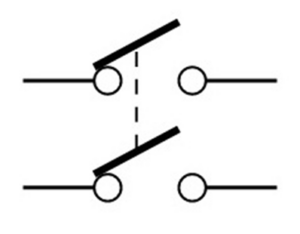

The term Double Pole indicates that the switch can control two separate circuits simultaneously, while Single Throw means that each circuit has only one ON/OFF switching position. In a DPST switch, both circuits are switched ON or OFF at the same time using a single actuator.
DPST Switch Symbol
The DPST switch symbol consists of two separate SPST switch contacts operated by a common actuator. Both contacts open and close simultaneously.
Working Principle of a DPST Switch
A DPST switch operates by controlling two independent electrical circuits simultaneously through a single switching mechanism. The switch contains four terminals:
- Two input terminals
- Two output terminals
When the switch is turned ON, both circuits are completed, allowing current to flow through each connected load. When the switch is turned OFF, both circuits are disconnected at the same time. In simple terms, a DPST switch functions as two SPST switches combined into a single device and controlled by one actuator.
Specifications of a DPST Switch
- Terminal Type: 4.8 mm × 0.8 mm quick-connect solder tail
- Contact Gap: ≥ 3 mm
- Insulation Spacing: ≥ 8 mm
- Initial Contact Resistance: < 20 mΩ
- Dielectric Strength: Up to 3.5 kV
- Insulation Resistance: > 50 MΩ
- Mechanical Life: ≥ 100,000 cycles
- Electrical Life: ≥ 20,000 cycles at full load
- Minimum Panel Thickness: 1 mm
- Maximum Panel Thickness: 3 mm
- Panel Cut-Out Size: 19.5 mm × 13 mm
- Body Material: Nylon 6/6
- Button Material: Polycarbonate
- Terminal Material: Copper Alloy
- Contact Material: Silver Alloy
DPST Switch Circuit Diagram and Operation
A DPST switch can be used to control two separate loads connected to two different power sources simultaneously. For example, consider two lamps connected to two separate batteries:
- Lamp 1 connected to Battery 1
- Lamp 2 connected to Battery 2
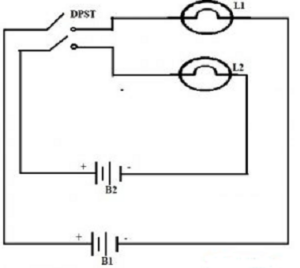

When the DPST switch is turned ON, both lamps receive power and illuminate simultaneously. When the switch is turned OFF, both lamps turn OFF at the same time. This simultaneous switching capability makes DPST switches useful in applications where two circuits need to be controlled together.
Advantages of a DPST Switch
- Can open or close two independent circuits simultaneously.
- Provides synchronized control of multiple circuits.
- Reduces the need for multiple switches.
- Simple and reliable operation.
- Functions similarly to two SPST switches operated together.
- Suitable for higher voltage applications where both live and neutral lines need to be disconnected.
Disadvantages of a DPST Switch
- Provides only ON/OFF switching functionality.
- Cannot select between multiple outputs.
- Less flexible than DPDT switches.
- Requires both circuits to be switched together.
- Not suitable when independent control of circuits is required.
Applications of a DPST Switch
1. Main Power Isolation
DPST switches are commonly used to disconnect both the live and neutral conductors of a power supply, providing improved electrical safety.
2. Industrial Control Systems
These switches are used in industrial selector switches and breaker control circuits to simultaneously control multiple electrical paths.
3. Dual Circuit Switching
DPST switches are ideal for turning two separate circuits ON or OFF using a single control mechanism.
4. Power Source Isolation
They are used to isolate electrical loads from power sources during maintenance or servicing.
5. 240V Electrical Applications
Many 240V electrical systems require both supply lines to be disconnected simultaneously, making DPST switches a suitable choice.
6. Heating and Temperature Control Systems
DPST switches are frequently used in electric heating equipment and thermostatic control systems where contacts open and close automatically based on temperature changes.
7. Thermostats
When integrated with temperature-sensing mechanisms, DPST switches can function as thermostats for controlling heating and cooling systems.
Features of a DPST Switch
- Controls two circuits simultaneously.
- Single actuator operation.
- Reliable ON/OFF switching mechanism.
- Suitable for AC and DC circuits.
- High mechanical and electrical durability.
- Available in toggle, rocker, push-button, and rotary designs.
Conclusion
A DPST (Double Pole Single Throw) Switch is an important electrical switching device used to control two independent circuits simultaneously using a single actuator. Its simple design, reliable operation, and ability to disconnect both live and neutral conductors make it ideal for industrial control systems, power isolation applications, heating equipment, and high-voltage electrical circuits. Due to its safety and efficiency, the DPST switch remains a widely used component in modern electrical and electronic systems.