

Introduction
A remote control switch is an electronic device that allows users to control electrical loads without the need for direct physical contact or extensive wiring. In industrial and residential environments, remote-controlled switches improve convenience, safety, and efficiency by enabling users to operate devices from a distance. Unlike traditional wired switches, remote control switches reduce maintenance requirements and provide flexibility in controlling electrical appliances. These switches are widely used in smart homes, industries, and automation systems.
What is a Remote Control Light Switch?
A Remote Control Light Switch is an electronic switching device used to turn electrical loads, such as AC lights, ON or OFF using a remote control. Similar technology is commonly used in televisions, air conditioners, music systems, DVD players, and other electronic devices. The system generally consists of two main sections:


- Transmitter – Functions as a handheld remote control.
- Receiver – Connected to the electrical load and receives commands from the transmitter.
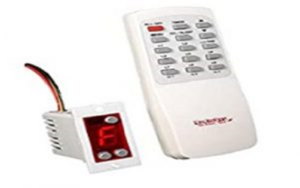

Remote control light switches are inexpensive, easy to install, and widely used in home automation applications.
Block Diagram of a Remote Control Light Switch
A remote control light switch consists of two major sections:
- Transmitter Section
- Receiver Section

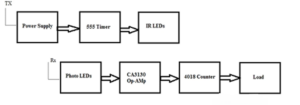
Transmitter Section
The transmitter section includes:
- Power Supply (9V Battery)
- NE555 Timer IC
- Infrared (IR) LEDs
- Switch
- Concave Lens
The NE555 Timer is configured as an astable multivibrator. When the switch is pressed, the timer generates a continuous pulse signal that drives the IR LEDs. The LEDs emit modulated infrared signals that are directed through a concave lens toward the receiver.
Receiver Section
The receiver section contains an IR receiver, amplifier circuit, counter IC, relay, and load. When the IR signal is received, it is converted into electrical signals and processed by the control circuit. The processed signal activates a relay, which controls the connected electrical load such as a light bulb.
Remote Control Light Switch Circuit Components
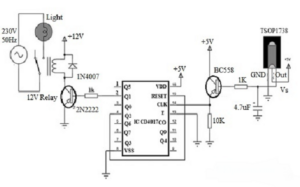
The following components are commonly used in a remote-controlled light switch circuit:
- CD4017 Decade Counter IC
- TSOP1738 Infrared Receiver
- 12V Relay Module
- BC558 PNP Transistor
- 2N2222 NPN Transistor
- 1N4007 Diode
- 1 kΩ Resistors
- 10 kΩ Resistor
- AC Light Bulb and Holder
- Remote Control Unit

Working Principle of a Remote Control Light Switch
Transmission Process
Whenever a button on the remote control is pressed, a modulated infrared (IR) signal is transmitted. This signal is received by the TSOP1738 infrared receiver. The TSOP1738 demodulates the received IR signal and generates a corresponding output signal. The output is connected to the base of a PNP transistor through a resistor. When the remote button is pressed, the transistor turns ON and generates a clock pulse for the CD4017 Decade Counter IC. This pulse causes the counter output to change state. The relay connected to the counter output is energized, turning the connected light ON.
Reception Process
When the remote control button is pressed again, another pulse is generated. This pulse causes the CD4017 counter to advance to the next state and reset. As a result, the relay is deactivated and the light turns OFF. Each button press alternates the state of the light between ON and OFF.
Features of a Remote Control Light Switch
- Wireless operation using infrared signals.
- Simple and cost-effective design.
- Easy installation and maintenance.
- Convenient remote operation.
- Can be integrated with home automation systems.
- Low power consumption.
- Improves safety and user convenience.
Advantages of a Remote Control Light Switch
- Easy and convenient to operate.
- Helps reduce electricity consumption.
- Provides greater comfort and accessibility.
- Especially useful for elderly and physically challenged individuals.
- Low-cost implementation.
- Can be expanded using microcontrollers to control multiple loads.
- Compatible with Arduino and other embedded platforms.
- Enhances smart home functionality.
Disadvantages of a Remote Control Light Switch
- Typically controls only one load in basic implementations.
- Limited communication range.
- Infrared communication requires a clear line of sight.
- Wireless communication can sometimes be unreliable.
- Requires periodic maintenance and battery replacement.
Applications of a Remote Control Light Switch
1. Home Lighting Control
Used to switch household lights ON and OFF remotely, improving convenience and energy efficiency.
2. Smart Home Systems
Integrated into smart home automation systems for centralized control of lighting and appliances.
3. Industrial Automation
Allows operators to control equipment from a safe distance, improving operational safety.
4. Elderly and Accessibility Applications
Provides convenient control of lighting without requiring physical movement to a wall switch.
5. Energy Management Systems
Helps reduce unnecessary power consumption by allowing quick and convenient control of electrical devices.
Conclusion
A Remote Control Light Switch is a simple yet effective wireless control system that allows users to operate electrical loads from a distance. By utilizing infrared communication, timer circuits, and relay control mechanisms, these switches provide enhanced convenience, safety, and energy efficiency. Their affordability and compatibility with home automation systems make them a popular choice for modern residential and industrial applications.