

What is Eddy Current?
Eddy currents, also known as Foucault currents, are circulating electric currents induced within a conductor when it is exposed to a changing magnetic field or moves through a magnetic field. These currents flow in closed loops inside the conductor, similar to swirling water currents.
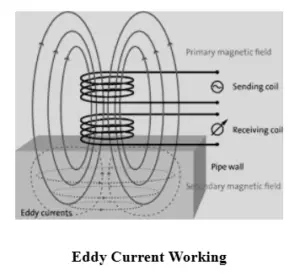

Eddy currents are produced due to electromagnetic induction. They can occur when a conductor moves through a magnetic field or when the magnetic field surrounding a stationary conductor changes. The magnitude of eddy currents depends on several factors, including:
- Strength of the magnetic field.
- Cross-sectional area of the current loops.
- Rate of change of magnetic flux.
- Electrical resistance or resistivity of the conductor.
Working Principle and Theory of Eddy Current
Eddy currents work on the principle of Faraday’s law of electromagnetic induction and Lenz’s law. According to Faraday’s law, an electromotive force (EMF) is induced in a conductor whenever the magnetic flux linked with it changes. This induced EMF produces circulating currents inside the conductor, known as eddy currents.
According to Lenz’s law, the magnetic field produced by these currents opposes the change in magnetic flux that causes them. Therefore, eddy currents create a magnetic effect that opposes the relative motion between the conductor and the magnetic field. When a conductor moves through a magnetic field, the interaction between the magnetic field and the induced eddy currents produces a force that opposes the motion. This principle is used in eddy current braking systems.
Eddy Current Testing
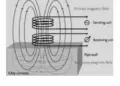
Eddy current testing is a non-destructive testing (NDT) technique used to inspect electrically conductive materials without damaging them. In this method, an alternating current is passed through a coil to produce a changing magnetic field. When the coil is brought near a conductive material, eddy currents are induced in the material.
If the material contains defects such as cracks, corrosion, or discontinuities, the flow of eddy currents changes. This affects the magnetic field and the electrical impedance of the coil. By measuring these changes, defects in the material can be detected. Modern eddy current testing techniques include pulsed eddy current testing and eddy current array testing.
Eddy Current Loss
When a magnetic material is exposed to a changing magnetic field, circulating currents are induced inside it. These currents flow through the electrical resistance of the material and produce heat. The power dissipated in this process is called eddy current loss.
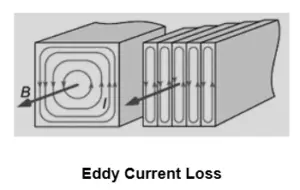
Eddy current losses are a part of the core losses, also known as iron losses, in electrical machines and transformers. These losses increase the temperature of the magnetic core and reduce the overall efficiency of the equipment.
Eddy Current Loss in a Transformer
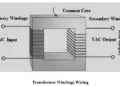
In a transformer, alternating magnetic flux flows through the iron core. According to Faraday’s law of electromagnetic induction, this changing magnetic flux induces EMF within the core. As the core material is electrically conductive, circulating currents are produced inside it, resulting in eddy current losses.
The approximate formula for eddy current loss is:
Pe = Ke × f² × Bm² × t²
Where:
- Pe: Eddy current loss.
- Ke: Eddy current loss constant, which depends on the core material and its properties.
- f: Frequency of the magnetic flux.
- Bm: Maximum magnetic flux density.
- t: Thickness of the core lamination.
This relationship shows that eddy current loss increases with the square of frequency, maximum flux density, and lamination thickness, under the assumptions of the standard thin-lamination model.
Methods to Reduce Eddy Current Losses
Eddy current losses can be reduced by using suitable core materials and construction techniques. The main methods are:
1. Using Laminated Cores
The transformer core is constructed using several thin sheets of magnetic material called laminations. Each sheet is insulated from the adjacent sheet using an insulating coating, such as varnish or oxide film. This arrangement increases the resistance to circulating current paths and reduces the magnitude of eddy currents. As a result, eddy current losses are reduced.
2. Using High-Resistivity Materials
Eddy current losses can also be reduced by using magnetic materials with high electrical resistivity, such as silicon steel. Higher resistivity restricts the flow of circulating currents and reduces the heat generated inside the core.
Eddy Current Braking System
An eddy current braking system, also known as electromagnetic or induction braking, is a braking mechanism used to slow down or stop a moving object without direct frictional contact between the braking components. When a conductor moves through a magnetic field, eddy currents are induced within it. These currents produce their own magnetic field, which opposes the relative motion according to Lenz’s law.
This opposition creates a braking force that slows down the moving object. The kinetic energy of the moving object is converted mainly into heat in the conductor. Eddy current braking systems are used in trains, industrial equipment, and other applications where smooth and contactless braking is required.
Advantages of Eddy Current
- Eddy current testing is a non-destructive method that does not damage the material being inspected.
- It provides quick inspection and measurement results.
- It can be used to detect surface and near-surface defects in conductive materials.
- It is useful for checking the condition of coated and metal surfaces.
- Eddy current technology is used in braking systems, speedometers, and induction heating equipment.
- Eddy current brakes provide braking without direct frictional contact.
Disadvantages of Eddy Current
- Eddy currents produce unwanted heat and energy losses in electrical machines and transformers.
- Magnetic flux leakage can occur in certain electromagnetic systems and affect their performance.
- Eddy current testing is generally limited to electrically conductive materials.
- Inspection depth is limited because eddy currents are concentrated near the surface of the conductor due to the skin effect.
- Testing results can be affected by material properties, surface conditions, and the geometry of the object.
Applications of Eddy Current
Eddy currents are used in various electrical, industrial, and testing applications. Some important applications are:
- Electric Trains: Eddy current brakes are used in certain railway systems to slow down trains without direct frictional contact.
- PMMC Instruments: Eddy currents are used to provide damping torque in permanent magnet moving coil instruments.
- Energy Meters: Eddy currents are used in traditional induction-type energy meters to produce driving and braking torque.
- Non-Destructive Testing: Used to detect cracks, corrosion, and other defects in conductive metal components.
- Induction Heating: Used to generate heat in metal objects for industrial heating, melting, and surface-hardening processes.
- Speedometers: Used in certain mechanical speedometers to produce torque for indicating speed.
- Industrial Braking: Used in selected machines and equipment for contactless braking.
Conclusion
Eddy currents are circulating currents induced inside a conductor due to a changing magnetic field or relative motion between the conductor and the magnetic field. They are explained by Faraday’s law and Lenz’s law. Although eddy currents cause unwanted energy losses in transformers and electrical machines, they are also useful in braking systems, non-destructive testing, induction heating, and measuring instruments.