

What is a MAGLEV Train?
MAGLEV stands for Magnetic Levitation. A MAGLEV train is a high-speed transportation system that uses magnetic forces to lift, guide, and propel the train along a specially designed track called a guideway.
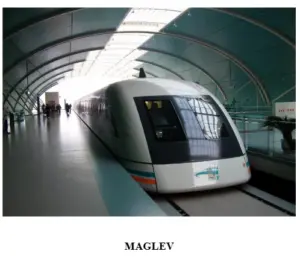

Unlike conventional trains, MAGLEV trains do not use steel wheels running on steel rails. Instead, they use electromagnetic forces to levitate above the guideway and move forward. This reduces mechanical friction and allows them to travel at very high speeds with less noise and vibration. MAGLEV technology is considered an advanced transportation system because it offers high speed, smooth operation, and reduced mechanical wear.
Magnetic Levitation
Magnetic levitation is the process of suspending an object in the air using magnetic forces. In MAGLEV trains, electromagnetic systems are used to lift the train above the guideway and maintain its position during movement.
The train is propelled using a linear motor system. Electromagnets installed along the guideway produce changing magnetic fields that interact with the magnets on the train to create forward motion. Since the train does not make direct contact with the track during normal high-speed operation, friction between the wheels and rails is eliminated.
Working Principle of MAGLEV Trains
MAGLEV trains work on the principles of magnetic attraction, magnetic repulsion, and electromagnetic propulsion. The train is lifted above the guideway using magnetic forces and propelled forward by a linear motor.
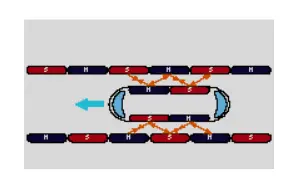
The working of a MAGLEV train can be explained through the following steps:
1. Magnetic Levitation
Electromagnets or superconducting magnets generate magnetic forces that lift the train above the guideway. Depending on the type of MAGLEV system, the train may be suspended using magnetic attraction or magnetic repulsion.
2. Magnetic Guidance
The magnetic system also helps maintain the train’s position along the guideway. It keeps the train aligned with the track and provides stability during movement.
3. Electromagnetic Propulsion
Electric current is supplied to coils installed along the guideway. These coils produce changing magnetic fields that interact with the magnets present in the train. The magnetic fields create attractive and repulsive forces that push and pull the train forward. The direction and timing of the magnetic fields are controlled to maintain continuous propulsion.
4. Speed Control
The speed of a MAGLEV train is controlled by adjusting the frequency and timing of the electric current supplied to the guideway coils. Increasing the frequency increases the speed of the train, while decreasing it reduces the speed.
MAGLEV Train Track or Guideway
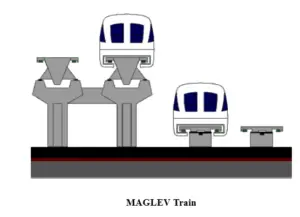
The guideway is the specially designed track on which a MAGLEV train travels. Unlike conventional railway tracks, it contains electromagnetic coils and other components required for levitation, guidance, and propulsion. The guideway is constructed to support the train and maintain a stable magnetic field during operation.
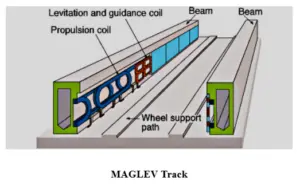
Electromagnetic coils installed along the guideway are supplied with controlled electric current. The changing magnetic fields generated by these coils interact with the magnets present in the train to produce forward motion. The guideway is an important part of the MAGLEV system because it provides the necessary magnetic forces for lifting, guiding, and moving the train.
MAGLEV Trains vs Conventional Trains
The fundamental difference between MAGLEV trains and conventional trains is the method of transportation and propulsion. Conventional trains use steel wheels running on steel rails. Their engines or electric motors provide the power required to move the train along the railway track.
MAGLEV trains use magnetic forces to levitate above the guideway. They are propelled by electromagnetic fields generated by linear motors, which may be installed along the guideway or incorporated into the train system, depending on the design. Since MAGLEV trains do not have direct wheel-to-rail contact during high-speed operation, mechanical friction is significantly reduced. This allows smoother movement, reduced wear, and higher operating speeds.
Types of MAGLEV Train Systems
There are two major types of magnetic levitation systems used in MAGLEV trains:
1. Electromagnetic Suspension (EMS)
Electromagnetic Suspension (EMS) is a magnetic levitation system that uses magnetic attraction to lift the train above the guideway. In this system, electromagnets are installed beneath the train and attract the steel guideway. The magnetic force lifts the train and maintains a small gap between the train and the track.
Electronic control systems continuously adjust the magnetic force to maintain a stable levitation gap. EMS systems can provide levitation even when the train is stationary. EMS technology is used in some high-speed MAGLEV transportation systems developed in Germany and other countries.
2. Electrodynamic Suspension (EDS)
Electrodynamic Suspension (EDS) is a magnetic levitation system that uses magnetic repulsion to lift the train above the guideway. In this system, superconducting magnets or other magnetic arrangements interact with coils installed in the guideway. As the train moves, changing magnetic fields induce currents in the guideway coils, creating magnetic forces that lift and stabilize the train.
EDS systems generally require the train to reach a certain speed before sufficient levitation force is generated. Therefore, some systems use wheels during low-speed operation. Japanese MAGLEV trains use EDS technology, including superconducting magnets in their high-speed systems.
Commercial Use of MAGLEV Trains
MAGLEV technology has been developed and tested in several countries, including Germany, Japan, China, and South Korea. The first commercial MAGLEV transportation service was introduced in Birmingham, England, in 1984. The system operated between Birmingham International Airport and a nearby railway station. However, it was discontinued in 1995 due to operational and reliability issues.
One of the most well-known commercial MAGLEV systems is the Shanghai MAGLEV Train in China. It connects Shanghai Pudong International Airport with the Longyang Road station. The Shanghai MAGLEV is designed for high-speed operation and has achieved speeds of up to approximately 431 km/h during commercial service. MAGLEV trains are capable of reaching very high speeds because they eliminate wheel-to-rail friction. However, aerodynamic drag becomes the major resistance at high speeds and requires significant energy.
Advantages of MAGLEV Trains
MAGLEV trains offer several advantages over conventional railway transportation systems:
- High Speed: MAGLEV trains can travel at very high speeds because wheel-to-rail friction is eliminated.
- Reduced Mechanical Wear: Since there is no direct contact between the train and the guideway during levitation, mechanical wear is significantly reduced.
- Low Noise: The absence of wheel and rail contact reduces rolling noise. However, aerodynamic noise increases at higher speeds.
- Smooth Ride: Magnetic levitation provides smooth movement with reduced vibration.
- Less Maintenance: Fewer mechanical contact components can reduce maintenance requirements.
- Efficient Acceleration: Linear motor propulsion allows rapid acceleration and deceleration.
- Improved Safety: The train is guided by the guideway and does not depend on conventional wheel-and-rail contact for high-speed operation.
Disadvantages of MAGLEV Trains
Despite their advantages, MAGLEV trains also have some disadvantages:
- High Initial Cost: Construction of MAGLEV guideways and electromagnetic systems requires a significant investment.
- Special Infrastructure: MAGLEV trains cannot operate on conventional railway tracks and require dedicated guideways.
- High Energy Requirements: At very high speeds, aerodynamic drag increases significantly, requiring substantial energy for propulsion.
- Complex Technology: Magnetic levitation, guidance, and propulsion systems require advanced control and monitoring equipment.
- Limited Network Availability: MAGLEV infrastructure is not widely available compared with conventional railway networks.
- High Maintenance Cost: Specialized guideways, control systems, and electromagnetic equipment may require expensive maintenance.
Environmental Friendliness of MAGLEV Trains
MAGLEV trains are considered an environmentally friendly transportation option compared with many conventional vehicles, particularly when they are powered by electricity generated from renewable energy sources. Since there is no wheel-to-rail friction, mechanical energy losses associated with rolling resistance are reduced. However, aerodynamic drag becomes the dominant resistance at high speeds. MAGLEV trains can offer reduced local emissions, lower mechanical noise, and efficient transportation of large numbers of passengers. Their overall environmental impact depends on electricity generation, infrastructure construction, energy consumption, and passenger capacity.
Applications of MAGLEV Trains
MAGLEV technology is used or developed for various transportation applications, including:
- High-speed passenger transportation
- Airport transportation systems
- Intercity transportation
- Urban transportation systems
- Advanced railway transportation projects
- Experimental high-speed transportation systems
Conclusion
MAGLEV trains are an advanced transportation technology that uses magnetic levitation and electromagnetic propulsion to move vehicles without direct contact with the guideway during high-speed operation. They provide high speed, smooth movement, reduced mechanical wear, and lower rolling noise. Although MAGLEV systems require expensive infrastructure and specialized technology, they have the potential to improve future transportation by offering faster, smoother, and more efficient passenger travel.