

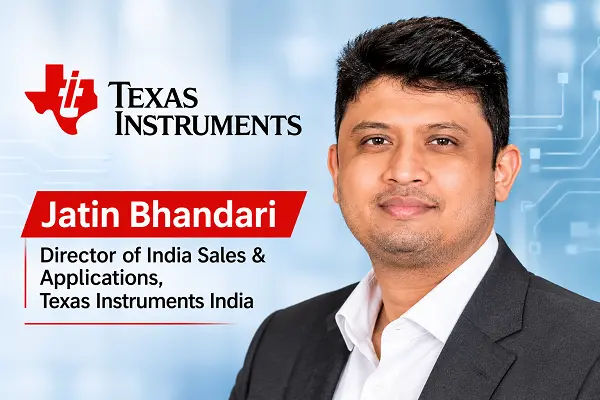
In an insightful dialogue at electronica India, Jatin Bhandari, Director of India Sales & Applications at Texas Instruments India, speaks with Vaishali Umredkar, Editor of Semiconductor For You. Bhandari discusses TI’s deep commitment to India’s design journey, breakthroughs in Gallium Nitride (GaN) power management, two-wheeler electrification, AI data centers, space-grade reliability, and enhanced INR purchasing options for Indian customers.
Excerpts from the interview:
Q: Could you share TI’s core focus in India and what key themes you are showcasing at electronica India?
Jatin Bhandari: At TI, we work closely with engineers to understand their challenges, whether at the semiconductor level or through reference designs that accelerate product development. India is an important part of our global engineering ecosystem, and we are committed to supporting the country’s electronics design and manufacturing ambitions. At electronica India, we are showcasing more than 20 live demonstrations across several application areas. These include sustainable energy, automotive electronics, including remote keyless entry, and wireless connectivity. The common thread across these applications is our focus on helping engineers solve real-world problems.
Q: Which emerging application sectors in India present the greatest technological and growth opportunities for Texas Instruments?
Jatin Bhandari: We see significant opportunities across three primary areas:
- Automotive & 2-Wheeler Electrification: As vehicles become increasingly electrified and connected, the need for efficient power management, battery management systems (BMS), motor control, and advanced displays continues to grow.
- AI & High-Density Data Centers: As AI workloads grow, data centers need to process more information while managing power consumption, thermal constraints and system efficiency. For instance, Zoho have built 48V data center racks using over 60% TI components. TI’s power-management technologies can help engineers develop solutions that meet these demanding requirements.
- Sustainable Energy: India’s growing adoption of renewable energy is creating opportunities across solar power conversion, energy storage, power distribution, and measurement, particularly localized 3.6 kW solar inverters that can be adapted for different application requirements.
Q: High-power density and energy management are paramount today. How is TI helping Indian design engineers optimize power and size without sacrificing performance?
Jatin Bhandari: Engineers are constantly balancing several requirements for their designs needs such as size, weight, power consumption, and cost. Our teams across India work closely with customers to understand their system requirements, evaluate architectures and identify opportunities to improve efficiency and integration. Using advanced technologies such as Gallium Nitride (GaN) and real-time microcontrollers like the C2000™, can help engineers develop power-conversion systems with higher efficiency and power density. In electric vehicles, gaining a 2% to 3% increase in efficiency translates directly into extended vehicle range, which is critical for OEMs. Ultimately, the objective is to help customers develop solutions that deliver better system performance while meeting their cost and design constraints.
Q: Aerospace, space-grade technology, and local startups are gaining massive traction in India. How is TI supporting these specialized domains?
Jatin Bhandari: India’s aerospace ecosystem is evolving, with opportunities emerging across satellite systems, Earth observation and other advanced applications. TI has a portfolio of radiation-hardened, space-grade semiconductors, supporting Indian Space Research Organisation (ISRO) missions including Chandrayaan-3 and Mangalyaan, and contributing to the advanced Earth-observation capabilities of NASA-ISRO Synthetic Aperture Radar (NISAR). Our approach is to engage with engineers, understand their technical challenges and help them identify the appropriate semiconductor technologies and system architectures.
Q: How is Texas Instruments simplifying the supply chain and commercial process for Indian manufacturers to buy local?
Jatin Bhandari: Making it easier for customers to access TI products is an important part of the overall customer experience. Beyond maintaining a geographically dependable global manufacturing footprint, we have streamlined procurement in India. Through TI, eligible Indian customers can purchase backlog orders directly in Indian rupees (INR). This provides a more convenient purchasing experience by allowing customers to transact in their local currency. For Indian businesses, being able to purchase components in INR can simplify the commercial process by reducing the need to manage foreign-currency transactions for eligible purchases.