

Introduction
As technological advancement continues, the demand for energy in all aspects of human life is increasing rapidly. Natural resources have traditionally been the primary sources of energy. These resources can be classified into two categories: renewable energy sources and non-renewable energy sources.
Most of the world’s energy currently comes from non-renewable sources such as coal, petroleum, and natural gas. However, these resources are limited and contribute significantly to environmental issues such as global warming and pollution. Rising fuel prices and environmental concerns have increased the importance of renewable energy sources.


Renewable energy sources, such as solar energy, wind energy, and thermal energy, provide sustainable and environmentally friendly alternatives. Among these, solar energy is considered one of the most important and abundant energy sources available.

Sun as a Source of Energy
The sun generates enormous amounts of energy through nuclear fusion reactions occurring within its core. The temperature at the sun’s core reaches approximately 107 K, producing intense radiation with a broad spectral distribution. The outer layers of the sun, which have temperatures of approximately 5800 K, emit this energy in the form of electromagnetic radiation. During its journey to Earth, solar radiation may be absorbed, reflected, or refracted. The Earth receives approximately 1.73 × 10¹⁴ kW of solar energy continuously. This enormous amount of energy makes solar power one of the most promising solutions for meeting future energy demands.
Methods of Solar Energy Collection
Solar energy can be collected using three major types of collectors:
1. Flat-Plate Collectors
Flat-plate collectors are the most commonly used solar energy collectors. They consist of flat surfaces designed to absorb solar radiation efficiently and convert it into usable energy.
2. Concentrating Collectors
Concentrating collectors use optical devices such as mirrors and lenses to focus sunlight onto a smaller area, increasing the amount of energy captured. Examples include solar furnaces and solar concentrators.
3. Passive Collectors
Passive collectors absorb solar energy naturally without requiring specially designed mechanisms. They convert absorbed radiation into heat energy directly.
Solar Panels
Solar panels are among the most widely used solar energy collectors. A solar panel consists of multiple solar cells connected in a matrix arrangement. These panels typically produce power ranging from 10 W to 300 W or more.
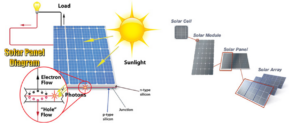

A solar cell is a semiconductor device that converts sunlight into electrical energy through the photovoltaic effect. When sunlight strikes the semiconductor material, electrons become excited and move between layers, creating an electrical potential difference and generating electricity.
Components of a Solar Power System
A typical solar power system consists of the following components:
- Solar Panel: Captures solar energy and converts it into electrical energy.
- Battery: Stores the generated DC electrical energy.
- Inverter: Converts DC power into AC power for practical applications.
- Mounting Structure: Supports and positions the solar panels.
- Solar Tracker: Ensures maximum sunlight exposure.
Need for Solar Tracking Systems
One of the major challenges in solar power generation is ensuring that solar panels receive maximum sunlight throughout the day. The efficiency of a solar panel depends on several factors, including:
- Direction: Panels should face south in the northern hemisphere and north in the southern hemisphere.
- Tilt Angle: The panel tilt should match the geographical latitude.
- Surface Area: Larger surface areas collect more solar energy.
- Tracking Mechanism: Solar trackers continuously adjust panel orientation toward the sun.
What is a Sun Tracking Solar Power System?
A sun tracking solar power system is a solar energy system that automatically adjusts the position of solar panels to follow the movement of the sun throughout the day. By maintaining the optimum angle between the panel surface and sunlight, the system maximizes solar energy collection. Sun tracking systems significantly improve the efficiency and energy output of solar panels compared to fixed installations.
Types of Solar Tracking Systems
Solar tracking systems are mainly classified into two types:
1. Passive Solar Tracker
Passive solar trackers use a fluid-based mechanism to move solar panels according to the sun’s position. In this system, two liquid-filled tanks are positioned on opposite sides of the solar panel. When one side receives more sunlight, the liquid expands due to heating, creating a pressure difference. The liquid then flows toward the cooler side, causing a shift in weight distribution. This weight change causes the panel to rotate and align with the sun.
Advantages of Passive Solar Trackers
- Low cost.
- No electrical power required.
- Minimal maintenance.
- Simple mechanical construction.
Disadvantages of Passive Solar Trackers
- Lower accuracy.
- Reduced performance during cloudy weather.
- Slower response time.
2. Active Solar Tracker
Active solar trackers use electric motors, such as servo motors or stepper motors, to rotate the solar panels toward the sun. The control system continuously adjusts the panel position to maintain an angle of approximately 90° relative to the incoming sunlight for maximum energy absorption. Active trackers generally use one of the following methods:
- Astronomical Tracking: Uses mathematical calculations based on the sun’s position.
- Light Sensor Tracking: Uses light sensors to detect the brightest direction and orient the panel accordingly.
Advantages of Active Solar Trackers
- Higher efficiency.
- Greater accuracy.
- Maximum energy extraction.
- Suitable for large solar installations.
Disadvantages of Active Solar Trackers
- Higher installation cost.
- Requires electrical power.
- Increased maintenance.
- More complex construction.
Advantages of Sun Tracking Solar Power Systems
- Improves solar energy collection efficiency.
- Increases power generation output.
- Maximizes sunlight utilization.
- Reduces the number of solar panels required.
- Provides better return on investment.
- Suitable for large-scale solar plants.
Disadvantages of Sun Tracking Solar Power Systems
- Higher initial investment cost.
- More maintenance requirements.
- Complex mechanical design.
- Consumes additional power for operation.
- Requires regular calibration and servicing.
Applications of Sun Tracking Solar Power Systems
- Solar power generation plants.
- Solar water pumping systems.
- Industrial solar installations.
- Solar street lighting systems.
- Residential rooftop solar systems.
- Agricultural irrigation systems.
- Solar-powered communication stations.
- Research and educational institutions.
- Satellite tracking systems.
- Remote power supply systems.
Conclusion
A sun tracking solar power system is an efficient technology designed to maximize solar energy utilization by continuously orienting solar panels toward the sun. By improving energy capture efficiency, these systems significantly enhance power generation and support the growing demand for renewable energy solutions. Although they involve higher costs and maintenance requirements, their long-term benefits make them an essential technology in modern solar energy applications.