Semiconductor for You
  • Home
  • Semiconductor News
  • Semiconductor Magazine
  • Technology
    • Automotive
    • Consumer Electronics
    • IoT
    • Test and Measurement
    • Lighting
    • Power Management
    • Wireless
    • Personal Electronics
    • Hardware & Software
    • Research
    • Medical Electronics
    • Embedded Design
    • Aerospace & Defence
    • Artificial Intelligence
  • Interview
  • Industries
  • Market
  • Knowledge Base
  • Events
  • Tools
    • Resistor Color Code Calculator
No Result
View All Result
  • Home
  • Semiconductor News
  • Semiconductor Magazine
  • Technology
    • Automotive
    • Consumer Electronics
    • IoT
    • Test and Measurement
    • Lighting
    • Power Management
    • Wireless
    • Personal Electronics
    • Hardware & Software
    • Research
    • Medical Electronics
    • Embedded Design
    • Aerospace & Defence
    • Artificial Intelligence
  • Interview
  • Industries
  • Market
  • Knowledge Base
  • Events
  • Tools
    • Resistor Color Code Calculator
No Result
View All Result
Semiconductor for You
No Result
View All Result
Home Knowledge Base

Difference between AC and DC

Vinita Koche by Vinita Koche
June 29, 2021
in Knowledge Base
0
ADVERTISEMENT
ADVERTISEMENT
Alternating current Direct current
1.Alternating current is the flow of electric charge that changes direction periodically. 1.Direct current is the flow of electric charge that only flow in one direction i.e unidirectional
2. In Alternating current, Rotating magnet along with the wire cause the direction of flow of electron. 2. In Direct current, Steady magnetism along the wire causes the direction of flow of electron.
3. The Alternating current changes its polarity and magnitude periodically w.r.t. time 3. Unlike Alternating current, direct current does not change the polarity and magnitude with time.


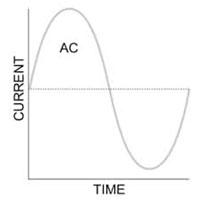
4. The current time graph for an Alternating current is a sine curve graph .
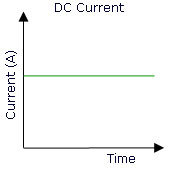
4.The current time graph for a Direct current as shown below.
5. Alternating current is produced in power systems. 5. Direct current is produced by cells and batteries.
6. Alternating current can be transmitted to long distance. 6.Direct current cannot be easily transmitted to long distance because of very large energy loss.
7. Depending upon country, Frequency of Alternating current is 50 Hz to 60Hz. 7.Frequency of Direct current is zero.
8. Source of availability in ac is generator or mains. 8. Source of availability in dc is battery or cell.
9. In ac, Power factor lies between 0 & 1. 9. In dc, Power factor is always 1.
10. It has more efficiency as compared to dc. 10. It has less efficiency as compared to ac.
11. Power consumption is less. 11. Power consumption is more as compared to ac.
12. Alternating current has higher voltage hence, it is not safe 12.Direct current has low voltage hence, it has safe operation.
13. In Alternating current, any terminal can be connected to the work or electrode. 13. In Direct current, positive terminal connected to the work and negative terminal connected to the electrode.
14. Impedance is passive parameter of alternating current. 14. Resistance is passive parameter of direct current.


Vinita Koche

Vinita Koche

Browse by Category

  • Aerospace and Defence
  • AI & Data Center
  • Articles
  • Automation
  • Automotive
  • Communication
  • Consumer-Electronics
  • Design & Manufacturing
  • Hardware & Software
  • Healthcare
  • Industrial Electronics
  • Interview
  • IoT
  • Knowledge Base
  • Lighting
  • Market
  • personal-electronics
  • Power Management
  • Research
  • Robotics
  • Semiconductor Events
  • Semiconductor News
  • Sensors
  • Technology
  • Test and Measurement
  • Uncategorized
  • Wireless
Semiconductor For You

Semiconductor For You is a resource hub for electronics engineers and industrialist. With its blend of
technology features, news and new product information, Semiconductor For You keeps designers and
managers up to date with the fastest moving industry in the world.

Follow Us

Browse by Category

  • Aerospace and Defence
  • AI & Data Center
  • Articles
  • Automation
  • Automotive
  • Communication
  • Consumer-Electronics
  • Design & Manufacturing
  • Hardware & Software
  • Healthcare
  • Industrial Electronics
  • Interview
  • IoT
  • Knowledge Base
  • Lighting
  • Market
  • personal-electronics
  • Power Management
  • Research
  • Robotics
  • Semiconductor Events
  • Semiconductor News
  • Sensors
  • Technology
  • Test and Measurement
  • Uncategorized
  • Wireless

Recent News

Tri-State Multiplexing for Efficient LED Control

Tri-State Multiplexing for Efficient LED Control

August 16, 2026
STMicroelectronics’ new galvanically isolated gate drivers simplify power design with advanced isolation

STMicroelectronics’ new galvanically isolated gate drivers simplify power design with advanced isolation

August 14, 2026
  • About
  • Advertise
  • Privacy & Policy
  • Contact

© 2026 Semiconductor For You

No Result
View All Result
  • Home
  • Semiconductor News
  • Technology
    • IoT
    • Wireless
    • Power Management
    • Automotive
    • Hardware & Software
  • Market
  • Interview
  • Knowledge Base
  • Tools
    • Resistor Color Code Calculator

© 2026 Semiconductor For You