
Introduction
Modern power systems handle enormous amounts of electrical power and supply energy to a wide range of electrical equipment. If a fault occurs in a power system, such as a short circuit, cable fault, or excessive current flow, both the equipment and the power network can suffer severe damage. To prevent further damage, these faults must be cleared immediately. Therefore, a special switching device called a circuit breaker is required to isolate faulty sections and reconnect them after the fault is cleared. Circuit breakers protect electrical systems from fault currents, overloads, and short circuits. There are many types of circuit breakers available, including air circuit breakers, oil circuit breakers, vacuum circuit breakers, air blast circuit breakers, and SF6 circuit breakers.
What is an SF6 Circuit Breaker?
An SF6 circuit breaker is a type of circuit breaker that uses pressurized Sulphur hexafluoride (SF6) gas to quench the electric arc. SF6 gas has excellent dielectric properties and superior arc-quenching capability. SF6 circuit

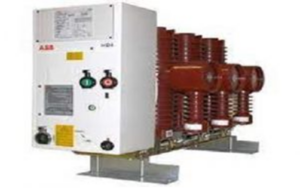 breakers are widely used in electrical power grids and power plants for voltage levels up to 800 kV. In distribution systems, they are commonly used up to 35 kV. The operating time of an SF6 circuit breaker generally ranges between 18 and 20 milliseconds, depending on the manufacturer. The SF6 gas absorbs free electrons generated during arcing and converts them into heavy negative ions. Since these ions have low mobility, the dielectric strength of the gas increases, which helps in rapid arc extinction.
SF6 Circuit Breaker Construction
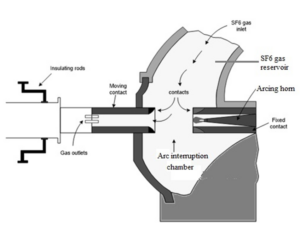
The SF6 circuit breaker mainly consists of two important parts:
- Interrupter Unit
- Gas System
Interrupter Unit
The interrupter unit consists of fixed and moving contacts enclosed inside an arc interruption chamber filled with SF6 gas. The moving contact is operated by a mechanical operating mechanism, while the fixed contact remains stationary. The arc interruption chamber is connected to an SF6 gas reservoir through a valve mechanism. The fixed contact is generally a hollow cylindrical contact with an arcing horn, while the moving contact is also hollow and has slots or holes on its sides. These openings allow the SF6 gas to flow along and across the arc, helping in effective arc quenching. The contacts are made of copper-tungsten material to withstand high temperatures and erosion. Since SF6 gas is expensive, it is cleaned, recompressed, and reused with the help of an auxiliary recovery system after each circuit breaker operation.
Gas System
SF6 gas is costly and its decomposition products are harmful to the environment. Therefore, a closed gas system is used to collect and reuse the gas after operation. The gas system also maintains the required pressure to preserve the dielectric strength. Proper sealing is essential to prevent gas leakage, especially at joints. Low pressure and high-pressure alarms, along with lockout switches, are provided for safety. If gas pressure falls below a specified level, the dielectric strength decreases, endangering the arc-quenching capability of the circuit breaker. In high-pressure chambers, SF6 gas is stored at approximately 16 atmospheres, while the low-pressure side operates around 3 atmospheres. To prevent liquefaction of SF6 gas, the temperature is maintained at around 20°C. A heater and thermostat are installed to maintain temperature during cold conditions.
Working of SF6 Circuit Breaker
Under normal operating conditions, the circuit breaker contacts remain closed. When a fault occurs, the contacts are forced apart, and an electric arc is formed between them. During contact separation, pressurized SF6 gas flows into the arc interruption chamber at a pressure of about 16 kg/cm². The free electrons in the arc are absorbed by the SF6 gas, forming heavy negative ions. These ions reduce electron mobility and increase the dielectric strength of the gas, causing the arc to extinguish quickly.
After arc extinction, the gas pressure reduces to around 3 kg/cm² and the SF6 gas is drawn back into the low-pressure reservoir for reuse. Modern SF6 circuit breakers mainly use a puffer piston mechanism to generate the required gas pressure during arc quenching.
Advantages of SF6 Circuit Breaker
- SF6 gas has arc-quenching ability nearly 100 times better than air
- Very short arcing time
- High dielectric strength due to electronegativity
- Capable of interrupting large fault currents
- Compact and space-saving design
- Suitable for all types of switching operations
- Closed gas system with no external leakage
- Can operate reliably in severe environmental conditions
- Noiseless operation
- SF6 gas is non-flammable and non-toxic
- Low maintenance requirements
Disadvantages of SF6 Circuit Breaker
- SF6 gas is heavier than air
- High initial cost
- Gas leakage must be continuously monitored
- Requires special handling and transportation
- Reconditioning and recombination of SF6 gas require additional equipment
Applications of SF6 Circuit Breakers
- Protection of very high voltage systems up to 800 kV
- Isolation of high-voltage circuits for maintenance and inspection
- Used in power transmission networks and power grids
- Protection of distribution systems
- Power generation plants
- Line protection in power circuits
- Used in rectifier and capacitor circuits
- Transformer protection