

Introduction
Pneumatic systems play a vital role in industrial automation and are widely used in the mechanical industry. These systems are similar to hydraulic systems, but instead of using hydraulic fluid, they use compressed air as the working medium.
The word pneuma means air, and pneumatics refers to the use of compressed air to perform mechanical work.
Compressed air is atmospheric air that has been compressed to reduce its volume and increase its pressure.

Typically, compressed air is used at pressures between 6 and 8 kg/cm². Using pneumatic systems, a maximum force of up to 50 kN can be generated. This article explains the construction, working principle, and applications of a pneumatic system.
What is a Pneumatic System?
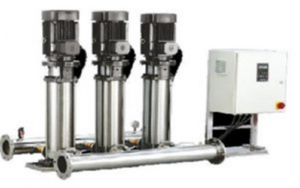
A pneumatic system is a system that uses compressed air to transmit and control energy in various industrial applications. These systems operate with a continuous supply of compressed air provided by an air compressor. The compressor draws air from the atmosphere and stores it in a high-pressure tank called a receiver. This compressed air is then supplied to the system through pipelines and control valves to perform useful work.
Pneumatic System Construction
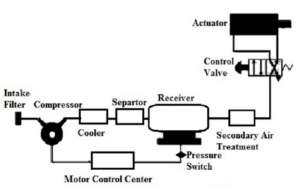
A pneumatic system is constructed using several essential components. The main components of a pneumatic system include:
- Intake Filter
- Compressor
- Motor Control Center
- Cooler
- Separator
- Receiver
- Air Treatment Unit
- Pressure Switch
- Control Valve
- Air Actuator
Intake Filter
The intake filter, also known as an air filter, is used to remove dust, dirt, and other contaminants from atmospheric air before it enters the compressor.
Compressor
The main function of the compressor is to reduce the volume of air and increase its pressure.
Motor Control Center
The motor control center supplies electrical power to the motor. The motor converts electrical energy into mechanical energy to drive the air compressor.
Cooler
The cooler is used to reduce the temperature of compressed air, which increases due to compression.
Separator
The separator removes moisture or water vapor present in the compressed air.
Receiver
The receiver is a high-pressure tank used to store compressed air coming from the air cooler. It ensures a steady supply of compressed air to the system.
Air Treatment Unit
Air treatment is carried out in three stages. In the first stage, the intake filter removes large particles. In the second stage, hot air leaving the compressor is cooled. In the final stage, a dryer removes moisture from the air.
This air treatment unit is commonly known as the Filter Regulator Lubricator (FRL). Proper air treatment improves system efficiency and protects pneumatic components.
Pressure Switch
Pressure switches are used to sense changes in air pressure. They can detect both pressure increase and decrease and are commonly used in pressure and vacuum applications.
Control Valve
Control valves regulate the direction, flow rate, & pressure of compressed air according to system requirements.
Air Actuator
The air actuator converts compressed air energy (pressure energy) into mechanical energy. It produces the final output in the form of linear or rotary motion.
Pneumatic System Working Principle
Atmospheric air is first drawn into the system through the intake filter, where it is cleaned and purified. Filtering is essential because unclean air can damage the compressor. The filtered air is then supplied to the air compressor, which is driven by an electric motor. The compressor reduces the air volume and increases its pressure. As the pressure increases, the air temperature also rises.
The hot compressed air is passed through an air cooler, where the temperature is reduced while maintaining constant pressure. After cooling, the air is stored in the receiver tank. The compressed air then passes through the air treatment unit (FRL), where it is dried and conditioned. This step is crucial because pneumatic components are sensitive to moisture and contaminants. The conditioned air is supplied to the control valve, which directs the airflow according to the system requirement. Finally, the air actuator converts the pressure energy of the air into mechanical energy to perform the desired operation.
Advantages of Pneumatic System
- Simple system design
- High efficiency
- Reliable and durable operation
- Unlimited availability of air
- Safe operation
- Economical
- Compressed air can be stored
- Easy control of power and speed
- High adaptability to harsh environments
- Easy selection of pressure and speed
- Environment friendly
Disadvantages of Pneumatic System
- Relatively low accuracy
- Low load-carrying capacity
- Air requires processing before use
- Uneven motion due to compressibility of air
- Requires air production equipment
- Air leakage is common
- Low operating pressure
- Condensation problems
- Compressed air is costly compared to electricity
- Generates noise, requiring silencers
- Installation cost increases with special piping
- Limited scope for system upgrades
Applications of Pneumatic System
- Manufacturing industries such as machine tools and automotive industries
- Domestic and commercial appliances
- Food processing, chemical, textile, paper, and petrochemical industries
- Railway coaches and automobile braking systems
- Printing presses
- Industrial robots for packing, filling, drilling, stamping, and clamping
- Assembly systems
- Plastic processing machinery
- Car washing systems
- Testing systems
- Rotary and linear actuators
- Coolant systems
- Automatic door opening and closing systems
- Material handling equipment
- Medical equipment and control systems
- Nut runners and power hammers
- Machine tool operations