
What is Transistor-Transistor Logic (TTL)?
Transistor-Transistor Logic (TTL) is a digital logic family constructed using bipolar junction transistors (BJTs). As the name implies, transistors are used for both logic operations and amplification. Some common examples of TTL logic gates include the 7400 NAND gate and the 7402 NOR gate. TTL logic circuits are built using multiple transistors with several emitters and inputs.

TTL logic gates can be implemented using resistors and BJTs. Over time, several variants of TTL have been developed to suit different applications, including Standard TTL, Fast TTL, Schottky TTL, Low Power TTL, High Power TTL, and Advanced Schottky TTL. Special-purpose TTL devices are also available, such as radiation-hardened TTL for space applications and low-power Schottky TTL that offers a good balance between speed and power consumption.
Types of Transistor-Transistor Logic
TTL families are classified mainly based on their speed and power dissipation characteristics.
- Standard TTL
- Fast TTL
- Schottky TTL
- High Power TTL
- Low Power TTL
- Advanced Schottky TTL
Low-power TTL operates at a switching speed of approximately 33 ns and consumes less than 1 mW of power. High-speed TTL offers switching times as low as 6 ns but dissipates higher power, around 22 mW.
Schottky TTL, introduced in 1969, uses Schottky diode clamps to reduce charge storage and improve switching speed. These devices operate around 3 ns but dissipate approximately 19 mW.
Advanced Schottky TTL provides a good compromise between speed and power consumption and is widely used in microcomputer systems as glue logic. Low-voltage TTL (LVTTL) is commonly used in memory interfaces and operates at 3.3 V.
Characteristics of TTL
The important characteristics of TTL include the following:
- Fan-Out: The maximum number of logic gate inputs that a single TTL output can drive without performance degradation.
- Power Dissipation: The amount of power consumed by the device, expressed in milliwatts (mW).
- Propagation Delay: The time delay between a change in input and the corresponding change in output.
- Noise Margin: The maximum noise voltage that can be tolerated without affecting normal circuit operation.
TTL Family Features
- Logic LOW level: 0 to 0.2 V
- Logic HIGH level: 5 V
- Typical fan-out of 10
- Average power consumption of approximately 10 mW
- Typical propagation delay of about 9 ns
- Noise margin of approximately 0.4 V
Series of TTL ICs
Most TTL integrated circuits belong to the 74 series, which includes several subfamilies:
- Low Power TTL: 35 ns delay, 1 mW power dissipation
- Low Power Schottky TTL: 9 ns delay
- Advanced Schottky TTL: 1.5 ns delay
- Advanced Low Power Schottky TTL: 4 ns delay, 1 mW power dissipation
In TTL IC nomenclature, the first digits indicate the temperature range, followed by letters denoting the subfamily, and the last digits specifying the logic function. For example, 74LS02 is a dual-input NOR gate, and 74LS10 is a triple-input NAND gate.
Typical TTL Circuits
TTL logic gates are widely used in everyday electronic systems such as printers, doorbells, and computer peripherals.
NOR Gate Using TTL
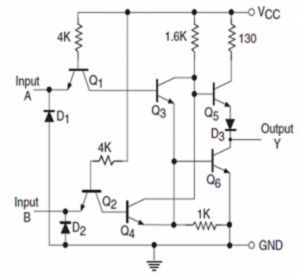
When input A is logic high, the associated transistor junctions are reverse-biased. Transistor Q3 saturates, pulling the output to ground. If both inputs are logic low, the output remains logic high.
NOT Gate Using TTL
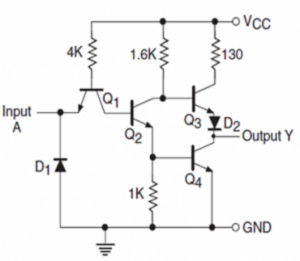
When the input is low, the base-emitter junction is forward biased and the base-collector junction is reverse biased. This causes transistor Q3 to saturate, pulling the output to a logic high. When the input is high, the output switches to logic low.
Advantages and Disadvantages of TTL
Advantages
- Easy to interface with other digital circuits
- Good noise margin and stable voltage levels
- High fan-in capability
- More resistant to electrostatic discharge compared to CMOS
- Low cost and durable construction
Disadvantages
- High current consumption
- Produces more heat compared to CMOS
- Slower than modern CMOS logic families
- Mostly replaced by CMOS in modern applications
Applications of TTL
- Used in controller circuits operating at 0–5 V
- Used as switching devices for lamps and relays
- Used in processors of minicomputers such as DEC VAX
- Used in printers and video display terminals
Conclusion
Transistor-Transistor Logic (TTL) has played a crucial role in the development of digital electronics. Although largely replaced by CMOS technology, TTL remains relevant in applications requiring robustness, simplicity, and reliable logic-level operation.